Showing posts with label blogging. Show all posts

Thursday, February 11, 2010

Elearning? Pedagogy?

Kia ora tātou – Hello Everyone
Southern Georgia teaching an intermediate session to ISTE members in Second LifeSouthern Georgia teaching an intermediate session to ISTE members in Second Life

Isn’t it strange that we read, hear, and see a lot about elearning, but we so rarely read, hear and see as much about eteaching?

Pedagogy?

I keep coming back to this topic. It is so vital to everything to do with teaching. The term, and all that it implies, also embraces elearning.

Elearning?

By implication, the focus is on the learner, and this is fine up to a point. But it is as if what goes on in the teaching is silently implied in the word elearning. The teacher has become the silent participant.

Well I’m going to stick my neck out here and say that there is a need for a change in emphasis so that elearning also implies an appropriate involvement by a teacher.

I’m not campaigning for teacher centred learning – not at all.

I’m agitating for pedagogy to return to its rightful place where a teacher is involved in the learning, which includes elearning.

Digital indicator

A simple examination of my blog’s statistics shows that the posts on pedagogy are considerably less popular than posts on learning. Yet they were written with the same passion, care and attention I give to posts on other topics.

My hunch is that for some reason not yet too clear to me, there is less interest in the part played by the teacher than the technology when it comes to elearning.

Interesting, isn’t it?

Ngā mihi nui – Best wishes

Friday, January 22, 2010

On Censorship and Human Nature

Tēnā koutou katoa – Greetings to you all

Censorship, Debate and Discussion

WARNING - The content of this post may disturb some readers.


The vagaries of censorship are mentioned throughout Hillary Clinton’s recent speech advocating Internet Freedom. Censorship is an action that often takes place behind the scenes. It is sometimes difficult to detect. You can be sure that someone somewhere will be confused, disturbed, annoyed, or even enraged when its occurrence is noticed.

Lately, printed news has come under threat. There is a belief that blogging might replace newspapers with a more up-to-date, less censored conduit. As well, the Web2.0 channel is purportedly a space for open debate and discussion.

Well, I wonder about all this. I believe that there is a place for censorship. Furthermore, my experience tells me that censorship is alive and well and is existing quite comfortably – in the blogosphere.

By the way, this post is not meant as a rant.

Moderation

During my first month of blogging I was introduced to some of the technologies that permit a blogger to choose whether or not a comment is published. Comment moderation is such a facility.

Some blog applications can even permit the content of a comment to be edited, before or after it is published. Comment moderation also gives bloggers relief from the increasing nuisance of spammed comments.

Hand in hand with all this is the idea that, through the provision of comment guidelines, commenters can sometimes be given the opportunity to learn what is likely to be accepted by a blogger on his or her blog. (Here’s a link to mine.)

Comment guidelines give the valid reasons for the culling of comments that may be in contravention of the blogger’s guidelines.

Biased opinion?

But comment guidelines are not the only criteria that may be used by a blogger who culls a comment. Am I not entitled to delete any comment that appears in my list of comments to be moderated, whether or not it meets all criteria in my comment guidelines?

How could I be accused of any discrimination even if I do cull comments containing valid opinions other than those that are aligned with my own? Who’s going to know?

You might say, “But isn’t this still a form of raw censorship?” Well of course it is. It also stymies healthy debate and discussion.

Okay, I’m being a tad hypothetical.

Or am I?

My quality comments

Over the years that I have been actively commenting on blogs, I‘ve witnessed this form of censorship. Of all the hundreds (perhaps thousands) of comments that I’ve entered against posts on other blogs, there have been a significant number, through the bloggers’ discretion in comment moderation, that have never appeared on the Internet.

You could say that this is a reflection on the quality and calibre of my comments. Well, there are enough of them still left out there. Take a look and judge the quality and calibre of my comments for yourself.

But I have always been careful to note, when my comment was removed or excluded, if the blog had any associated comment guidelines that I may have contravened. Most bloggers do not provide comment guidelines. I put it down to raw censorship.

So you may think that the blogosphere is entirely a place for freedom of expression. Just check when you leave comments on posts that have comment moderation. You could be surprised at the proportion of your comments that never appear on the blogs you post against.


Ka kite anō – Catch ya later

Wednesday, December 23, 2009

Deck The Halls

Ngā mihi o te kirihimete me Te Tau Hou - A Merry Christmas and a happy New Year

Opens new window at The Titanic

    Deck the halls with cloud computing,
    fa la la la la, la la la la.
    Tis the season, no disputing,
    fa la la la la, la la la la.

    See the blazing screen before us,
    fa la la, la la la, la la la.
    Strike the keys and join the chorus,
    fa la la la la, la la la la.


    Follow me in multi-tasking,
    fa la la la la, la la la la.
    Is it useful? No point asking,
    fa la la la la, la la la la.

    Can this be? I’ve no cognition,
    fa la la, la la la, la la la.
    Heedless of my mind’s condition,
    fa la la la la, la la la la.


    Don our coats for it is raining,
    fa la la la la, la la la la,
    things to learn, but where’s the training?
    Fa la la la la, la la la la.

    Sing we joyous, all together,
    fa la la, la la la, la la la.
    Heedless of the global weather,
    fa la la la la, la la la la.


Thank you - bloggers, commenters, followers, visitors and great mates - for your support and friendship. I have really appreciated you being with me this year.

Have a rave time this festive season!


Rangimārie - Peace in Harmony

Tuesday, December 1, 2009

Odd Tails – a post for bloggers

Kia ora tātou – Hello Everyone

It is usual for a blog post to attract nearly all its visitors during the first few days after being published. This is so much so that the term
‘the long tail’ is often used to describe the shape of the visitor profile of a typical post.


Now and again a blogger may spot an exception.

Digital Natives? Digital Immigrants?’ is a post I published in mid-July this year. It was popular and attracted a couple of comments.

Normally even the tail of a popular post would dwindle quickly over a period of less than a week. After two or three months, only the occasional visitor would be registered by visitor tracking.

I use Google Analytics (GA) to track one sector of visitors to my blog.
It gives a fair indication of comparative popularity.

The July post is an exception to the long tail trend.
Its visitor profile is at the top of this post. It has received recent attention of a magnitude not unlike what might be expected of a newly published post, yet it was published over four months ago.

I first took note of its unusual visitor profile when comments started to appear, again, as if out of the blue. It has since attracted a significant number of comments.

Occasionally posts generate very long tails that never really dwindle to nothing. Working With Online Learning Communities is such a post, published 1 April 2009. Its visitor profile shows recent steady traffic.


Posts with visitor profiles of this type tend to have been cited and linked on popular blogs or web pages.

Isn’t it heartening that not all posts receive the same fate as a time-capsule?


NASA's Voyager Golden RecordCourtesy NASA


related posts - >> ( 5 ) ( 4 ) ( 3 ) ( 2 ) ( 1 )


Ngā mihi nui – Best wishes

Thursday, November 12, 2009

Lead by Example

Tēna Koutou Katoa - Greetings To You All
The Big QuestionIt could be that the purpose of your life is only
to serve
as a warning to others Ashleigh Brilliant.


This month, The Learning Circuits Blog has the theme:

‘Presenting the Value of Social Media for Learning’.


Tony Karrer puts The Big Question:


How do I communicate the value of social
media as a learning tool to my organization?


The answer I have for him is, perhaps very slowly.


In the year 2000 I used Web1.0 technology in an attempt to emulate Web2.0. At that time I didn't know what Web2.0 was.

As senior teacher, I began designing web pages and developing elearning resources permitting learner interaction and feedback.
I was labelled as a geek. This was despite the organisational approval, funding and planning time provided for me to engage in the development of elearning resources.

In 2002, as a full-time elearning teacher, this opinion of my role in using digital technology was confirmed by a newly appointed manager.

When she saw what I was doing using Web1.0/Web2.0 technology, she openly declared that she was not a geek. She affirmed that she could never embrace what I was practicing, for she did not want to be seen as a geek.


In 2007, a leading light on the staff created her blog especially, but not exclusively, for staff use and interaction. I was astonished that, from an organisation that supported hundreds of teaching staff, there were so few participants who entered into discussion on the blog.

In 2008, while working in the same organisation, I started a blog.

I discovered that many of my colleagues viewed this practice as a risky business. Some were still not sure what a blog was.

They had a vague idea that web pages, blogs and wikis, were all related in some way, but their exact function, usefulness and operational value were unclear to many and often viewed with suspicion. I have many colleagues who still find Web2.0 quite elusive.


In 2009, I'm pleased to share the blogosphere with several work colleagues ( 1 ), ( 2 ), ( 3 ), ( 4 ), ( 5 ), ( 6 ), ( 7 ) who actively maintain their blogs and post regularly.

Some have been blogging since early 2007. Whether anything I did had any influence on my colleagues to do likewise is purely a matter for conjecture. It’s been a long time.


But when it comes to communicating the value of social media as a learning tool, leading by example may be as good a way as any.


Rangimarie - Peace and Harmony

Monday, November 9, 2009

Clutter

Tēnā koutou katoa – Greetings to you all
Clutter
    My colleagues and I have been writing learner reports this week. We follow convoluted procedures to ensure no parts are missed. The process is to provide effective feedback.

I reminded myself of the complexity of it all by sneaking a look at instructions that were circulating the office. The directions were clear, linear and easy to follow.

But I had a busy confusion going on in my head as I read them.
I was looking at a block of text that filled a page.

Balance of objectives

In the days when printed instruction was it, squeezing as much text and other information as possible onto a page met some objectives. There is merit in only one page of instruction. Selecting a smaller font-size was a trick I’d seen for ‘getting it all onto one page’.

But at that time, the Science and Art of developing easy-to-follow learner instruction was well known by experienced educators. They knew that ease-of-reading and learner-interest didn’t necessarily follow when information was packed so tightly into a page that you couldn’t put your finger down on bit of white space.

Extremists


White space became a prerequisite for a ‘good looking’ page of instruction. Born out of the look and colour of a blank sheet of plain A4, the ‘white space’ practice was carried, almost to extremes, by some writers and designers who actually shunned text – minimalists who’d trim even a brief, well written instruction.

Margins were widened, headers and footers were deepened.
Text quantity was limited per page.

Tricks and impressions

One trick often used, when no more text culling could be performed on an important block of text, was to emulate the impression of white space by selecting a very pale font colour.


    In this way, otherwise unwanted text could be merged into the background. Of course, it defeated the purpose of providing instruction, for it was almost impossible to read.


No, I’m not knocking white space. It works well when used properly.
It lends itself to good web design and elearning resource design. The look and form of a blog post page can even be improved by applying it.

Techniques I’ve found that reduce the busy look of a page of text are:

  • short paragraphs most readers find spaces between small blocks of text easier on the eye

  • double space around blocked text or images an image can be aesthetically framed by a border of text-free space; the effect is more pleasing and restful on the eye

  • brief subheadings these create chunks of text-free space by default.

You may have other techniques for improving the look of a page.

Why not share some of them here?


Ka kite anō – Catch ya later

Saturday, November 7, 2009

November

Kia ora tātou – Hello EveryoneOpens a new window on Kowhai Blossom - photo ken allan
It’s New Zealand’s last month of spring for 2009.


When I started blogging, one of the things I became attuned to was the sheer upside-downness of the rest of the world – compared to where I live, that is.

In the first few months, it was customary for me to wait overnight for the wave of blog comments to wash across a new post from countries other than those in the South Pacific, if it happened at all.


Most activity I observe on my blog takes place after daylight. Of course, there are always exceptions. There are nocturnal bloggers throughout the world and some who seem to be active 24/7!

Unsurprisingly, most people do not consider the time zones across the world when it comes to blogging. Last year I posted a Middle-earth time widget in my side-bar to help with this.

The academic year

There is as much disparity of alignment across the world when considering the education cycle. How many countries can enjoy an academic year that begins in January or early February and finishes in December? How many countries can claim that the (actual) year starts and finishes in summer?

The upside-downness prevails when reflecting on the seasons. While Canada was in summer New Zealand was steeped in mid-winter. Now, as Kiwiland warms towards summer, starting officially on 1 December, Britain chills into winter.

I receive regular communication from people overseas who are amused and surprised at the seasonal differences – till they think about the global cycles. It’s not something that can be easily summarised in a chart, for the seasons in each country progress and change.


video of northern hemisphere seasons (check out amazing videos)


November in New Zealand starts me dreaming of summer.


The hazy balmy days have come in fast,
A garden-loose late-blooming tulip yawns,
Limp petals soft from drooping roses cast,
And daisies flourish on the feathered lawns;
A cicada wakes from the nymphal sleep
Then sheds the fragile nut-brown pupal shell,
And so begins its steady skyward creep
To chant the long percussive choric spell;
The karo's darkened pods crack and expose
The cloying seed in clusters set to fall,
A blackbird swoops down keen to interpose
And sing his warbling chronicle to all;
With these the days I long for have begun,
The warm and lazy summer days of sun.

related post - > ( 1 )

Ngā mihi nui – Best wishes

Sunday, October 25, 2009

One Voice? A post for bloggers

Kia ora tātou – Hello Everyone
Voice in a Necker Cube - artist ken allan
What sort of voice do you use when you write a blog post? Do you have an informal or personal tone to your writing? Or do you prefer the more formal structured approaches?

Perhaps you like to adjust your writing style to suit the topic. Many good writers do, but my observation has been that even some of the top bloggers use essentially a single voice in most of their writing.

Randy Olson’s book, Don’t Be Such A Scientist, slams the scientist for being too cerebral when it comes to writing for the lay reader. He explains that scientists are too literally minded, are poor story-tellers and in general tend to be unlikeable when they write about their passion, Science (check out Talk of the Nation interview).

Authorship

Bill Bryson is one of my favourite authors. He has written earnestly and engagingly on Science, and often. Just read a chapter or two from his book, A Short History of Nearly Everything, and you’ll know what I mean. But he’s not a scientist.
Bryson is a journalist. Yet even for me, twice a Science graduate, his ‘voice’ immediately captures my interest in the Science he writes about. He speaks as if he is talking with me, not talking directly at me.

Can bloggers learn a thing or two from successful writers like Bryson?
I think we can. But I also feel there’s more to it than just being able to write well in a specific style.
Genre

Knowing the appropriate
genre to use, as well as how to apply it, is part-way to writers’ success. My literary friend and blogging colleague, Virginia Yonkers, agrees with this point of view.

Is there a single genre that is appropriate to writing blog posts?
Or should the genre be selected according to the topic of the post? Could genre be chosen to address a particular target group within the readership of the blog?

There are six genres that embrace most of the writing styles that bloggers may use:

    descriptive
    expository
    narrative

    persuasive

    poetry

    technical

Which would you select when you write your next post?
Ngā mihi nui – Best wishes

Saturday, October 3, 2009

So You Have a Major Project! Where Do You Start?

Tēnā koutou katoa – Greetings to you all
Major Project
I’m on leave this week. I decided to paint the bathroom. This was no small undertaking for me. Not the painting – the decision!

I’m no great shakes as a painter. I do the job thoroughly though, which is why I won’t get someone in to do it. But I’d rather watch TV.

This is the third time I’ve painted our bathroom in almost as many centuries. So I know what’s involved. But for me, it’s still a major project. Where do I start?

Around the scraping, sanding, swearing, stepladder and pots of paint,
I have to organise the family. That includes one loveable teenage daughter. Bathrooms are it for teenage girls, and we have only one bathroom. The strategy needed to coordinate even a small family around an arguably useful bathroom-being-renovated is a major project in itself.

Pale Sky Blue seems like a good colour for the walls – Oriental Bay, that’s the tint! It’ll match the nearly new shower and window curtains that everyone’s so fond of. We’ll get some new vinyl for the floor – replace the vanity mirror and everything will be hunky-dory.

I’ve forgotten where I put the old paint-roller and tray. Yes, I could really do with some new paint-brushes. There was a hardware sale advertised in the Weekender. Perhaps I should pay the store a visit and have a look. And there was the advert we saw on TV last night. Pity I didn’t take a note of the dates. Maybe there’ll be an ad on TV
now.

So you can see that I have a problem starting a major project!

Where to start?

At home and at work, I’ve had lots of major projects that I’ve deliberated over. One thing has come clear to me over the years. Procrastinating gets me nowhere when it comes to the major project.

So where do I start?

The answer is . . .
anywhere.

With a task like this, postponing the inevitable just runs away with the valuable time I need for scraping, sanding, swearing and messing about with stepladder and pots of paint.

So I get into town and buy the paint. Return home, change, grab the scraper and sandpaper and start preparing the walls.

"What about the family and access they have to the bathroom?" you say. Needs must. They’ll just have to make the best of a bathroom-being-renovated the same as I will.

So that’s it really.

Where do you start a major project? The answer is 'anywhere'. Oh, a bit of planning won’t go amiss. But it’s the same with planning. In fact, for some projects, just the planning becomes a major project. So you have to draft a plan.

Where do you start with that? Anywhere!

It’s the starting that’s the thing.

The weight
on the mind of any major project can be profoundly burdensome. And a project doesn’t really have to be all that big for it to be considered major. Take writing this blog post for instance. I really wasn’t up to writing a post today. I’d just finished nursing my aching back after painting the bathroom ceiling. But where did I start?

Anywhere!

I just have to get started, that’s all. Sometimes starting a major project can be as difficult as completing the rest of the project!

Ka kite anō – Catch ya later

Friday, October 2, 2009

Review of a Month of Fun

Tēnā koutou katoa – Greetings to you all
Sixes
Well my blog didn’t get voted Blog-o-the-Month for September. But I reckon I had a good shot at it. I learnt a lot into the bargain. I found Second Life to be a lot of fun and certainly worth a second look.

The winner

The blog, e-Clippings (Learning As Art) won Blog-o-the-Month for September. I heartily congratulate Mark Oehlert on this distinction.

I have to admit that this blog was a new one on me. I didn’t know of it until Scott Merrick drew my attention to its existence in his announcement at the beginning of September. Blogger Mark Oehlert maintains a mean blog. I recommend you check it out.

The runner ups

The other nominees were The Bamboo Project, by blogger Michele Martin and Donald Clark Plan B, by Donald Clark no less. I was privileged to be nominated alongside such prestigious bloggers!

Michele Martin’s blog has been in my RSS Reader and blog roll almost since I first wrote a blog post. In May 2008, Michele not only convinced me I should get into blogging, she also furnished me with nearly all of the blogging skills I possess today. (I am indebted to you Michele.)

The posts Michele publishes on her blog make me think, and I salute her ability to solicit thought by her incisive choice of topics. If you have not already done so, I’d recommend you hop over to The Bamboo Project and check out what’s happening there.

Donald Clark, of Plan B fame is another whose blog has been in my RSS Reader and blog roll since I began blogging. I have always viewed Donald as a bit of an icon in elearning. He is an icon in elearning!

Donald’s blog provides topical conversation with a variety of topics that I so much enjoy. Whether you have a plan A or a plan B, I advise you to check out Donald Clark Plan B.

Thanks to ISTE and to Scott Merrick for the nomination and for delivering to me a new and interesting topic for posts in the month of September.

Ka kite anō – Catch ya later

Friday, September 25, 2009

Trilogy

Tēnā koutou katoa – Greetings to you all

I have three announcements about things that will be happening in the blogosphere next month. The first is an appeal to all bloggers to contribute to Blog Action Day 2009.

1


“Blog Action Day is an annual event that unites the world's bloggers in posting about the same issue on the same day on their own blogs with the aim of sparking discussion around an issue of global importance. Blog Action Day 2009 will be the largest-ever social change event on the web.”

This year’s Blog Action Day is on 15th October, the issue being Climate Change.


Bloggers are encouraged to write about climate change in the context of how it relates to the topic of their blog. To help you start thinking, hop across to the Blog Action Day site where there is listed a few ideas about how you might connect climate change to things you might write about on your blog.

Please contribute to this worthy cause by registering your intended post title at http://blogactionday.org/
and publishing your blog post.

2


George Siemens, Jay Cross and Tony Karrer have recently announced the first ever LearnTrends 2009 Innovation Awards. The intention is to attract nominations from all parts of the globe.

“These awards are designed to recognize the products, projects and companies that represent interesting innovations in the use of technology for Corporate / Workplace Learning and Performance.”

The deadline is 30 October. To apply for an award you must complete the Submission Form.

If you wish to find out more, leave a comment on Tony Karrer’s site, or drop him an email at akarrer@techempower.com.

3


My third announcement is to do with Blogger in Middle-earth's nomination for the Blog-o-the-Month award, sponsored by the International Society for Technology in Education (ISTE).

The announcement and polling place is at ISTE Island's Blogger's Hut in Second Life.

So fly across to Blogger’s Hut on ISTE Island now, and register your support for this blog. If you need to register with Second Life first, the registration is easy. I recommend it.

Blogger in Middle-earth has the blue square on the polling board.
Pick up your avatar and teleport to Blogger’s Hut.

Ka kite anō – Catch ya later

Friday, September 11, 2009

And Now It's Blog Post of the Week!

Tēnā koutou katoa – Greetings to you all
Elearning@ UWEKallan at Elearning@ UWE (University of the West of England, Bristol)

Blogger in Middle-earth was nominated Blog-o-the-Month at ISTE Island's Blogger's Hutt last week (ISTE - International Society for Technology in Education).

Now it’s been awarded Blog Post of the Week! I will not be able to get my headphones on if my blog gets any more accolades!


E-learning Planet’s Pick of the Week has awarded my exploratory post, Visitor to Second Life, the honour of Blog Post of the
Week!

E-learning PlanetThey are sure that any visitor, who has not explored Second Life yet, will become too curious not to visit it after reading my post.

I also got a commendation from Scott Merrick for that same post.
He reckons I haven’t really splashed around enough about my nomination for Blog-o-the-Month. There are notable elearning icons on the nomination list.

So here’s the splash.


Kallan at Blogger's Hut

Fly across to Blogger’s Hut on ISTE Island now, and register your support for this blog. I need your vote!

If you need to register with Second Life first, the registration is easy.
I recommend it. Pick up your avatar and teleport to Blogger’s Hut. Blogger in Middle-earth has the blue square on the polling board.


I share E-learning Planet's Pick of the Week with Michael Hanley's E-Learning Curve Blog. I congratulate Michael for being awarded
Blog of the Week for his five blog posts on podcasting for e-learning.
You should check out his blog.


( 7 ) ( 6 ) ( 5 ) ( 4 ) < - related posts - > ( 2 ) ( 1 )

Ngā mihi nui – Best wishes

Sunday, September 6, 2009

Visitor to Second Life

Tēnā koutou katoa – Greetings to you all
View of Blogger's Hut
    Last year, I listened to Clare Atkins talk of Koru at the DEANZ Conference, Wellington. I watched as Nancy White met with Clare (or rather Choconancy1 met with Arwenna) on Koru Island, just one of many virtual islands in Second Life (SL).

    This weekend I ventured into Second Life as a first time visitor. Here are my first impressions.

Having done the requisite registration and created my avatar, I set off to visit ISTE (International Society for Technology in Education) Island.
I followed the link to Blogger’s Hut given to me by Scott Merrick who announced the nomination of this blog for Blog-o-the-Month sponsored by ISTE.

Getting the hang of a few mobility controls was easy, assisted by an easy-to-follow tutorial.

Blogger’s Hut sits among many other similar and some larger buildings, as well as stadia, conference centres and concourses on the island - an educator’s dream. The Island’s clean, freshly cropped grassy terrain and its shrubs and trees reminded me of Kinloch, a little village on the North Shore of Lake Taupo, New Zealand.

I felt quite at home walking about the precincts of the hut. I met Scott’s friendly ginger pussy-cat snoozing nearby.

Flying away from Blogger's Hut
I think I was extremely fortunate to meet up with a few very helpful ISTE Second Life members, among them PZ Zadark, from Mexico, who took me off to meet Snowflake and Aviva. After a brief conversation following introductions, Aviva invited me to become an ISTE SL member, which I accepted.

Exploring the Island was an experience. I enjoyed the flying – a far more efficient way of moving about from place to place on an island. Having got the hang of flying and then returning to terra firma, as it were, I happened to be soaring across the Monroe Public School building, when I decided to drop down to have a look.

Unfortunately, I stopped flying immediately above the swimming pool there, only to find that I dropped right to the bottom of the pool.

The Moon Mural
No problem. It’s SL. I started to explore underwater and was delighted to see that the pool designer had a sense of humour. Along the base of the pool is a lamp-lit street with a mural of the moon on one side and a couple of what look like vacant shop premises on the other.

One of the shops sports the sign, “Second Life Education Resources”! Now that’s funny!

At The Bottom of The Pool
PZ also gave me the teleport coordinates for the Science Centre, Info Island. I teleported straight to Info Island! Best ever way to travel.

Info Island
This was a most interesting excursion. I visited a memorial exhibition, Slane College of Communications and Fine Arts Gallery, in memory of author Philip José Farmer who died early this year. It features Cover Art from International Exhibitions of his works.

Memorial Exhibition
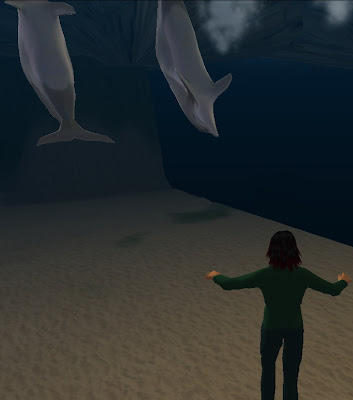
I recalled my experience in the swimming pool when I came across dolphins frolicking in the water outside Bradley University main building. I didn’t pass up the experience of having a virtual swim with the dolphins.

Swimming with the Dolphins
Living in New Zealand means that at certain times during the day there would be very few educators who would be visiting ISTE Island. Most of my time was spent exploring alone. But on one occasion, early on, and being new to teleportation, I happened to choose ‘Go Home’ when selecting a destination. I found myself at Bay City Airport.

Bay City Airport
This destination was not the most enamouring. Lots of people there. But like most airports I’ve been to, it made me feel I wanted to teleport out of the place, soon as.

( 7 ) ( 6 ) ( 5 ) ( 4 ) ( 3 ) <-related posts - > ( 1 )

Ka kite anō – Catch ya later