In September last year, I ventured into Second Life (SL) to explore.
My purpose was similar to that of most educators whom I have welcomed in the short time I have been a SL ISTE docent. I wanted to find out what SL could offer as an elearning environment.
I now have a clearer idea of its worth and potential.
The near-reality of much of the 3D simulation offered by SL is a valuable element – it is a key quality of this elearning platform. However, its aesthetic charm may dull even an educator’s appreciation of the true value of what SL can hold for a learner.
I enjoy the fantasy aspect which is so often present when I’m in SL. The huge variety of costume, and the opportunity available for disguise, make it splendid for roleplay. This aspect of SL has great potential to extend the imagination of the participant. There are a number of features that identify SL's genuineness as an authentic elearning environment:
The people
Second Life is an environment that embraces people. This quality alone brings authenticity.
There is a wide range of ways of recognising the presence of people, wherever the participant happens to be in SL. Channels to engage in communication between those who are online are easy to use. They can be facilitated in many different ways and at different levels. They are certainly not limited to simple txt or voice chat.
Even body language can play its part in exchanges between people.
There is a culture of sharing that is clearly evident among people in SL. This has possibly arisen through recognition of the need for assistance, sharing and collaborating when people first come into SL.
The cultural practice of sharing tends to be passed on. And it is accomplished at different levels, from a brief offer of situational help between two strangers at meeting, to organised sessions where experienced trainers can volunteer skills to others who are less competent. The music
SL presents music to its participants through various pathways, either live, pre-recorded or streamed directly from international radio stations. YouTube plays its part in all this, bringing music, new and old, as well as videos on many other themes to the eyes and ears of participants who have full control over audio levels within a full range of different sound channels.
The medium
Within the first few weeks as a visitor, I was able to engage in the construction of the digital stuff that is the fabric of SL. I don’t think there is another elearning environment where participants can so freely make use of the componentry and structure that comprise the environment they are in. Many of its cultural environments provide support for this engagement, through classes provided voluntarily by experienced exponents of the craft.
Two main techniques that contribute to this are building and scripting. They go hand in hand, employed in the construction of the simplest thing such as an item of jewellery, to the most complicated assemblage of the foundation of the environment itself.
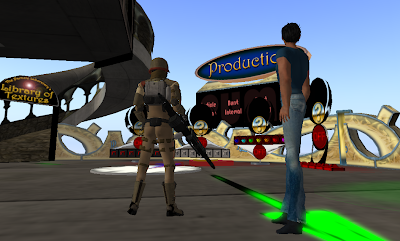
For the motivated learner, there is a copious amount of well-laid-out tutorial material to be found in centres throughout the environment. Splendid examples of these are the Particle Laboratory Learning Centre and the Ivory Tower Library of Primitives, where a learner can acquire knowledge and skills on the fundamentals of building and scripting.
It is at centres like these that both beginner and experienced developer can visit and gather pearls of 21st century wisdom on the construction of the digital fabric of Second Life.
Deck the halls with cloud computing, fa la la la la, la la la la. Tis the season, no disputing, fa la la la la, la la la la.
See the blazing screen before us, fa la la, la la la, la la la. Strike the keys and join the chorus, fa la la la la, la la la la.
Follow me in multi-tasking, fa la la la la, la la la la. Is it useful? No point asking, fa la la la la, la la la la.
Can this be? I’ve no cognition, fa la la, la la la, la la la. Heedless of my mind’s condition, fa la la la la, la la la la.
Don our coats for it is raining, fa la la la la, la la la la, things to learn, but where’s the training? Fa la la la la, la la la la.
Sing we joyous, all together, fa la la, la la la, la la la. Heedless of the global weather, fa la la la la, la la la la.
Thank you - bloggers, commenters, followers, visitors and great mates - for your support and friendship. I have really appreciated you being with me this year.
As a child, I was never aware of any real ability I had, other than to get into mischief or catch cold. I discovered these rich talents early on. Even as a ten year old, I bumbled along with no appreciation of any real capabilities I might have had as a human being.
My grandfather used to take me fishing. I got a buzz from the wonderfully natural places we visited. My head got filled with the summer sounds and scenery of these spots. But I was hopeless at catching a fish, having too much compassion for the poor hapless creature to get any enjoyment from the event.
I recall stabbing my finger with a fishhook, being more astonished at how easily the needle-sharp device entered the tissue than the searing pain it caused. It stuck firmly, deep in my fingertip.
My grandfather was annoyed and looked at me sternly for a moment. He fumbled in the pocket of his fishing jacket and took out a small pair of pliers, holding them tightly in his hand.
With his other hand, he grabbed mine and lifted the injured finger so high that my shoulder hurt. I watched to see what he would do. I thought he might pull out the hook with his pliers but I was too dumb and curious to close my eyes and brace myself.
He deftly pinched the hook in the jaws of the pliers and gave it a powerful and sudden twist. What I saw made my eyes pop.
Contrary to what I’d hoped, he didn’t pull out the hook. Instead, the business end of it reappeared through the tip of my finger – a tiny fluted barb, tinged with the blood that dripped from the newly pierced hole.
Grandfather carefully snipped off the barb with his pliers and swiftly pulled out the remains of the hook. He explained that the barb would have torn my finger apart if he'd remove it the same way it went in.
As I held my sore finger, wrapped tightly in a piece of bandage, I reflected on what it might be like for a poor fish who unwittingly takes the bait.
I stood beside a brooklet, that sparkled on its way, and there beneath the wavelets, a tiny trout at play, as swiftly as an arrow, he darted to and fro, the gayest of the fishes among the reeds below, the gayest of the fishes among the reeds below.
Angler there was standing, with rod and line in hand, Intent upon the fishes, a sportive fearless band, “`tis vain” said I “good neighbour, to fish a brooklet clear” The fish will surely see you upon the bank so near. The fish will surely see you upon the bank so near.
But skillful was the angler, and artful too, The crystal brooklets depths defying, he hid the fish from view, and then he skill renewing, the fishes unheeding took the bait, and I was left lamenting, my tiny troutlet’s fate, and I was left lamenting, my tiny troutlet’s fate.
Video - The Trout Daniel Barenboim, Itzhak Perlman, Pinchas Zukerman, Jacqueline du Pré and Zubin Mehta
Huge sponges of millennial growth and height; And far away into the sickly light, From many a wondrous grot and secret cell Unnumbered and enormous polypi Winnow with giant arms the slumbering green.
Alfred Lord Tennyson
My love of fantasy has taken me deeper into Second life (SL) than I’d imagined. The distinction between reality and fantasy becomes more diffuse with every minute I spend in these regions. Coming back to RL (real life) is a bit like walking out to a daylit street from an exciting and gripping movie. It puts a new perspective on reality.
The effect that SL has on the mind can be powerful if the imagination is energised. For a few minutes after logging off, I wonder if real life isn’t all virtual too. It makes me think again about what some people say about violent virtual games and the effect they may have on the real life behaviour of some people.
But like every other thought stimulation, SL is just another influence. Persona and personality are two entirely different things.
Real adventure
A recent sojourn into SL found me a delightful companion, Zylle (zill).
Like me, she is new to SL but she has a little more experience and that is useful. We share our interests and our fascination for SL in conversation, while we show each other around islands that we'd discovered in the short time since we were rezzed.
part of Kalepa
The other night we took off to the volcanic island of Kalepa, one of Zylle’s favourite spots. It is an enchanting place with lots to explore, including a sail in a gondola and a journey on a huge enchanted feather.
On our second visit to the island, she took me on the Da Vinci Gardens Indiana Jones Adventure.
Here we entered the lobby, close to the entrance to the tomb of the Pharaoh where the Sarcophagus and treasure chamber lay.
Among the rich assemblage of Egyptian statues, treasure chests and ornate accoutrements, were opportunities to actively participate in snake charming, or try a spot of belly dancing, supervised by the resident genie-of-the-lamp.
Kallan watching Zylle belly dancing
Our quest for the treasure chest was fraught with unimaginable peril.
Zylle had to teleporte me to safety from the deathly pit of cobras and avatar-eating spiders at least twice. I wasn’t at my ease in those circumstances and had to keep saying to myself, “this is SL!”
We found the treasure chest eventually, but unfortunately neither of us could lift any of the treasure it contained. Getting back out to the sunny sands of Kalepa meant retracing our steps! I was relieved to get out.
While looking around outside, we spotted Felixx, the developer of Kalepa! We identified him by his name tag as the owner of all that we had seen in Kalepa.
We approached him, and after brief introductions, he kindly showed us around. Felixx teleported us to his customer service depot where we had a chat and shared a few of our interests.
Felixx meeting Kallan and Zylle
I think he was taken with our interest in his work. He gave us the link to a recent video made in Kalepa, starring Alissa Moreno, singing and accompanying herself on piano.
I got the impression time was running short for Felixx. He had lots to get on with, yet he continued to show us around.
When Zylle explained that we’d been to Sunken Atlantis, he asked, “Did you take a ride on the sea-horses?” We hadn’t.
So off we went, teleport-fashion, to ride the sea-horses in the “slumbering green”.
Kallan and Zylle on the sea-horse chariot
Felixx took a snapshot of us as we rode into the depths, and bid us farewell. This journey was amazing, for it revealed the true beauty of Felixx’s animations.
He explained that he first got into building in SL when he'd been out of work for some months, during which time he taught himself the ropes, while building his amazing fantasy land.
He told us that, as a student, he'd studied Biochemistry. He had a PhD in Genetics. I could see where his love for detail in nature came from.
A shipwreck, a lost treasure chest and a visit from a giant octopus set the scene for much adventure. The next evening, we were in Hawaii and met Pawn who had been newly rezzed. As dutiful avatars, we helped him with some of the basic skills in SL, and a few more tricks, not that I knew much! Swimming underwater with the dolphins was a great introduction to having fun with animation in SL.
Zylle and Pawn swimming with the dolphins
But Kalepa is obviously the place to go for ‘real’ adventure. So off we went, only to meet Felixx, once again! He so much wanted to demonstrate what he could do to entertain us and had us fascinated as he scripted the crocodiles to fight with each another.
Zylle and Kallan look on as Felixx scripts the crocodiles
Isn’t Zylle’s hair wonderful? She decided she needed a complete change after losing her hair while playing chess with Pawn earlier.
Felixx’s power with scripting allowed him to work magic with the Sarcophagus of the Pharaoh.
Kallan, Pawn and Zylle watch as Felixx scripts the Sarcophagus
Later, we decided to take up Felixx’s earlier advice to visit Mars! We’d spent too much time on the seahorses the evening before to enter the underwater spaceship that takes us to Mars from Sunken Atlantis.
It was count down . . . - 3, - 2, - 1, - 0 . . . “We have lift off!”
The journey was somewhat rocky. But with me in the controls, what would you expect? When we landed, we decided it was better that Zylle took the controls on the Mars buggy! Did you know that’s there’s water on Mars? And all sorts of fantasy plant life?
And mushrooms! Or are they Marsrooms? For Jaba the Hut?
Zylle got us safely to the observation tower, where we took a drink from the bar, relaxed a bit and enjoyed the view.
Throughout the adventure, at the back of my mind I was making mental notes on the potential Second Life had in providing a platform for elearning. Its networking potential, for me, is implicit.
In a flight of fantasy, one need not wonder if even romance is possible in Second Life.
The voice I hear this passing night was heard In ancient days by emperor and clown: – John Keats
Isn’t it . . .
interesting that bird-song has charmed the hearts of explorers the world over? sensational how people are stirred to dance when they hear lively music? touching how music can arouse memories of past events otherwise long forgotten?
profound that some melodies, still popular today, were played so long ago their origins have been forgotten?
curious how some forms of music can affect the function of the brain?
remarkable that nations burst into song as a symbol of solidarity in moments of triumph or disaster?
intriguing that all over the globe, mothers murmur, coo and sing to their newborn children who, at only a few days old, will invariably respond by listening or vocalising?
An ancient practice
Archaeological remains of flute-like instruments suggest that music must have been known and practiced as far back as 10,000 BC.
The fragmentary physical remains of musicianship represent a mere trace of the significance that music may have played in the lives of the people of those Palaeolithic times. One can only surmise that singing would also have been a component of that music. Perhaps it may well have been customary thousands of years before that era.
Music has an amazing power to bring people together. Legend tells us that Apollo initiated the earliest festivals of music and poetry around 6th century BC. Cultural elements of these arts became part of the festivity of the Pythian Games. Musicality
Dancing and music have been major components of cultures from time immemorial. Yet only in recent years has musicality been considered to be of key importance to communication and to human development.
We live in an environment that’s steeped in rhythm and movement. If all musical devices including radio, TV, CD and DVD drives, and the Internet were mysteriously to cease to function, the rhythmical component of our day-to-day lives would still make a significant contribution to the musicality of the environment we are in.
Just take a walk to the corner shop and listen to the rhythm and timbre of the sound of your footstep. Or lie still in a quiet room and sense the dull throb of your heartbeat. You become aware of the leisurely tempo of your own sibilant breathing.
It may be you overhear a conversation between neighbours in the street outside, voices too faint for you to make out the words. The patterns in their speech are familiar. You may even recognise a voice from its rhythm and pitch. A bird utters its warbling chronicle from a distant perch. You recognise the call of a songthrush.
New Zealand Emeritus Professor
In today's Radio NZ interview by Gordon Harcourt, New Zealander Colwyn Trevarthen, child psychologist and Emeritus Professor at Edinburgh University, explains the recent and not so recent researches on the mother and child relationship.
He tells of the major contribution brought to that relationship through the musicality of vocal interaction. The endearing conversation of parent and baby is a musical symphony. Babies are very attentive to the ritual of these interactions and take part by actively contributing through their own movement and vocalisation. He talks of recent studies that show an exact similarity of mother and baby communication to jazz music, in terms of the structural dynamics of rhythm and pitch.
Bridging the communication gap, well known in the study of autistic conditions, is made possible through music. Trevarthen introduces, through example, how communication with an autistic child can be initiated through the skilled use of rhythm.
Complexity in motion
Trevarthen describes the motion of the human body as polyrhythmic. It is complex owing to the ability to stand on two feet with independent movement of legs, arms and hands.
He likens the complexity of the extravagant gestures of the human body to the structure of human thought.
People are as individual in the way they move as they are in the way they use speech patterns to communicate. Movement and dance, speech and speech patterns all contribute to a musicality that’s unique to the human form.
His idea on the origin of language, through the musicality of human interaction, is one that challenges traditional theories of the origin of speech.
A series of posts has recently nudged my interest in language and thinking. George Siemens, in his short post Tool making and language, drew our attention to Edmund Blair Bolles' post, The Idea of Language.
In it, Bolles posited that “the ingredients of speaking and toolmaking are similar. Both require a brain capable of complex imitation and a community that wants to share information. Toolmaking also requires hands capable of shaping tools, while speech requires a throat capable of vocalization.”
Different than chimps
Like the capability of making tools, the ability to use speech is an acquisition most humans own from birth.Peter Turney, in his post Meditation, Language, and Evolution, broaches the idea that meditation “seems to involve stopping or altering the internal monologue that usually fills our consciousness.” He posits that “this constant flow of language, is the main thing that distinguishes us from our nearest living relatives, the chimps.”
Peter thinks of the “human mind metaphorically as a chimp mind with language processing bolted on top.” But in the evolutionary history of humans, there must have been a time when language was a lesser part of our thinking and communicating. Even without language, our ancestors still had to think.
In order to think about complicated or complex ideas, humans today find a need to have the vocabulary of these in order to think about them and relate to one another. I believe that our ancestors must have been experts at thinking abstractly. They would not have had a ready vocabulary to help them with their thinking. Think vocab
Higher order thinking skills need vocabulary. But our ancestors, at the evolutionary stage I refer to, would not have had that vocabulary, nor even perhaps the language ability, but they still had to think.
Trying to think without vocabulary is difficult to do. But in a creative artistic pursuit, such as in music, or fine art, or even in poetry when thinking on the lines of J K Baxter’s matrix of a poem – not the words and form – the mind thinks abstractly and is facile in that mode. Language gets in the way of this facile thinking.
Many who are adept at this mode of thinking simply curtail the use of vocabulary. What Peter refers to as ‘language processing’ is simply shut down. He sees advantages to "moderating the language layer" and suggests that "humans are in the middle of an ongoing evolutionary process; that language has not yet been fully integrated with our chimp cores." Language may obstruct
I believe that language can get in the way of some modes of abstract thinking. Even the most highly skilled in the use of language have complained about the words getting in the way of what they wanted to express. William Wordsworth did and many poets have met this same impediment. Chicken-and-eggish though it may seem, it is understandable if you ascribe to the idea that words and language actually limit, rather than extend, some if not all forms of creative thinking.
Music extemporisation is a mode of thinking I’m familiar with. It is not unlike meditating. It has a similar calming and relaxing effect that is also prolonged, bringing about a feeling of at-one-ness most often met in playing jazz music, a genre based on extemporisation.
It’s curious that musicians who are site-readers and who are skilled in the notations and language of music, can often find it inordinately difficult to extemporise. I cite an example of this in Yehudi Menuhin, who had to admit that he could not improvise while he was dueting with Stephane Grappelli. That mode of thinking was beyond him, despite his undoubted superb skill with the violin.
North of Scotland, 25 miles south west of the Shetland Islands, lies Frjóey (Sheep Island - from the Norse) or Fair Isle. About 3 miles long and 1.5 miles wide, it is the most remote inhabited island in the United Kingdom. Despite its almost complete lack of raw materials, Fair Isle has been occupied since the Bronze Age.
The resourcefulness of the people of Fair Isle is extraordinary. The principle occupation of the men is crofting. The people subsist almost entirely on their own fine produce of meat and vegetables.
The women foster an impressive cottage industry in woollen knitwear, from natural coloured home-spun wool.
Their intricate Fair Isle patterns are legendary and are favourites in fabric and textile industries, local and world-wide.A wind-powered electricity supply seasonally provides between 50% and 85% of the island’s electricity needs. Fair Isle is a world leader in the use of renewable energy.
In 1900 there were 300 inhabitants. Less than 70 people live there today, ranging in age from 6 months to 96 years old. But what is truly remarkable is that the community has a lifestyle based almost entirely on mutual help and community effort. Disputes between individuals or between families on the island are virtually unknown; such is their dependency on, and commitment to cooperation and mutual support.
The commitment to cooperation and mutual support is self-sustaining. It is what has permitted the people of Fair Isle to live as a community for thousands of years.
A lesson in community
There is much to be learnt from the people of Fair Isle. In recent years, people networks, groups and communities, and the relevance of their activity in present day education, have captured my attention.
A fascination for the behaviour of communities and a desire to learn how to encourage learners to participate within learning groups, motivated me to become a blogger in May last year.
Through my own practice and research, I’ve discovered that achieving a sustainable online learning community is very difficult. Over the years, and especially recently, I’ve been relieved though not satisfied to learn, from many different sources, that it’s not just me. Teacher/facilitator reports of the endeavour needed to engage online learners in community participation are to be found everywhere I look.
So-called learning communities are capricious in the way they perform. Growing an online learning community needs a specialist skill. It also takes a lot of time, effort and patience. Such undertakings do not always achieve the desired learning successes. In Clark Quinn's recent post Real Community, he questions if what we call online communities are really communities. I continue to look, learn and try to understand how some communities function and survive.Taking a lesson from the people of Fair Isle, how can a sustained commitment to cooperation and mutual support be brought about in a group of online learners?
On this day, fifty years ago, the life of a young singer-songwriter ended tragically. The end for this brief and brilliant artistic career was a supernova in the pop music galaxy that continues to reverberate with the shock.
Early in the morning (3 February 1959) a light plane crashed shortly after take-off, near Mason City Municipal Airport, Iowa. All passengers died: pilot Roger Peterson, Ritchie Valens, J P “The Big Bopper” Richardson, and Charles Hardin Holley, otherwise know as Buddy Holly.
Holly’s life was short - too short for him to commit mistakes enough to influence, in the slightest, his inevitable place in the history of music.
Don McLean’s famous line on the event, “the day the music died”, is a conundrum. What Holly gave, in the few years before then, had a colossal influential effect on the music of many singers and musicians. Millions of people throughout the world have been touched by Holly’s artistry, and through their appreciation of the momentum of the music that's still evolving from it.
I was too young to fully appreciate Buddy Holly’s music before he died. But in the years since, I have come to understand how his light is such an amazing guiding beacon to so many in the music world:













 Posts
Posts


