Showing posts with label communities. Show all posts

Wednesday, March 3, 2010

A Hierarchy of Learning

Tēnā koutou katoa – Greetings to you all300th Post
Heat Exchanger - artist ken allan
My work environment has been a bit noisy lately. The school is having the roof renovated. The building’s air-conditioning units have been disconnected during the time of this refurbishment.

It being summer, there’s a need to open windows and to bring in industrial air-conditioning units to maintain a workable atmosphere within the building. At the beginning of this week, contractors wheeled two of these units into the space close to my office area, plugged them into the mains and switched them on.

Other units were similarly introduced at points throughout the building. The Science teachers who worked in the areas, including myself, viewed this activity with amusement. It was evident that the contractors knew nothing about thermodynamics.

It sucks

The heat exchange part of an air-conditioning unit operates in a way similar to a refrigerator. In normal use, the unit sucks warm air from the room through a cooling unit and filter.
Fresh air from outside the building is drawn in through windows and other openings to replace the heated air expelled during the process.

The resulting chilled air is blown back into the room while the removed heat is air-pumped to the exterior, usually through a duct in a window.

In the case of the units that we observed, there was no such venting. Instead, the hot air from the action of the cooling unit was being pumped back into the room. It was as if a fridge had been turned on and its door had been left wide open. In such a circumstance, the fridge does nothing more than make a noise and heat the room.

The overall effect of the air-conditioning units being used in this way was not unlike that of using large blow heaters. In no time, people started to complain about the rising temperature.

A little learning

Science is a wonderful thing. Its principles are being utilised in just about every piece of technology that contributes to our lives today. Of course, an understanding of scientific principles isn’t always necessary to use or install the equipment that puts these principles into effect.

There are at least three levels of understanding that can allow one to realise the significance of a scientific idea, such as the thermodynamic principles that were put to use in the construction of the air-conditioning units:

  1. It works provided certain conditions are met according to a recipe for installation. For the air-conditioning unit to be effective, it has to be functioning and have its required vents clear, one of which has to be ducted to the exterior.

  2. It works as it follows the thermodynamic idea that heat can be pumped by using a small amount of energy that is eventually released as heat (which is why the fridge with its door open does nothing more than heat up the room).

  3. It works, and its function can be explained by thermodynamic principles:

    a) energy can neither be created nor destroyed,

    b) heat energy is released when a gas is compressed so that it condenses to a liquid and this same heat is taken in when the liquid is allowed to evaporate
    – this is what happens in the heat exchange unit of a fridge,

    c) some energy will always be wasted when heat energy is pumped using mechanical means – entropy is always increased as a consequence
    .

Understanding at level 3 can be achieved by senior secondary school Physics students.

Level 2 can be understood by able students of Junior Science.

Working recipes that define the factors that are important in level 1 need only be followed when it comes to the correct and appropriate installation of a piece of technology in general circumstances.

The example that I unpack here shows how related learning can apply at various levels to the curriculum. What is significant is that the most elementary levels of learning are still important to the correct use of technologies that involve sophisticated principles in their design and construction.

Sorted

As it happens, the contractors were notified by Science teachers about the correct use of the air-conditioning units which were immediately switched off. Appropriate locations near windows were then found. Necessary ducts to the outside of the building were fitted correctly to the machines within 24 hours.

Cicada
Through all this, the cicadas continued their sibilant summer chorus.

Ka kite anō – Catch ya later

Friday, February 19, 2010

Computer Reality

Tēnā koutou katoa – Greetings to you all
Portable Typewriter
Typists who could rattle out a notice on a Remington Portable knew nothing of word wrap. So-called word processors simulated part of the procedure of carriage return by using ‘Return’ keys, now replaced by ‘Enter’ keys on the QWERTY keyboard.


I worked in an office when bound, printed instruction manuals were in their heyday. I didn’t need to read a manual to find out that it was useless either. I could tell from its crisp pages and gleaming cover.

The contents of useful manuals fell at my feet when I took them from the shelf. Company experts on procedures were usually those who wrote, added to, or amended manuals like these.

Many things we now do in the workplace, and the way we go about them, have arisen through the inclusion of the computer. Much of those were modified and re-jigged, or even scrapped from practiced routines and procedures and reinvented, when the use of computer technology became a mandatory part of the processes.

Dissemination of procedural instructions

One of the artefacts that almost disappeared through all this was the printed process specification or business procedure manual. It was sometimes replaced by an online version – less convenient in some ways, more facile in others.

One argument in favour of this replacement was that updates to procedures could be conveyed instantly to a network of workers. In the past these changes were scribbled on the margins of printed manuals and referred to until new versions were published.

But if there is no rigorous and timely procedure for updating an online manual, the user can’t scribble notes in the margins when instructions drift out of date. That is unless they print their own version at some stage. Many do, for this and a number of other reasons. In doing this, however, they may lose touch with subsequent amendments that are only announced on the online version.

Sometimes the business procedure manual, if it existed at all, simply disappears altogether, to be recreated in notes and copies of those made by industrious workers who recognise the need for a manual of some sort. Announcements of new procedures or changes to existing ones sent round by email are filed in either digital or printed form by this diligence.

Evolving 'expertise'

Through this process there evolves a wealth of expertise of varying quality. Someone in need of
information about a business procedure may skip around a workplace looking for advice from those workers well known for gathering and squirreling away procedural information.

And new ‘experts’ come into being.

This is all very well, until there is a real need for a unified approach to a specific and important procedure. It is a property of communities that exists in large workplaces, that they are recursively elaborate and capricious in how each separate part functions according to its situation.

So what's the solution to communicating unequivocal up-to-date procedural methods of practice to all parts of the workplace?


Ka kite anō – Catch ya later

Friday, February 5, 2010

Elearning in Second Life

Tēnā koutou katoa – Greetings to you allLink to Elearning Planet


In September last year, I ventured into Second Life (SL) to explore.

My purpose was similar to that of most educators whom I have welcomed in the short time I have been a SL ISTE docent. I wanted to find out what SL could offer as an elearning environment.

I now have a clearer idea of its worth and potential.


The near-reality of much of the 3D simulation offered by SL is a valuable element – it is a key quality of this elearning platform. However, its aesthetic charm may dull even an educator’s appreciation of the true value of what SL can hold for a learner.

I enjoy the fantasy aspect which is so often present when I’m in SL. The huge variety of costume, and the opportunity available for disguise, make it splendid for roleplay. This aspect of SL has great potential to extend the imagination of the participant.

There are a number of features that identify SL's genuineness as an authentic elearning environment:

The people

Second Life is an environment that embraces people. This quality alone brings authenticity.

There is a wide range of ways of recognising the presence of people, wherever the participant happens to be in SL. Channels to engage in communication between those who are online are easy to use. They can be facilitated in many different ways and at different levels. They are certainly not limited to simple txt or voice chat.

Even body language can play its part in exchanges between people.


The sharing culture

There is a culture of sharing that is clearly evident among people in SL. This has possibly arisen through recognition of the need for assistance, sharing and collaborating when people first come into SL.

The cultural practice of sharing tends to be passed on. And it is accomplished at different levels, from a brief offer of situational help between two strangers at meeting, to organised sessions where experienced trainers can volunteer skills to others who are less competent.

The music


SL presents music to its participants
through various pathways, either live, pre-recorded or streamed directly from international radio stations. YouTube plays its part in all this, bringing music, new and old, as well as videos on many other themes to the eyes and ears of participants who have full control over audio levels within a full range of different sound channels.


The medium


Within the first few weeks as a visitor, I was able to engage in the construction of the digital stuff that is the fabric of SL. I don’t think there is another elearning environment where participants can so freely make use of the componentry and structure that comprise the environment they are in.

Many of its cultural environments provide support for this engagement, through classes provided voluntarily by experienced exponents of the craft.

Two main techniques that contribute to this are building and scripting. They go hand in hand, employed in the construction of the simplest thing such as an item of jewellery, to the most complicated assemblage of the foundation of the environment itself.


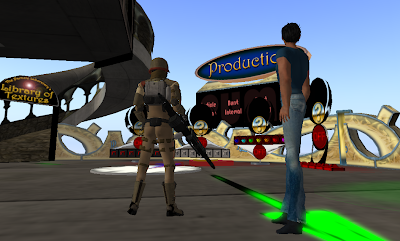
For the motivated learner, there is a copious amount of well-laid-out tutorial material to be found in centres throughout the environment. Splendid examples of these are the Particle Laboratory Learning Centre and the Ivory Tower Library of Primitives, where a learner can acquire knowledge and skills on the fundamentals of building and scripting.


It is at centres like these that both beginner and experienced developer can visit and gather pearls of
21st century wisdom on the construction of the digital fabric of Second Life.


Ka kite anō – Catch ya later

Monday, February 1, 2010

Standards, Statistics and Steps Forward

Kia ora tātou – Hello Everyone
Roundabout in Jabberwocky
It looks like John Hattie’s words of wisdom may well have been said in vain. Implementation of the New Zealand National Standards for primary and intermediate school pupils starts today.

School boards and principals are not convinced that there is much to be gained by applying the standards. They have numerous reasons for their beliefs. Many school boards are planning to boycott their use, which would be illegal.

Nevertheless, government approval has been given for the campaign to persuade communities and school boards of the usefulness of the standards, at an estimated cost of $26,000,000NZ.

The pros and cons

I listen to the arguments that abound in the national news, buzzing with the debate between the parties in favour of using standards and those against. Some politicians who were originally in favour of the standards are now arguing against them. I’m amused at what I hear.

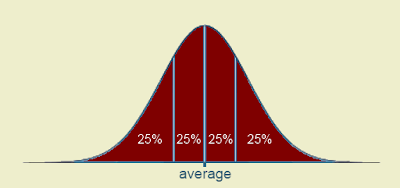
Here’s an example. There is argument of dismay expressed about the 25% of children in New Zealand who are well below average in literacy abilities, an average which was no doubt considered when setting the literacy standards in the first place. The argument is that the introduction of standards will help those in that well-below-average group.

I wonder if some of the contributors to that argument can understand what a distribution is, and the significance of an average based on that same distribution. Misguided use of statistics, even by authorities, is not unknown in disciplines other than education.

People statistics

In the late eighties, the Plunket movement was very enthusiastic, as it is today. Mothers with newborn children can choose to be visited by a Plunket nurse who administers advice when needed and who makes regular checks to record the development of children under their care.

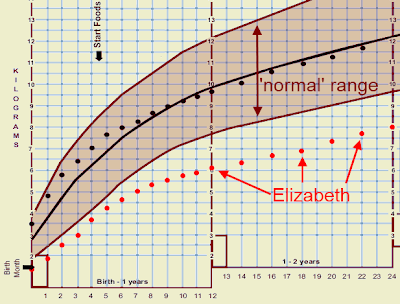
I knew a young family back then. Murray and Pauline who is a nurse, had a beautiful bouncing baby daughter. Both Pauline and her husband were petite people of delicate build and stature. At birth, Elizabeth was a small baby. The presiding doctors agreed she was normal for her birth weight. She was a healthy child who developed well in all respects.


Child Development Chart

One day I walked round to see the family only to find Pauline quite upset. She’d just had a visit from the Plunket nurse who’d said that Elizabeth was well below average in both size and weight. Pauline had been told that she should ensure Elizabeth was given the food required to lift her weight into the ‘normal’ range.

Pauline felt insulted and annoyed. Her reasoning was implicit. A petite newborn from parents of small stature would be expected to grow into a petite child, and subsequently mature to a petite adult. Over the years we found that was exactly what happened.

Furthermore, Elizabeth’s potential to maintain this has been with her since birth. It comes down to the difference between body size and body development. These measurable quantities are not the same.

The Plunket movement in New Zealand do a deal of good work in monitoring and caring for the health and welfare of the very young from birth. But the interpretation
of the growth chart by the nurse indicated that Elizabeth’s data was being clearly misunderstood.

Academic parallel

There is a parallel in the academic progress of children who are developing normally. That’s not to say that a child who is below what’s considered ‘average’ at an early age won’t continue to develop to have useful and perhaps even above average abilities in the future.


Bell Curve

But there is always going to be 25% of children who are well below average in literacy ability. Any standard based on what is expected of an ‘average’ child will indicate this when applied to a fair and random sampling from a nation’s children.

I applaud the arguments that are saying let’s improve the nation’s academic achievement through good teaching. Forget about assessment of the child at early stages as a comparison with what’s considered ‘average’. Let’s look towards progress and development in the child.

My hunch is that the introduction of standards will not bring about an understanding of what is good to look for in child development in literacy, numeracy or any other ability. Instead, it is likely to serve as a measuring stick for a whole range of things unrelated to child development.


Haere rā – Farewell

Tuesday, January 26, 2010

Elearning Patterns and Predictions

Kia ora tātou – Hello Everyone

In 1972 I took my first permanent teaching job in an elite Edinburgh secondary school. Just the year before, it had been a private school. James Gillespie’s High School (JGHS) always prided itself on its high standard of education.

A maximum class size was among many standards that JGHS maintained. It strove to have no more than 25 learners per class. The belief was that a finer relationship between teacher and learner could be attained. Through this practice, significantly better educational successes were achieved.

The number of scholars who left JGHS to take up
business careers, or went on to higher education, was proof enough of this accomplishment.

It was a fantastic start for me as a teacher to be with classes of this size. But it was certainly no preparation for the learning environments that confronted me in teaching positions I took up after that time.

In 1974, I had a form class of 36 learners in a school that maintained an average class size of 35.

An elearning counterpart

Almost 30 years later, research into educational achievement through elearning methods suggested that there was an optimum size for elearning groups led by a teacher.

In any group of elearners, there will always be those who can be considered ‘active’ – others who learn despite their apparent inactivity in engagement with a teacher or facilitator – and those who are neither active nor engaged significantly in learning. Time has to be distributed fairly in attending to the needs and wants of each these groups.

An e-teacher who has more than 15 to 20 ‘active’ learners in a group is always extremely busy. When the number of active learners increases much above 20, strategies have to be developed and practiced to cope with the constant learner-teacher activity that inevitably occurs in those environments.

Symptoms of stress and exhaustion are inevitable in any teacher who succeeds in engaging enough learners so that the active group comprises much above 25. My own experiences of this have been confirmed by those of my colleagues teaching in e-environments similar to my own.

A recent experience


Recently, I’ve been actively engaging in discourse with groups of people in Second Life (SL). In the months that I’ve assiduously studied in this networking environment, the number of ‘friends’ in my Friends List has slowly increased. The size of my list is now well over 60.

Within that group is a sub-group of 15 to 20 friends who actively use instant messaging (IM) to contact me whenever I am online. It is a great experience to network with people in this way. Not all of this is done locally – that is to say, my avatar is not necessarily appearing on the same screen as the avatars of those who are IMing me.

Of late, I have found it difficult to be online while following any intended
single pursuit. Two weeks ago, I became an ISTE docent, as avatar Kallan. In adhering to the expected commitment that comes with this office, I discovered that my group of ‘active’ friends caused me significant concern when attending to docent duties on campus.

At first, I was torn between being seen to be ignoring my friends, while attending to a duty which I enjoyed. Even sending messages of apology to IMing friends was an activity that I found distracting while attending to docent duties.

I’ve since learnt from other colleagues in similar SL situations that they often simply ignore the incoming IMs during the time that they are occupied with more immediate activities. Obviously they too have difficulty reading and responding to incoming IMs when engaged in other cerebral activity.

Elearning environment

In translating this to the elearning environment, I can see clearly how a teacher can become stressed and overworked. There is the part that is played by commitment. There is also the aspect of prioritisation.

Who gets priority from the teacher in a learning environment?

When a teacher is actively assisting several learners together, how does she cope when a learner puts forward
, out of the blue, a desperate plea for help?

What strategies can she employ to ensure that this learner, who may well be one who has never before communicated directly with her, gets the necessary immediate support?

What provisions must administration provide in a school to ensure that the number of active learners in a teacher’s group is kept to a manageable level?

How can administration ensure that teachers are not forced to adopt strategies to disengage themselves from needy learners in order to protect their own stress levels?


Ngā mihi nui – Best wishes

Friday, January 22, 2010

On Censorship and Human Nature

Tēnā koutou katoa – Greetings to you all

Censorship, Debate and Discussion

WARNING - The content of this post may disturb some readers.


The vagaries of censorship are mentioned throughout Hillary Clinton’s recent speech advocating Internet Freedom. Censorship is an action that often takes place behind the scenes. It is sometimes difficult to detect. You can be sure that someone somewhere will be confused, disturbed, annoyed, or even enraged when its occurrence is noticed.

Lately, printed news has come under threat. There is a belief that blogging might replace newspapers with a more up-to-date, less censored conduit. As well, the Web2.0 channel is purportedly a space for open debate and discussion.

Well, I wonder about all this. I believe that there is a place for censorship. Furthermore, my experience tells me that censorship is alive and well and is existing quite comfortably – in the blogosphere.

By the way, this post is not meant as a rant.

Moderation

During my first month of blogging I was introduced to some of the technologies that permit a blogger to choose whether or not a comment is published. Comment moderation is such a facility.

Some blog applications can even permit the content of a comment to be edited, before or after it is published. Comment moderation also gives bloggers relief from the increasing nuisance of spammed comments.

Hand in hand with all this is the idea that, through the provision of comment guidelines, commenters can sometimes be given the opportunity to learn what is likely to be accepted by a blogger on his or her blog. (Here’s a link to mine.)

Comment guidelines give the valid reasons for the culling of comments that may be in contravention of the blogger’s guidelines.

Biased opinion?

But comment guidelines are not the only criteria that may be used by a blogger who culls a comment. Am I not entitled to delete any comment that appears in my list of comments to be moderated, whether or not it meets all criteria in my comment guidelines?

How could I be accused of any discrimination even if I do cull comments containing valid opinions other than those that are aligned with my own? Who’s going to know?

You might say, “But isn’t this still a form of raw censorship?” Well of course it is. It also stymies healthy debate and discussion.

Okay, I’m being a tad hypothetical.

Or am I?

My quality comments

Over the years that I have been actively commenting on blogs, I‘ve witnessed this form of censorship. Of all the hundreds (perhaps thousands) of comments that I’ve entered against posts on other blogs, there have been a significant number, through the bloggers’ discretion in comment moderation, that have never appeared on the Internet.

You could say that this is a reflection on the quality and calibre of my comments. Well, there are enough of them still left out there. Take a look and judge the quality and calibre of my comments for yourself.

But I have always been careful to note, when my comment was removed or excluded, if the blog had any associated comment guidelines that I may have contravened. Most bloggers do not provide comment guidelines. I put it down to raw censorship.

So you may think that the blogosphere is entirely a place for freedom of expression. Just check when you leave comments on posts that have comment moderation. You could be surprised at the proportion of your comments that never appear on the blogs you post against.


Ka kite anō – Catch ya later

Sunday, January 3, 2010

Second Life Scripting Colour Code Explained

Kia ora tātou – Hello EveryoneOpens a new window in Koru
I thought I’d start the year off with a colourful post. I’ve been doing some building in Second Life (SL) recently. I got stuck when I came to interpreting how the colour codes work when scripting some effects.

Perhaps I should explain for those who are not so familiar with SL.

All of SL, including the avatars that frequent it, is constructed from what are known as prims, or ‘primitives’ – polygonal three-dimensional shaped objects, like the ones Kallan demonstrates here.

Of course, not all that can be seen in SL is made entirely from these primitive shapes alone. They can be distorted by an effect, called sculpting, to reshape, or ‘tortured’ by changing their shape and size by other means.

Painting things in SL
Opens a new window in Koru
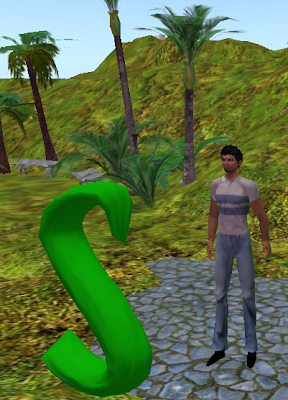
Colouring, or painting prims can be done in at least two ways. Choosing a single colour by using the colour picker, is a way of painting. The S-shaped sculpted sphere, above, was coloured this way.Lara
Another is selecting a texture, which is really an uploaded image, and using this to give a defined pattern or intricate detail to the prim.

The picture here shows my friend Lara wearing a pendant that is decorated and coloured using this texturing method.

The standard RGB colour code is used. Each colour is defined digitally (8-bit) by its Red, Green and Blue components – shown as numbers between 255 and 0, in so-called vector arrays.
Colour Picker

The code for white is (255, 255, 255) and for black is (0, 0, 0). All other available colour combinations in the colour picker occur as permutations between these two vectors.

Scripts

Opens a new window in KoruOne way of imparting effects to objects in SL is by using scripts. In Lara’s candle, for instance, she uses a script that gives the wick the effect of a flickering flame.

When it came to scripting, I was completely baffled at first by colour codes and how they worked. Lara, showed me that an arithmetical code is used in scripting – different from the 8-bit coding used for colours in non-scripted prims.

The arithmetical code embraces a similar RGB range of colours, with some minor limitation in the range of hues available.
The RGB components are represented by numbers between 1 and 0, instead of 8-bit digital numbers between 255 and 0.

An easy conversion

Lara explained it to me this way:

Whereas 255 is the maximum number allowable in the 8-bit digital code, the corresponding maximum number is 1.0 for scripts and for some other uses in SL.

This means that any RGB code has to be converted to the equivalent code before it can be used in a script.
The numbers in the 8-bit digital codes must be divided by 255 to be corrected for use in scripting.The code for white used in script becomes < 1, 1, 1 > and the script code for black becomes < 0, 0, 0 >.


sapgreen(48, 128, 20)

The arithmetic in the code conversion for sapgreen is as follows:
    48 converts to 48/255 = .19

    128 converts to 128/255 = .50

    20 converts to 20/255 = .08

So sapgreen 8-bit digital code (48, 128, 20) becomes < .19, .50, .08 > .
Another example is blueviolet. Its 8-bit digital code is (138, 43, 226). The code for the colour used in script is < .51, .17, .89 >.The same process can be used for any other colour expressed in 8-bit digital code.


I am grateful for assistance and advice given to me by Lara.


Ka kite anō – Catch ya later

Wednesday, December 23, 2009

Deck The Halls

Ngā mihi o te kirihimete me Te Tau Hou - A Merry Christmas and a happy New Year

Opens new window at The Titanic

    Deck the halls with cloud computing,
    fa la la la la, la la la la.
    Tis the season, no disputing,
    fa la la la la, la la la la.

    See the blazing screen before us,
    fa la la, la la la, la la la.
    Strike the keys and join the chorus,
    fa la la la la, la la la la.


    Follow me in multi-tasking,
    fa la la la la, la la la la.
    Is it useful? No point asking,
    fa la la la la, la la la la.

    Can this be? I’ve no cognition,
    fa la la, la la la, la la la.
    Heedless of my mind’s condition,
    fa la la la la, la la la la.


    Don our coats for it is raining,
    fa la la la la, la la la la,
    things to learn, but where’s the training?
    Fa la la la la, la la la la.

    Sing we joyous, all together,
    fa la la, la la la, la la la.
    Heedless of the global weather,
    fa la la la la, la la la la.


Thank you - bloggers, commenters, followers, visitors and great mates - for your support and friendship. I have really appreciated you being with me this year.

Have a rave time this festive season!


Rangimārie - Peace in Harmony

Friday, December 18, 2009

Experience and Qualification

Tēnā koutou katoa – Greetings to you all
Opens a new window at Bradley University in Second Life

I’ve been reflective in my thoughts on where teaching and learning, training and higher education have been leading us recently.

I find it curiously odd that there seems to be a cogent drift away from the value of qualification, in those who are actively engaged in creating educational and training resources. This, at a time when experience is already not held universally in high esteem.

By qualification, I mean a formal standard, diploma or degree, conferred by an authorised and antonymous education or training body.

By experience, I’m implying months or years actually practicing a discipline, in whatever role the position requires.

I have tremendous faith in the youth of today, so I’m not denying their worth and value. They have unbelievable potential and the future of the world as we know it lies undeniably in their hands.

But in the past decade or more, there has been a move away from recognising experience in the workplace. Fresh minds – and let’s not deny it, youth – and the promise of creativity coming from those, have been put above the true and proper value of experience.

And now, we might be misled into believing that qualification could also be discarded.

I put it to you, that by severing the effective combination of qualification, experience and innate ability of the potential appointee to a position in the workforce, we are not only doing a disservice to the workplace, we are putting the future of the world at risk.


Ngā mihi nui – Best wishes

Saturday, November 21, 2009

Denial - Tumbling Walls

Tēnā koutou katoa – Greetings to you all9/11
This month’s theme from Paul Cornies’ Green Pen Society is
writing about a wall you would like to see come down.

In Wellington, New Zealand, just after 6 am on 12 September, 2001,
I learnt of the World Trade Centre Twin Towers collapse.

In New York City, it would have been just after 1 pm on 11 September.
At that time the original 7 World Trade Centre building was still standing. More than four hours passed before it too collapsed.

Official reason

The official reason given for the subsequent disintegration of the 7 WTC building described that it was damaged by debris when the nearby North Tower of the WTC collapsed. Fires were ignited on the lower floors, which continued to burn throughout the afternoon. The 7 WTC building collapsed catastrophically when a main column buckled causing structural failure throughout.

Expectations don’t stack up


There were features about the collapse of the building that puzzled me.

One was that the initial damage was caused by debris, apparently ejected during the collapse of the North Tower at speeds close to 100 kilometres per hour.

Material ejected at this speed could only have been assisted by huge amounts of energy, driven from some source
other than just the collapsing of the North Tower. Any bright year-13 Physics student can prove this.

Video footage screened on television in New Zealand clearly showed the 7 WTC building fell extremely rapidly. It looked like a controlled demolition using explosives.

Recent investigations from video footage have shown that the disintegration was what’s known as a free-fall collapse. It took just over 6 seconds for the top of the building to fall onto the collapsed pile of rubble that was all 47 compacted storeys.

Only an explosion-assisted collapse of the type used in controlled demolitions could have caused such a free-fall collapse. The explosives would had to have been detonated on almost every floor.

Pancake collapse

In a so-called pancake collapse of a building, the floors remain more or less as discrete layers. Contrary to expectations, however, the rubble from the collapsed building showed no sign of layering of floors at all.
Instead, it consisted of crushed concrete, dust and twisted steel.

Danish scientist Niels Harrit carried out rigorous investigations of the debris from the collapsed WTC buildings and published a report in April this year. He and his co-workers found evidence for a significant amount of a substance known as
thermite in the debris.

Thermite can consist of fine aluminium dust and powdered iron oxide. When well mixed and ignited, these substances react rapidly,
forming aluminium oxide, molten iron, smoke and huge amounts of heat.Thermite Equation
Thermite was used for welding tram tracks early in the
20th century.

Molten iron

Observations from videos taken just before the collapse of the towers showed the ejection of huge amounts of molten iron. Experiments have confirmed that these quantities of molten iron could not have come from steel structures melting in the burning building and aviation fuel. Steel girders, roasted in a burning building, do not melt and flow freely.

Until 11 September 2001, no high-rise steel constructed building had ever collapsed because of fire
yet on that day, three WTC buildings collapsed. One of these buildings wasn't even hit by a plane.


There has been a series of consistent analyses conducted by independent analysts. Compositional analysis shows that the molten iron ejected from the building was what’s expected from iron made during thermite ignition.

A wall
 

Examination of footage of the moment of collapse of the South Tower shows clear evidence for a descending series of explosions, preceding a floor-by-floor collapse – an occurrence that could only be brought about by synchronised detonation of a type used in building demolition. I find it almost unbelievable that the publicity surrounding the collapse of the 7 WTC building was so scant. It’s only recently, in reading about the emerging evidence for the presence of thermite in the tower debris, that my initial suspicions have been wakened.

What these facts and other evidence point to is a cover-up of some huge dimension that was apparently enacted at the time of the towers disaster, and maintained over the years since. They leave questions hanging over why the planes were involved in what seems to have been a large scale and extremely well-planned operation.

Somehow a wall appears to have been successfully built around what really caused the collapse of the World Trade Centre buildings. I would dearly love this wall to be demolished so the truth of what happened in New York CBD on 11 September 2001 is revealed.


Check out 911 In Plane Site for further observations.
pen
A Green Pen Society contribution

Ka kite anō – Catch ya later

Sunday, November 15, 2009

It’s All Good

Tēnā koutou katoa – Greetings to you allTime Bomb

    Good that we have the radio to listen to, news and weather reports – how convenient it is to hop on a bus to work in the morning – I must post that letter before last collection today – how lucky we are to receive medical care when needed – what an amazing thing to send kids off to school to learn something before bedtime – so convenient to be able to book movie tickets on the Internet – isn’t it a great asset to switch on a light in the black of night and check a window rattling in the wind?

The list goes on

We live within a complexity system called society. What’s listed above is some of what we expect from the place we live in. It’s as if it’s always been there, and always will be. If it collapsed tomorrow, the things we accept, and indeed rely on, might vanish.

This is exactly what happened when the Soviet Union collapsed in 1992. Apparently it is something that can happen to any society, within any country. It’s only a matter of time.

In a conversation on the radio this morning, someone suggested that efficiency within a society could be looked on as a threat that could precipitate collapse or at least make for a less robust society in the face of possible collapse. Funny enough, less efficient societies tend to be more resilient and more resourceful in crisis, or so mathematicians tell us.

Complexity

Less efficient societies tend to possess repetitiveness within their makeup. They embody many processes within processes that are duplicated throughout their entirety. This feature of being recursively elaborate appears to be a strength within a society rather than a weakness.

Contrary to expectation, high efficiency makes a society vulnerable. Maintaining efficiency means that the administration of resources is fine tuned, so there are fewer margins for adjustment. When things get financially or operationally tight, high efficiency can become a critical, vulnerable weakness.

Close to crisis


A society always runs close to possible crisis and collapse when it relies on a single provider of essential commodities. The hierarchical nature of the management of these commodities means that the job of managing them becomes more complex. Unfortunately, societies tend to evolve by developing hierarchies of control like this.

Ultimately one person has to embrace the complexity of the whole system, a task that sooner or later becomes impossible and therefore unworkable. A decentralised or distributed network structure for administering such a task would be more vigorous and manageable.


Network
If we look around for a stable, vigorous and safe system built on a distributed network structure, we need look no further than the Internet. It has no central hub. It consists of many independent, yet interlinked nodes. If one node is knocked out, the operation of most if not all of the remaining nodes can continue as before.

Competition

From a lay perspective, and not being a mathematician, I look on complexity in a system as something that’s unpredictable, yet recognisable. The collapse of the Soviet Union occurred because of its high degree of complexity - true. My hunch tells me that, perhaps, the Soviet Union contained elements that actually reduced its degree of complexity. High complexity does not necessarily mean vulnerability.

For instance, I wouldn’t consider the existence of monopolies as being a feature of complex systems. Their existence is a feature of how societies have evolved over time. Monopolies comprise complicated engines around which whole systems depend. They represent vulnerable nodes within any system.

Oligopolies contribute to what are recognisable parts of complexity systems. As a group of nodes, they fit one of the key characteristics of a complexity system, that of being recursively elaborate. If one such node becomes extinct, the system can still function comfortably by using the other nodes.

Education as we know it

Might it be that the maintenance and preservation of future society is brought about by tending a degree of recursive elaborateness within that society? It’s what has kept education simmering for hundreds of years. Yet in many countries today, the signs are that education as we know it appears to be reaching a crisis point.

Is there something to be learnt here?


Rangimārie - Peace In Harmony