Showing posts with label complexity. Show all posts

Wednesday, August 11, 2010

An Apology To Stephen Hawking

Tēnā koutou katoa – Greetings to you allLink to image of Lake Taupophoto courtesy Jack Allan

In April 2009 I wrote a futuristic verse. It was a contribution to meet
Bud the Teacher’s deal to write a poem a day for the whole of that month. The verse looked only a little way into our possible future.


In the last stanza I predicted that Stephen Hawking might never have had a chance to say what I assumed had been running through his mind.


“It’s been a long time since Cataclysm.
They said in the beginning it might be
quite a journey. And so we are all here
in one form or another. No one knew
it would be so simple to start it off.

Even
Fermi didn’t, though more than most
he had the insight. ‘So where are they all?’
was what he put to them, knowing full well!

Fermi? He’s over by the supernova.
Can’t get him away from it. Addicted
they say – he always was fanatical.
Apparently he was among the first
to congratulate Hawking when he got here.

Hawking knew all along of course. It was
only a matter of time. And before
he let it all out it was far too late.”


I may have been wrong about Stephen's timeliness. I hope I was.
If so, I offer him my sincerest apology.


Let’s hope that Stephen’s advice is timely, to assist us to survive so our successors can tell a different tale a few hundred years from now.


Ngā mihi nui – Best wishes

Friday, May 28, 2010

Where Has Education Gone?

Tēnā koutou katoa – Greetings to you all
The Skill Mastery HyperdomeThe Skill Mastery Hyperdome - SLENZ Project - Foundation Studies Build, Kowhai

Authentic learning is a solution to some of the problems
that arise in schools, workplaces and in society today.

Isn’t it funny that at a time when training is being heaved out of the workplace by a change of organisational thinking, it must find in-roads to secondary schools where, purportedly, it is desperately needed?

Last week, I attended the Te Aho o Te Kura Pounamu All-School Forum 2010. This was an international occasion for Te Kura.

Three Keynote speakers - Viv White from Australia, Elliot Washor from the United States and Stuart Middleton from New Zealand - gave their perspectives on ‘authentic learning’ in schools.


Stuart could not attend the Forum. He gave a recorded presentation outlining how he saw the history of what has happened globally to education in the past 50 or so years, and how those changes are impacting on what is happening to the youth in society today.

ROSLA

Clearly, the raising of the school leaving age, by several years, has brought about changes in how education is delivered. It has also altered how society looks on school-leavers who go about looking for jobs.


A number of associated changes have accompanied all this.
The origins and reasons for the changes are complex. But the situations for prospective employment of school-leavers are implicit.


Over 40 years ago it was acceptable for kids to leave school without having any formal qualification. There were plenty of jobs for them. They were trained and educated on-the-job, and stories of their successes in life are numerous. Education through ‘the university of life’ was not an uncommon occurrence. As well, night classes became very popular. These provided a useful adjunct to the education of that group of learners
.

But the gradual societal changes, brought about through the raising of the school-leaving age and the programs introduced to schools to cope with these, meant that jobs for inexperienced and unqualified youths became less and less plentiful. What’s more, the general calibre of those jobs is now of a lowly nature and night classes
are disappearing.

Hands on

Today there is a desperate need for kids who are likely to leave school early to be introduced to vocational possibilities during their remaining school years. It’s being recognised that preparation for the workplace in a hands-on manner and while kids are still attending school, is an effective way to accomplish this.

It so happens that the standards-based qualifications system adopted in New Zealand early this century was adapted from the trades schemes. Argue as you may, there is more training taking place in schools today than was delivered there 40 years ago.

It’s now recognised that the vocational access routes available for learners in schools are still not enough, a situation which is driving ‘authentic learning’ schemes into schools. I agree that more of this is now needed. I just wonder at what society is doing to education.

Knowing what to do

Education is supposed to be preparation for life. It has been said by many educators that “education is knowing what to do when you don’t know what to do”. When schools become geared to providing training for kids so that they can step into a job as soon as they leave school, isn’t there a possibility that ‘preparation for life’ will have to be diminished and/or postponed? When does that start if it has been displaced by the need for more immediate training in schools?


Where Has Education Gone?

Rangimārie - Peace In Harmony

Wednesday, March 3, 2010

A Hierarchy of Learning

Tēnā koutou katoa – Greetings to you all300th Post
Heat Exchanger - artist ken allan
My work environment has been a bit noisy lately. The school is having the roof renovated. The building’s air-conditioning units have been disconnected during the time of this refurbishment.

It being summer, there’s a need to open windows and to bring in industrial air-conditioning units to maintain a workable atmosphere within the building. At the beginning of this week, contractors wheeled two of these units into the space close to my office area, plugged them into the mains and switched them on.

Other units were similarly introduced at points throughout the building. The Science teachers who worked in the areas, including myself, viewed this activity with amusement. It was evident that the contractors knew nothing about thermodynamics.

It sucks

The heat exchange part of an air-conditioning unit operates in a way similar to a refrigerator. In normal use, the unit sucks warm air from the room through a cooling unit and filter.
Fresh air from outside the building is drawn in through windows and other openings to replace the heated air expelled during the process.

The resulting chilled air is blown back into the room while the removed heat is air-pumped to the exterior, usually through a duct in a window.

In the case of the units that we observed, there was no such venting. Instead, the hot air from the action of the cooling unit was being pumped back into the room. It was as if a fridge had been turned on and its door had been left wide open. In such a circumstance, the fridge does nothing more than make a noise and heat the room.

The overall effect of the air-conditioning units being used in this way was not unlike that of using large blow heaters. In no time, people started to complain about the rising temperature.

A little learning

Science is a wonderful thing. Its principles are being utilised in just about every piece of technology that contributes to our lives today. Of course, an understanding of scientific principles isn’t always necessary to use or install the equipment that puts these principles into effect.

There are at least three levels of understanding that can allow one to realise the significance of a scientific idea, such as the thermodynamic principles that were put to use in the construction of the air-conditioning units:

  1. It works provided certain conditions are met according to a recipe for installation. For the air-conditioning unit to be effective, it has to be functioning and have its required vents clear, one of which has to be ducted to the exterior.

  2. It works as it follows the thermodynamic idea that heat can be pumped by using a small amount of energy that is eventually released as heat (which is why the fridge with its door open does nothing more than heat up the room).

  3. It works, and its function can be explained by thermodynamic principles:

    a) energy can neither be created nor destroyed,

    b) heat energy is released when a gas is compressed so that it condenses to a liquid and this same heat is taken in when the liquid is allowed to evaporate
    – this is what happens in the heat exchange unit of a fridge,

    c) some energy will always be wasted when heat energy is pumped using mechanical means – entropy is always increased as a consequence
    .

Understanding at level 3 can be achieved by senior secondary school Physics students.

Level 2 can be understood by able students of Junior Science.

Working recipes that define the factors that are important in level 1 need only be followed when it comes to the correct and appropriate installation of a piece of technology in general circumstances.

The example that I unpack here shows how related learning can apply at various levels to the curriculum. What is significant is that the most elementary levels of learning are still important to the correct use of technologies that involve sophisticated principles in their design and construction.

Sorted

As it happens, the contractors were notified by Science teachers about the correct use of the air-conditioning units which were immediately switched off. Appropriate locations near windows were then found. Necessary ducts to the outside of the building were fitted correctly to the machines within 24 hours.

Cicada
Through all this, the cicadas continued their sibilant summer chorus.

Ka kite anō – Catch ya later

Friday, February 19, 2010

Computer Reality

Tēnā koutou katoa – Greetings to you all
Portable Typewriter
Typists who could rattle out a notice on a Remington Portable knew nothing of word wrap. So-called word processors simulated part of the procedure of carriage return by using ‘Return’ keys, now replaced by ‘Enter’ keys on the QWERTY keyboard.


I worked in an office when bound, printed instruction manuals were in their heyday. I didn’t need to read a manual to find out that it was useless either. I could tell from its crisp pages and gleaming cover.

The contents of useful manuals fell at my feet when I took them from the shelf. Company experts on procedures were usually those who wrote, added to, or amended manuals like these.

Many things we now do in the workplace, and the way we go about them, have arisen through the inclusion of the computer. Much of those were modified and re-jigged, or even scrapped from practiced routines and procedures and reinvented, when the use of computer technology became a mandatory part of the processes.

Dissemination of procedural instructions

One of the artefacts that almost disappeared through all this was the printed process specification or business procedure manual. It was sometimes replaced by an online version – less convenient in some ways, more facile in others.

One argument in favour of this replacement was that updates to procedures could be conveyed instantly to a network of workers. In the past these changes were scribbled on the margins of printed manuals and referred to until new versions were published.

But if there is no rigorous and timely procedure for updating an online manual, the user can’t scribble notes in the margins when instructions drift out of date. That is unless they print their own version at some stage. Many do, for this and a number of other reasons. In doing this, however, they may lose touch with subsequent amendments that are only announced on the online version.

Sometimes the business procedure manual, if it existed at all, simply disappears altogether, to be recreated in notes and copies of those made by industrious workers who recognise the need for a manual of some sort. Announcements of new procedures or changes to existing ones sent round by email are filed in either digital or printed form by this diligence.

Evolving 'expertise'

Through this process there evolves a wealth of expertise of varying quality. Someone in need of
information about a business procedure may skip around a workplace looking for advice from those workers well known for gathering and squirreling away procedural information.

And new ‘experts’ come into being.

This is all very well, until there is a real need for a unified approach to a specific and important procedure. It is a property of communities that exists in large workplaces, that they are recursively elaborate and capricious in how each separate part functions according to its situation.

So what's the solution to communicating unequivocal up-to-date procedural methods of practice to all parts of the workplace?


Ka kite anō – Catch ya later

Thursday, February 11, 2010

Elearning? Pedagogy?

Kia ora tātou – Hello Everyone
Southern Georgia teaching an intermediate session to ISTE members in Second LifeSouthern Georgia teaching an intermediate session to ISTE members in Second Life

Isn’t it strange that we read, hear, and see a lot about elearning, but we so rarely read, hear and see as much about eteaching?

Pedagogy?

I keep coming back to this topic. It is so vital to everything to do with teaching. The term, and all that it implies, also embraces elearning.

Elearning?

By implication, the focus is on the learner, and this is fine up to a point. But it is as if what goes on in the teaching is silently implied in the word elearning. The teacher has become the silent participant.

Well I’m going to stick my neck out here and say that there is a need for a change in emphasis so that elearning also implies an appropriate involvement by a teacher.

I’m not campaigning for teacher centred learning – not at all.

I’m agitating for pedagogy to return to its rightful place where a teacher is involved in the learning, which includes elearning.

Digital indicator

A simple examination of my blog’s statistics shows that the posts on pedagogy are considerably less popular than posts on learning. Yet they were written with the same passion, care and attention I give to posts on other topics.

My hunch is that for some reason not yet too clear to me, there is less interest in the part played by the teacher than the technology when it comes to elearning.

Interesting, isn’t it?

Ngā mihi nui – Best wishes

Tuesday, January 26, 2010

Elearning Patterns and Predictions

Kia ora tātou – Hello Everyone

In 1972 I took my first permanent teaching job in an elite Edinburgh secondary school. Just the year before, it had been a private school. James Gillespie’s High School (JGHS) always prided itself on its high standard of education.

A maximum class size was among many standards that JGHS maintained. It strove to have no more than 25 learners per class. The belief was that a finer relationship between teacher and learner could be attained. Through this practice, significantly better educational successes were achieved.

The number of scholars who left JGHS to take up
business careers, or went on to higher education, was proof enough of this accomplishment.

It was a fantastic start for me as a teacher to be with classes of this size. But it was certainly no preparation for the learning environments that confronted me in teaching positions I took up after that time.

In 1974, I had a form class of 36 learners in a school that maintained an average class size of 35.

An elearning counterpart

Almost 30 years later, research into educational achievement through elearning methods suggested that there was an optimum size for elearning groups led by a teacher.

In any group of elearners, there will always be those who can be considered ‘active’ – others who learn despite their apparent inactivity in engagement with a teacher or facilitator – and those who are neither active nor engaged significantly in learning. Time has to be distributed fairly in attending to the needs and wants of each these groups.

An e-teacher who has more than 15 to 20 ‘active’ learners in a group is always extremely busy. When the number of active learners increases much above 20, strategies have to be developed and practiced to cope with the constant learner-teacher activity that inevitably occurs in those environments.

Symptoms of stress and exhaustion are inevitable in any teacher who succeeds in engaging enough learners so that the active group comprises much above 25. My own experiences of this have been confirmed by those of my colleagues teaching in e-environments similar to my own.

A recent experience


Recently, I’ve been actively engaging in discourse with groups of people in Second Life (SL). In the months that I’ve assiduously studied in this networking environment, the number of ‘friends’ in my Friends List has slowly increased. The size of my list is now well over 60.

Within that group is a sub-group of 15 to 20 friends who actively use instant messaging (IM) to contact me whenever I am online. It is a great experience to network with people in this way. Not all of this is done locally – that is to say, my avatar is not necessarily appearing on the same screen as the avatars of those who are IMing me.

Of late, I have found it difficult to be online while following any intended
single pursuit. Two weeks ago, I became an ISTE docent, as avatar Kallan. In adhering to the expected commitment that comes with this office, I discovered that my group of ‘active’ friends caused me significant concern when attending to docent duties on campus.

At first, I was torn between being seen to be ignoring my friends, while attending to a duty which I enjoyed. Even sending messages of apology to IMing friends was an activity that I found distracting while attending to docent duties.

I’ve since learnt from other colleagues in similar SL situations that they often simply ignore the incoming IMs during the time that they are occupied with more immediate activities. Obviously they too have difficulty reading and responding to incoming IMs when engaged in other cerebral activity.

Elearning environment

In translating this to the elearning environment, I can see clearly how a teacher can become stressed and overworked. There is the part that is played by commitment. There is also the aspect of prioritisation.

Who gets priority from the teacher in a learning environment?

When a teacher is actively assisting several learners together, how does she cope when a learner puts forward
, out of the blue, a desperate plea for help?

What strategies can she employ to ensure that this learner, who may well be one who has never before communicated directly with her, gets the necessary immediate support?

What provisions must administration provide in a school to ensure that the number of active learners in a teacher’s group is kept to a manageable level?

How can administration ensure that teachers are not forced to adopt strategies to disengage themselves from needy learners in order to protect their own stress levels?


Ngā mihi nui – Best wishes

Friday, January 22, 2010

On Censorship and Human Nature

Tēnā koutou katoa – Greetings to you all

Censorship, Debate and Discussion

WARNING - The content of this post may disturb some readers.


The vagaries of censorship are mentioned throughout Hillary Clinton’s recent speech advocating Internet Freedom. Censorship is an action that often takes place behind the scenes. It is sometimes difficult to detect. You can be sure that someone somewhere will be confused, disturbed, annoyed, or even enraged when its occurrence is noticed.

Lately, printed news has come under threat. There is a belief that blogging might replace newspapers with a more up-to-date, less censored conduit. As well, the Web2.0 channel is purportedly a space for open debate and discussion.

Well, I wonder about all this. I believe that there is a place for censorship. Furthermore, my experience tells me that censorship is alive and well and is existing quite comfortably – in the blogosphere.

By the way, this post is not meant as a rant.

Moderation

During my first month of blogging I was introduced to some of the technologies that permit a blogger to choose whether or not a comment is published. Comment moderation is such a facility.

Some blog applications can even permit the content of a comment to be edited, before or after it is published. Comment moderation also gives bloggers relief from the increasing nuisance of spammed comments.

Hand in hand with all this is the idea that, through the provision of comment guidelines, commenters can sometimes be given the opportunity to learn what is likely to be accepted by a blogger on his or her blog. (Here’s a link to mine.)

Comment guidelines give the valid reasons for the culling of comments that may be in contravention of the blogger’s guidelines.

Biased opinion?

But comment guidelines are not the only criteria that may be used by a blogger who culls a comment. Am I not entitled to delete any comment that appears in my list of comments to be moderated, whether or not it meets all criteria in my comment guidelines?

How could I be accused of any discrimination even if I do cull comments containing valid opinions other than those that are aligned with my own? Who’s going to know?

You might say, “But isn’t this still a form of raw censorship?” Well of course it is. It also stymies healthy debate and discussion.

Okay, I’m being a tad hypothetical.

Or am I?

My quality comments

Over the years that I have been actively commenting on blogs, I‘ve witnessed this form of censorship. Of all the hundreds (perhaps thousands) of comments that I’ve entered against posts on other blogs, there have been a significant number, through the bloggers’ discretion in comment moderation, that have never appeared on the Internet.

You could say that this is a reflection on the quality and calibre of my comments. Well, there are enough of them still left out there. Take a look and judge the quality and calibre of my comments for yourself.

But I have always been careful to note, when my comment was removed or excluded, if the blog had any associated comment guidelines that I may have contravened. Most bloggers do not provide comment guidelines. I put it down to raw censorship.

So you may think that the blogosphere is entirely a place for freedom of expression. Just check when you leave comments on posts that have comment moderation. You could be surprised at the proportion of your comments that never appear on the blogs you post against.


Ka kite anō – Catch ya later

Tuesday, January 19, 2010

On Creativity

Tēnā koutou katoa – Greetings to you all
Opens a new window at Chakryn Forrest, SL
I took my daughters out for a coffee the other day. Just before we left, Hannah who is age 19 and the older of the two, stepped out of her bedroom looking like a Vogue model. I was charmed that she took time and effort to change before going out for coffee with her old dad.

“I like your outfit, especially the belt”, I said as we got into the car.

“Two dollars in a second-hand shop”, she quipped with a cheeky smile.

That’s one way a second year Art student at AUT demonstrates her creativity to the world – by choosing appropriate clothes to dress smartly on a minimal budget.

Did she have to study Art to express her imagination this way? Certainly not. Anyone can do it if they have a mind to.

But Hannah worked very hard to secure her place in her course at AUT. When she studied Art at High School, she created many different things. Not everything she did was as successful as she’d like it to have been. But she did it all the same. It all contributed to her portfolio – time after time.

    To me, the difference between the artist and the non-artist
    is that the artist is the one who does it.
    – Helen Garner

If a thing’s worth doing . . .

When my son, Jack, was to be married a few years back, I wrote a waltz in honour of his lovely Irish bride, Ailish. She had told me that she loved dancing to waltzes. As it happened, she liked the tune I wrote for her. I commissioned a local Irish dance band to play at the wedding.

A musician friend of mine who was a member of the band obviously didn’t like my waltz. When the band was rehearsing it under my supervision, he asked me why I composed stuff like this.

I explained that the alternative was that I did nothing at all. Then the bride would not have her own waltz for her wedding day. He quietly picked up his violin and played the music
beautifully.

Creativity has to be nurtured

    Creativity is so delicate a flower that praise tends to make it bloom, while discouragement often nips it in the bud. Any of us will put out more and better ideas if our efforts are appreciated.
    – Alex F Osborn

The connection between Art and creativity is so intimate, it is almost impossible to define a difference between the two. One thing is clear, and that is that creativity has first to exist before Art comes into being. Creativity tends to be the easier to recognise, while identifying Art can often be an elusive and subjective assignment.

Schools have a big part to play in encouraging creativity in learners.
But they are not the only important influences, and this has been demonstrated by the work of some of the world’s greatest artists, many of whom were influenced by factors well beyond the precincts of the school grounds.

The importance of what is within us

The mind inhabits a complex organ. The self has to be nourished from within. Two undoubtedly brilliant artists in two discrete disciplines, who lived their lives in different countries and in separate centuries, had very similar views on what nurtures and brings out creativity from within. Check them out.

    Go cherish your soul;
    expel companions;
    set your habits to a life of solitude;
    then will the faculties rise
    fair and full within.
    – Ralph Waldo Emerson

    When I am . . . completely myself, entirely alone . . . or during the night when I cannot sleep, it is on such occasions that my ideas flow best and most abundantly.
    – Wolfgang Amadeus Mozart


Rangimārie - Peace in Harmony

Monday, November 30, 2009

Science, Context and Humour

Tēnā koutou katoa – Greetings to you all
Card Stack in Jabberwocky
When was the last time you laughed at a joke? Where did you hear it? Was it on TV? Or was it on a video clip or podcast?


Susan Greenfield says, “Everything that happens to you will be seen in terms of previous experiences.“

Your brain “can see one thing in terms of something else and that’s your unique perspective”, even when it comes to appreciating a joke.

Here’s what she says:


If you are a scientist or if you are just interested in Science, you may also be familiar with the erroneous opinion that Science is humourless. A joke is a cognitive jolt based on your previous experiences. This jolt can happen even if these experiences are to do with Science.


So let yourself go! Abrogate your sense of self and have “a cognitive time” with some Science humour from Brian Malow.


Ka kite anō – Catch ya later

Saturday, November 21, 2009

Denial - Tumbling Walls

Tēnā koutou katoa – Greetings to you all9/11
This month’s theme from Paul Cornies’ Green Pen Society is
writing about a wall you would like to see come down.

In Wellington, New Zealand, just after 6 am on 12 September, 2001,
I learnt of the World Trade Centre Twin Towers collapse.

In New York City, it would have been just after 1 pm on 11 September.
At that time the original 7 World Trade Centre building was still standing. More than four hours passed before it too collapsed.

Official reason

The official reason given for the subsequent disintegration of the 7 WTC building described that it was damaged by debris when the nearby North Tower of the WTC collapsed. Fires were ignited on the lower floors, which continued to burn throughout the afternoon. The 7 WTC building collapsed catastrophically when a main column buckled causing structural failure throughout.

Expectations don’t stack up


There were features about the collapse of the building that puzzled me.

One was that the initial damage was caused by debris, apparently ejected during the collapse of the North Tower at speeds close to 100 kilometres per hour.

Material ejected at this speed could only have been assisted by huge amounts of energy, driven from some source
other than just the collapsing of the North Tower. Any bright year-13 Physics student can prove this.

Video footage screened on television in New Zealand clearly showed the 7 WTC building fell extremely rapidly. It looked like a controlled demolition using explosives.

Recent investigations from video footage have shown that the disintegration was what’s known as a free-fall collapse. It took just over 6 seconds for the top of the building to fall onto the collapsed pile of rubble that was all 47 compacted storeys.

Only an explosion-assisted collapse of the type used in controlled demolitions could have caused such a free-fall collapse. The explosives would had to have been detonated on almost every floor.

Pancake collapse

In a so-called pancake collapse of a building, the floors remain more or less as discrete layers. Contrary to expectations, however, the rubble from the collapsed building showed no sign of layering of floors at all.
Instead, it consisted of crushed concrete, dust and twisted steel.

Danish scientist Niels Harrit carried out rigorous investigations of the debris from the collapsed WTC buildings and published a report in April this year. He and his co-workers found evidence for a significant amount of a substance known as
thermite in the debris.

Thermite can consist of fine aluminium dust and powdered iron oxide. When well mixed and ignited, these substances react rapidly,
forming aluminium oxide, molten iron, smoke and huge amounts of heat.Thermite Equation
Thermite was used for welding tram tracks early in the
20th century.

Molten iron

Observations from videos taken just before the collapse of the towers showed the ejection of huge amounts of molten iron. Experiments have confirmed that these quantities of molten iron could not have come from steel structures melting in the burning building and aviation fuel. Steel girders, roasted in a burning building, do not melt and flow freely.

Until 11 September 2001, no high-rise steel constructed building had ever collapsed because of fire
yet on that day, three WTC buildings collapsed. One of these buildings wasn't even hit by a plane.


There has been a series of consistent analyses conducted by independent analysts. Compositional analysis shows that the molten iron ejected from the building was what’s expected from iron made during thermite ignition.

A wall
 

Examination of footage of the moment of collapse of the South Tower shows clear evidence for a descending series of explosions, preceding a floor-by-floor collapse – an occurrence that could only be brought about by synchronised detonation of a type used in building demolition. I find it almost unbelievable that the publicity surrounding the collapse of the 7 WTC building was so scant. It’s only recently, in reading about the emerging evidence for the presence of thermite in the tower debris, that my initial suspicions have been wakened.

What these facts and other evidence point to is a cover-up of some huge dimension that was apparently enacted at the time of the towers disaster, and maintained over the years since. They leave questions hanging over why the planes were involved in what seems to have been a large scale and extremely well-planned operation.

Somehow a wall appears to have been successfully built around what really caused the collapse of the World Trade Centre buildings. I would dearly love this wall to be demolished so the truth of what happened in New York CBD on 11 September 2001 is revealed.


Check out 911 In Plane Site for further observations.
pen
A Green Pen Society contribution

Ka kite anō – Catch ya later

Wednesday, November 18, 2009

Common Sense

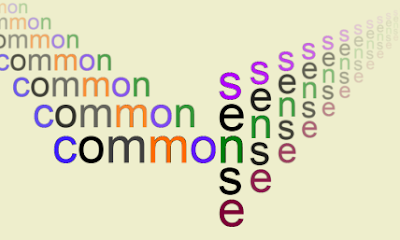
Kia ora tātou – Hello EveryoneCommon Sense

In his book, Where Have All The Leaders Gone, Lee Iaccoca claims common sense as one of the Nine Cs of Leadership.

The Ninth International Symposium on Logical Formalizations of Commonsense Reasoning, Commonsense 2009, took place this year to explore one of the long-term goals of Artificial Intelligence, that of providing computers with common sense.

Stephen Downes claims common sense is what’s needed to avoid or prevent some Internet fraud.

In 1776 Thomas Paine published anonymously a best seller 48 page pamphlet, Common Sense, challenging the authority of British rule in America.


Have you ever thought about what makes up common sense?
Have you ever tried to explain what common sense is?

Seemingly, it’s an awareness, like the ability to judge temperature, recognise directions close to the vertical, or the talent for dress sense.

Difficult to measure

We hear a lot about common sense today. It’s something that every school teacher admires. Possessing common sense seems to be one of the key attributes for achieving success – in any walk of life.

Each of us has a quantity of it – some of us have more than others.
Yet it is extraordinarily difficult if not impossible to measure, let alone define. We are more often made aware of common sense as an entity by its absence than through its occurrence.

Intelligence & noticing the obvious


The brightest and most knowledgeable among us can succumb to a lapse of common sense. Even trainee doctors can suffer a lack of it. When it comes to recognising simple clues, it’s clear that what’s required is more than just expert knowledge or even skill.

One of the most celebrated American scientists, Linus Pauling, undoubtedly possessed a fair amount of common sense in his day.
His researches and passion for what is right earned him Nobel prizes in two disciplines.

Common sense drove him to pursue research into vitamin C and the common cold in directions that have since been proven unequivocally fallacious. This is not a criticism of Pauling. I have a huge respect for all that he did in his life. But his efforts show the illusive nature of common sense and how it can direct or mislead decision making.

Is it instinctive?


If common sense is innate, does this mean that it cannot be acquired by someone who begins life with a less-than-average amount? This idea suggests that it’s like the gene for eye-colour – you are stuck with whatever calibre of common sense you had at birth.

There’s a lot to suggest that common sense is instinctive. In action it tends to be intuitive rather than contrived. Generally the common sense decision is not brought about through a process or processes involving logical thinking strategies, though the use of these cannot be discounted when common sense is brought into play.

Can it be learnt?

If it isn’t an inborn trait, how can a person ensure that a useful amount of common sense is acquired?

I’m only too aware of the rhetorical nature of these questions,
but I’m going to ask them anyway:

  • Is it possible to teach/learn common sense?

  • Can common sense be assessed?
    If so, how can it be measured?

  • Should common sense be included as an essential part of the school curriculum, like literacy and numeracy?

Ngā mihi nui – Best wishes

Sunday, November 15, 2009

It’s All Good

Tēnā koutou katoa – Greetings to you allTime Bomb

    Good that we have the radio to listen to, news and weather reports – how convenient it is to hop on a bus to work in the morning – I must post that letter before last collection today – how lucky we are to receive medical care when needed – what an amazing thing to send kids off to school to learn something before bedtime – so convenient to be able to book movie tickets on the Internet – isn’t it a great asset to switch on a light in the black of night and check a window rattling in the wind?

The list goes on

We live within a complexity system called society. What’s listed above is some of what we expect from the place we live in. It’s as if it’s always been there, and always will be. If it collapsed tomorrow, the things we accept, and indeed rely on, might vanish.

This is exactly what happened when the Soviet Union collapsed in 1992. Apparently it is something that can happen to any society, within any country. It’s only a matter of time.

In a conversation on the radio this morning, someone suggested that efficiency within a society could be looked on as a threat that could precipitate collapse or at least make for a less robust society in the face of possible collapse. Funny enough, less efficient societies tend to be more resilient and more resourceful in crisis, or so mathematicians tell us.

Complexity

Less efficient societies tend to possess repetitiveness within their makeup. They embody many processes within processes that are duplicated throughout their entirety. This feature of being recursively elaborate appears to be a strength within a society rather than a weakness.

Contrary to expectation, high efficiency makes a society vulnerable. Maintaining efficiency means that the administration of resources is fine tuned, so there are fewer margins for adjustment. When things get financially or operationally tight, high efficiency can become a critical, vulnerable weakness.

Close to crisis


A society always runs close to possible crisis and collapse when it relies on a single provider of essential commodities. The hierarchical nature of the management of these commodities means that the job of managing them becomes more complex. Unfortunately, societies tend to evolve by developing hierarchies of control like this.

Ultimately one person has to embrace the complexity of the whole system, a task that sooner or later becomes impossible and therefore unworkable. A decentralised or distributed network structure for administering such a task would be more vigorous and manageable.


Network
If we look around for a stable, vigorous and safe system built on a distributed network structure, we need look no further than the Internet. It has no central hub. It consists of many independent, yet interlinked nodes. If one node is knocked out, the operation of most if not all of the remaining nodes can continue as before.

Competition

From a lay perspective, and not being a mathematician, I look on complexity in a system as something that’s unpredictable, yet recognisable. The collapse of the Soviet Union occurred because of its high degree of complexity - true. My hunch tells me that, perhaps, the Soviet Union contained elements that actually reduced its degree of complexity. High complexity does not necessarily mean vulnerability.

For instance, I wouldn’t consider the existence of monopolies as being a feature of complex systems. Their existence is a feature of how societies have evolved over time. Monopolies comprise complicated engines around which whole systems depend. They represent vulnerable nodes within any system.

Oligopolies contribute to what are recognisable parts of complexity systems. As a group of nodes, they fit one of the key characteristics of a complexity system, that of being recursively elaborate. If one such node becomes extinct, the system can still function comfortably by using the other nodes.

Education as we know it

Might it be that the maintenance and preservation of future society is brought about by tending a degree of recursive elaborateness within that society? It’s what has kept education simmering for hundreds of years. Yet in many countries today, the signs are that education as we know it appears to be reaching a crisis point.

Is there something to be learnt here?


Rangimārie - Peace In Harmony

Thursday, November 5, 2009

Remember, Remember

Tēnā koutou katoa – Greetings to you allKallan in a cellarRemember, remember,
The 5th of November,
The gunpowder, treason and plot.
I see no reason
Why Gunpowder Treason
Should ever be forgot.

Tonight is Guy Fawkes Night in New Zealand – and it will be Guy Fawkes Night in several countries on this day – potentially a fun night for most children and adults.

The history of its origin has been well documented.

The scene is a cellar, directly underneath the House of Lords (Parliament) London, early in the morning of 5 November, 1605.

In a few hours, King James VI/I, the British Parliament and many dignitaries will be in attendance for the opening of Parliament. Having learnt of a rumour of a plot to blow up the Houses of Parliament, the King has ordered a check of the cellars to be executed this morning.

Guy (Guido) Fawkes is quietly leaving the cellar, having just completed his undertakings and last minute checks on dozens of barrels of gunpowder, laid all set to explode in a couple of hours. Fawkes is apprehended by the guards and the stockpile of gunpowder is discovered.

Further investigations reveal that Fawkes and several of his accomplices had attempted to destroy Parliament in what is now known as the Gunpowder Plot.

The outcome of the trial that ensued in January the following year brought Fawkes and his cohorts to the gallows. The King ordered that the event be celebrated by burning fires all over the kingdom.

And so a tradition began for a customary annual celebration.

What intrigues me is the fierce adherence to the Guy Fawkes tradition in New Zealand, a country that is now colonised by many nationalities. What is more intriguing is that a significant portion of people who celebrate ‘Guy Fawkes’ in that country have no knowledge of the origin of this almost pagan custom. Many simply refer to the celebration as Fireworks Night.

What is even more astonishing is that it’s nearly summer in New Zealand at this time of the year. Skyrockets and exploding firecrackers (or bangers) are already banned as they are a fire hazard. It’s not uncommon for dwellings (predominantly of wooden construction in NZ) to be burnt to the ground or large areas of bush and scrub to be razed over the ‘fireworks’ season. In its country of origin, Britain, the tradition takes place during winter when there is a low fire risk.

Legislation already restricts the sale of fireworks to a brief period in November. There have been several moves in recent years to ban the sale of fireworks for use at private celebrations in favour of public municipal firework displays.

My family watch the city display from our living room window. The whole sky is lit with pyrotechnics over a period of half an hour.

Interesting isn’t it, that the fun aspect of a bygone, almost forgotten celebration should so fiercely dictate how people choose to conduct themselves? For me, a shift to a suitable mid-winter date seems obvious as a first move towards safer fun for all.

Enjoy the fireworks!

Ka kite anō – Catch ya later

Saturday, August 29, 2009

Complexity & Standard-based Assessment

Tēnā koutou katoa – Greetings to you all
Complexity The only thing that interferes with my learning is my education – Albert Einstein

Last year, I attended a seminar on Complexity and Education given by Brent Davis and Denis Sumara. In my attempt to pass on to my respected colleagues what I’d learnt, I wrote a report that’s still available on our work-place Intranet.

Immediate reaction to it was mixed. The responses that most interested me were those expressing some concern:
    Perhaps the subject is a bit academic?

    Who bothers with this stuff anyway?

    Had I gone clean out of my mind?

Coming from educators, I thought that these were odd points of view.
I began to think of how we think of education as educators.

Education is adaptive and emergent


adaptive

Education has the ability to adapt and evolve. A system with this attribute is like a living system rather than a mechanical one.

The adaptive nature of Darwinian evolution resembles education more than does the dynamic nature of Newtonian mechanics.
Education can change its structure and is said to be adaptive because of this.

emergent

What arises within education is a synergy from the activity between and within its individual structural components. The effect of the whole is greater than the sum of the single effects from any of its parts.

Education should be forever striving to embrace emergent technologies, innovative knowledge, developing social issues and world opinion.

By keeping a focus on these goals, it is extremely reliant on situations that constantly arise in life. It is emergent.

Complexity

The word complex, and all its derivatives, is finding its way into the routine language of educators. Rather than taking the position as an adjective to other context-related things, its occurrence and use, in referring to complexity, is becoming a more common inclusion in educational discussion.

I think it is significant that there has been recent discourse in the blogosphere on the distinction between what is complicated and what is complex. Some of the similarities and differences between complicated and complex are listed here:

Complex and Complicated
Education versus standard-based assessment

Process standards and technical regulations find their way into standard assessment for trades qualifications and certificates of competence. The stepwise introduction of standard-based assessment in New Zealand secondary education, 2002 to 2004, meant that senior secondary education is now geared to complicated training routines.

To achieve their required level of qualification according to NCEA, learners are coached in delivering subject oriented responses. These preparative measures are selected and delivered to address narrow strips of the curriculum. They use constraints of vocabulary dictated by prescriptions found within each standard.

Practice in the application of rigorous protocol is needed when giving answers to questions that lead to a level of achievement. While these techniques might well be considered good ways to train people for trade qualifications, they are certainly not so efficient in providing education.

Recursively elaborate

Education is complex, yet it embraces things that are not complex
things that are often routine and habitual. In this respect and in others, education tends to be recursively elaborate. A unit of learning that occurs in one place may appear in many other places in different forms, described by a different vocabulary or situational relevance.

Generic Mathematical expressionAreas of learning appropriate to Mathematics, for instance, find their use in other subjects. These inclusions may all adhere to the same fundamental set of laws. Conventions for their use may differ from subject to subject or even within a subject, however, so much that at first sight, they may be almost unrecognisable to teacher and learner.Recursive Fractal

Mathematics as a discipline is just one of many common parts of knowledge that contribute to the
recursively elaborate nature of education.

Education is transdisciplinary


In the mid 60s a friend announced to me that he had enrolled in Ecology, a new degree course at Edinburgh University.

I’d never heard of Ecology, but I was delighted to learn that it involved many disciplines.

Other areas of education that encompass multiple disciplines are information science, biology and economics. They are examples of the many parts that form an all embracing transdisciplinary entity.

Education is transphenomenal

In his recent address to staff at TCS, Scott Flansburg demonstrated and spoke of the different ways people use to perform multiplication.
He reminded me that everyone has their own personal understanding of this complex process. It is not limited to computational routines. Here are just a few of the ways how multiplication can be considered:


The list is not exhaustive. A study of the above operations shows how parts of education may seem multi-faceted, almost ubiquitous in the way they call on different conceptual representation. To make complete sense of the idea of multiplication, however, requires investigation of personal experiences. Unfortunately, these are not commonly explored when learning about multiplication or how to apply it.

Personal appreciation of multiplication can be:

    embedded in hereditary structure – biological

    supported by one's own activity – personal experience


    structured within social interactions – symbolic tools


    made possible by cultural tools – societal usage


    part of an emerging discourse between people.

The items in the above list embrace characteristics of different phenomena. Moving from one idea to the next involves jumping between thoughts to do with each phenomenon – transphenomenal hopping.

To embrace the many facets of ideas around a topic, a teacher and learner may be forced to engage in transphenomenal hopping. This cognitive aspect is what makes education transphenomenal.

Subject relevance
versus standard-based assessment

Subject-specific vocabulary of particular learning is important to learner understanding in a subject. It is also particularly appropriate that the learner has opportunity to embrace the situational relevance of what is learnt.

Part or all of a unit of learning may reside in several different standards. So it is with NCEA. It permits a degree of subject relevance to be included in the teaching of a generic standard. However, such NCEA standards tend to be listed as exclusions. This means that qualification credits are only counted once if a learner achieves two or more credited standards where the same exclusion occurs.

Some standards have been adjusted so that part or all of a relevant unit of learning has been removed to a standard in a specific subject area. In presenting such standard-based units of learning in another subject area, teaching relevant content becomes compromised by the constraints of the standard itself.

Just one of many instances of this happened in New Zealand in 2006 when the unit of learning on Radio-chemistry, incorporated in a standard relevant to Level 2 Physics, was removed from a Level 3 Chemistry standard.

Education should be enlightenment


At present, learners pay a fee to receive the results of their educational achievement (NCEA) determined by standard-based assessment.

It is my contention that standard-based assessment that drives learning, degrades the potential quality of education that could be made available in school. For as much as it is argued that the curriculum should drive the learning and that it should not be driven by assessment, this is not what happens in practice. It never has.

The compartmental character of standard-based assessment, and the narrow focus that this brings to learning, throws the spotlight on complicated assessment routines and the preparations leading up to them. It leaves the rich complexity of education in the shade.

To argue that studying towards standard-based assessment provides an education is a contradiction.


relevant posts - >> ( 4 ) ( 3 ) ( 2 ) ( 1 )

Ka kite anō – Catch ya later