

 AUSTRALASIAN ASSOCIATION OF DISTANCE EDUCATION SCHOOLS
29 September - 1 October
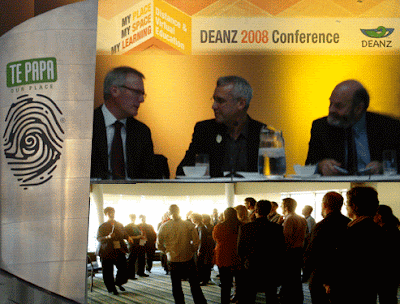
Venues: Te Kura (Day 1) and Te Papa Museum of New Zealand (Days 2 and 3)
Wellington, New Zealand
Wellington, New Zealand
SUMMARY:
I was privileged to attend the AADES Leaders' Forum 2010.
This was a well attended three day event, with speakers from New Zealand and afar. While I attended all three days of the Forum,
I did not attend every session and there were some that were held concurrently. However, I report on all the keynote speeches here.
This was essentially a listeners’ event, though there was a little opportunity for participation from the floor.
Day One consisted of a late afternoon powhiri held at Te Kura.
Marcus Akuhata-Brown was the facilitator for Days Two and Three of the Forum, at Museum of New Zealand Te Papa Tongarewa. His humility, balanced approach and sense of humour were evident in the elegant way he conducted the programme.
A feature of the Forum was the Māori music and harmony. Each guest speaker was thanked in a traditional way by music and song, a true mark of respect. It is a credit to Mike Hollings that he joined in with every one of those musical occasions (I’m sure he engineered them all) most times accompanying on his guitar. This part was altogether a most memorable, entertaining and cultural contribution to the atmosphere of the Forum.
DAY ONE
The Forum began mid-afternoon with the gathering of staff, contributors and visitors and a powhiri in Kauri room, Te Kura, followed by congenial time for refreshment.
Then followed brief welcoming addresses from Mike Hollings, Trish McKelvey and the Chair of ADDES, Bronwyn Stubbs, as well as short speeches from Karen Sewell and Janelle Cameron.
Karen Sewell
Karen spoke of the future that lay in the education of children. She spoke of the trauma that children suffered during and after the recent Christchurch earthquake, and how Te Kura had stepped in extremely quickly to provide support with this.
She talked of the complex and uncertain future that children will follow. Education must transform, not reform ‘the system’ in order to permit children to navigate intricate pathways. Teachers have a part to play in changing our children’s future.
Janelle Cameron
Janelle spoke of the digital divide – how she was still grappling with the technologies – how the digital age seems to overwhelm many people of her age.
Her metaphor for the happenings in learning today was like “a train going through (a station) and not stopping”.
She referred to the Internet and its use as a teaching tool and to what she called “Bloom’s Pedagogy”, the new “Digital Taxonomy” and their part in teaching today.
Day One closed with drinks and nibbles and a chance to network.
DAY TWO
Hekia Parata
Hekia gave us a National Party view of where teachers are at in 2010. She spoke of them focussing “on teaching rather than learning”
(I think she was referring to their learning rather than the learning of their students). Hekia explained that teachers do not seem to learn from learning, and referenced this to education research.
She referred to the mind/brain as the most important part of the being. Yet kids, all over the world, are still sitting in classrooms being taught by a single teacher using traditional teaching methods.
Hekia specially referred to the 1 in 5 students that were clearly being failed by the system – that schools focussed on crowd control rather than on learning.
Hekia’s description of Ruatoria formed a large part of the manifesto-like speech she delivered. She spoke of her family/ brothers, sisters/ community and what they did when she was a child.
Hekia spoke of the demography of New Zealand and of how many children were uninspired at school.
She spoke of the money New Zealand borrows every year to spend on education and the community. Hekia referred to the 1 in 5 ratio and that for many, the model is not working. Her concern was mainly about what she called “brown students”, and referred to their place in the diverse population that is evolving in New Zealand.
She spoke of professionalism that customises skills to give a service, and that such a service was needed by the 1 in 5 children in New Zealand: those that needed to find a job, for instance – a sector that “deserved all the attention teachers can give”.
Hekia summarised her speech by referring to the triangle of Identity, Community and Education: three important areas that provide the basis for learning in an individual.

Liz McKinley
Liz examined some of the statistics on Māori success in education from the Starpath project, University of Auckland. Her quote from Niels Bohr, “Nothing exists until it is measured”, summarised her approach.
She also examined some recent government statistics of Level 2 NCEA results, from 2003 to 2008, comparing Māori with non-Māori. Only 40% of Māori learners get to year 13. Less than half of these go on to study at tertiary level. She showed graphs indicating that in percentage achievement and in success rate, Māori learners were substantially behind learners from other ethnic groups.
Liz analysed these results in a number of ways: that 32% of Māori learners in a year 13 group will eventually go on to further study – that 18% of those will have achieved university entrance qualification – that 6% will actually enter university – that 2% will finish the courses with a degree – that 0.4% will go on to doctorate study.
She explained that Starpath, led by The University of Auckland in partnership with the New Zealand Government, is a research project (now in its 6th year) that focuses on the educational outcomes of New Zealand learners who under-achieve at secondary school. Starpath utilises:
- research teams,
- 5 high schools,
- 1 university and 1 technical institute.
Liz spoke of the need for evidential material that schools require in order to make informed decisions – that schools were not getting help with bringing all available useful data/ideas/strategies together and with aligning these so that they could be used to improve learner outcomes.
She explained that schools do collect data on student learning and achievement, but the data is not centrally stored. She asserted that schools do not feel that ownership of this data is important. She stressed that there was a real need for concerted strategies so schools could usefully collate data related to student achievement and use this to accomplish an improvement in learner achievement.
Liz spoke of the Academic Counselling and the Target Setting (ACTS) programme and how they improved final year NCEA completions. The biggest gains were made by Māori and Pasifika students, with 16% more Māori students and 20% more Pasifika students achieving important learning in NCEA Level 1 Numeracy and Literacy.
Liz concluded by warning that gains for Māori learners were lessening - that many schools had a plethora of programmes, 84 in some, based on teacher interest rather than what could benefit the learner. She appealed that this was actually a moral issue that needed attention, by all parties including teachers in order that it be addressed effectively.
Bentham Ohia
Bentham, CEO of Te Wānanga o Aotearoa, gave an overview of the Open Wānanga – a “Māori Higher Learning Tertiary Institution” of 37,000 learners – 40% of those do not have a secondary education.
He put a number of questions:
- What counts as knowledge? What knowledge counts? Who decides?
- What counts as success? What success counts? Who decides?
- What counts as assessment? What assessment counts? Who decides?”
Te Wānanga o Aotearoa is unique:
- kaupapa wānanga
- unique programme-offering delivery
- home based kaitiaki (guardian) supported
- monthly cohort enrolments
- centralised support
- minimised restrictions.
Viv White
Viv spoke briefly of Big Picture Education Australia (BPEA). She then looked at some learner statistics and other related learner information:
- 14% learners not learning or earning – 50% in some places
- 20% fail to complete year 12 – 50% in some places
- complex social background
- distance education is not immune to the same problems that exist in F2F systems.
She stressed how serious these facts were and that a new model was called for. Viv then put the question that I had asked her at TCS Forum in May this year(!) – basically:
“Can we create a Big Picture Distance Education model?”
Viv then returned to the Big Picture model:
- 1 learner at a time (which is how Te Kura works)
- small by design
- advisory 1 – 15 | 1- 17 |
- Learning Training Internship.
Learners could achieve improved outcomes: engagement – graduation – tertiary learning. She spoke of beginning with network connections – developing a community of practice and commitment to collaborate – building a system of influence: not with critical mass but with critical connections (BPEA and Te Kura).
Jen McCutcheon
Jen defined authentic learning in the context of Te Kura, explained the process and outlined some of the approach used – one that focussed on the learner in context. She spoke of how it relies on rich conversation between the Learning Advisor, the learner and whanau.
Jen explained how finding the centre of what interests and impassions a learner was an all important part of that process. It’s then that a start can be made on building relevant programmes around the learner and nurture these with frequent ongoing discussions.
Jen went on to define what constituted a ‘rich conversation’: goal setting – identifying ‘aspirational’ goals – career exploration – interviews and talking with people – job-shadowing – resetting goals. She mentioned the part that Gateway, Star and other programmes can play in the development of this process.
She described the ‘tail of underachievement’ and mentioned the consequential 25% of people aged 15 to 19 years who are unemployed.
Westley Field
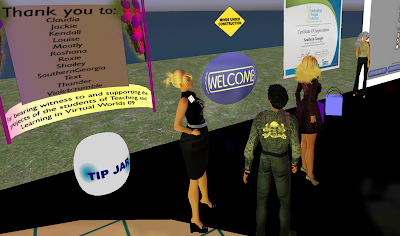
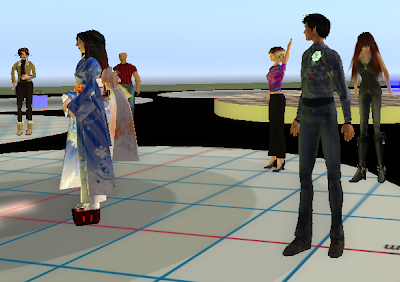
Westley is Director of Online Learning, Skoolaborate. He began his delivery by demonstrating an online delivery/facilitation by an avatar in Second Life (SL). Westley then Skyped his friend, Chris, who was the person behind the SL avatar.
Westley spoke briefly of the developments in online learning at MLC School. He spoke of how technology makes the routes to achievement more facile, and not just in learning but also in creating commercially useful objects, such as the Doritos commercial he showed us and that was made for $150 by a teenager using readily available equipment.
He encouraged that we should “try things new” – to “move forward with real action”. He spoke about personalised (online) learning. He spoke of how to get the attention of learners if they have computers in their hands. He spoke of how “knowledge”, and how to use it, takes on a new meaning with the developments in technology, Google and the Internet.
Westley talked about giving people experience in the use of technology – in particular giving young learners safe, ‘unblocked’ experience in technology use. He spoke of the technologies that can change learning, including the development of the e-book such as the Amazon Kindle.
He referred to the improved success by learners using online learning productively with other learning methods compared to those learners who are in the classroom without such technology.
Sandy Dougherty & Nathaniel Louwrens
Sandy and Nathaniel gave a presentation on their experiences in trialling Active Worlds. The study was to evaluate Active Worlds as a learning technology and also its suitability in a distance education setting.
They demonstrated a treasure hunt that had been built in the 3D environment of Active Worlds. Some of what they reported was about their own initial experiences in the 3D environment – some of the seeming ‘chaos’ perceived by people who are new to this technology – which later developed to a successful resolution.
Their intended focus was to be on working with learners collaboratively and how to get learners to work together. The reality was slightly different.
Sandy and Nathaniel found that young learners (years 7 to 10) learnt the technology skills for themselves very quickly, skills that the teachers had taken 2 terms to learn. They also reported that the learners preferred online (txt) chat rather than using the voice chat, though they were comfortable with the teacher using voice chat in instruction.
Sandy was careful to get useful (and fascinating) feedback from her learning group, to which she put a number of questions. Asked how they learnt, Sandy’s students gave a number of interesting answers, among which were ‘playing’ and ‘practicing’.
Asked if they needed a teacher there was met with a resounding, “YES”. The children preferred the teacher speaking to them rather than using the chat box. The common feeling expressed by learners was that the whole learning experience was “awesome!”
About the technology . . . learners felt that though it was a bit clunky, it was like playing a game that was really school. Navigation in commercial games technologies tend to be far more facile in comparison and the 3D renditions are often superior to what they experienced in Active Worlds.
DAY THREE
Mike Hollings – Walking in Two Worlds
Mike spoke of the money poured into education and the efforts that are not actually achieving learning. He cited Cisco’s The Learning Society and stressed that the cost of education should be tax-efficient.
A successful education system has to be based on the principle that it is for everyone and must embrace ones personal culture while at the same time supporting innovation. He stressed that there was a need for a huge change in present systems. He cited Phillippe de Woot’s need for societal educational metamorphosis and referred, once again, to Allen Curnow’s Landfall into Unknown Seas:
“Simply by sailing in a new direction
You could enlarge the world.”
Mike spoke of leadership today and the huge diversity of theories that are based largely on western ideas. He asked of leadership, “what could we learn from other wisdom?”
He drew attention to how Māori people spend a lot of time ‘going back’ to their cultural places, communities and the related pursuits. The educational system in New Zealand does not acknowledge this cultural aspect as much as it does that of western cultures in activities such as music, opera, and dance.
Mike gave an overview of some of the wisdom from Māori leadership, and how it focussed on the needs of people and the resources they needed – the understanding of communities and their tribal/cultural boundaries. Māori leadership qualities are not necessarily accepted or respected in the wider community in New Zealand. Mike listed some of the elements of that leadership:
Manākitanga – hospitality
Rangitiratanga – weaving people together
Whanaungatanga – interdependence
Wairuatanga – spirituality
Kaitiakitanga – guardianship
Whakapapa – genealogical connections
Te Reo Rangatira – Māori language
Mike observed that community intellect is at risk when languages are lost. He also spoke of the worth of trust and the value of openness – that for trust to exist, intentions must be clearly understood and patently visible.
Mike summarised the thrust of his speech by saying “we cannot (always) rely on western systems”. He referred to the importance of locality in determining who we are and where we are at in New Zealand. He used lines from the poem Lost, by David Wagoner, to illustrate this:
Lost
Stand still. The trees ahead and bushes beside you
Are not lost. Wherever you are is called Here,
And you must treat it as a powerful stranger,
Must ask permission to know it and be known.
The forest breathes. Listen. It answers,
I have made this place around you,
If you leave it you may come back again, saying Here.
No two trees are the same to Raven.
No two branches are the same to Wren.
If what a tree or a bush does is lost on you,
You are surely lost. Stand still. The forest knows
Where you are. You must let it find you.
Jen McCutcheon and Viv White
This was a panel session introduced by Marcus Brown where Jen and Viv spoke freely of their vision of the Big Picture.
Jen gave a brief summary of the Big Picture process including some of the best practice used. There then followed a brief session of questions from Marcus and from the floor. Jen and Viv both spoke to the questions that were asked.
Brenda Frisk
Brenda summarised her vision of what she called “visual knowledge” and its place in 2010. She spoke of the need to reduce the barriers that may exist between people and their use of available technology, and also of the need that industry has to learn to manage technology. She posited that teenagers lose trust and respect for people in industry when they see that they do not have skills to use the technology effectively.
Brenda spoke of tacit knowledge, implicit knowledge and cultural knowledge and their use to the people employed in a company. She emphasised the need to have online portals for children to access at any time of the day.
She spoke of the frustrations that an organisation has in finding and in accessing data with technology and that there was a need to have technology built for people, not just for the technologists to use. Its property and function need to be relevant, evidential, contextual, credible and collaborative.
Brenda spoke of two important reports, the Horizon Report and Learning Powered by Technology, and summarised some of the key elements brought out in these. She then spoke further on visual knowledge and explained and demonstrated how 3D (stereoscopic) visualisation could give a better perspective in viewing machines and other structures in context.
Hine Waitere
Hine introduced herself from her tribal background, then spoke of ako, a pedagogical concept that encompasses both teaching and learning as parts of the same process. She illustrated how ako had been brought out in the Forum with reference to those presenters who had told of their experiences in learning (and teaching) during their presentations, and the stories they told.
She spoke of Māori carvings and tukutuku and how these also have stories to tell. They are different forms of literacies. Hine spoke of her appreciation of landscape but also recognised that there was much there she did not understand.
Hine read the story, Butterflies, by Patricia Grace, depicting ‘difference’ without a need for that difference to be fixed. She went to the heart of this idea by referring to how the grandfather did not correct the teacher, but simply explained where she was at.
She also illustrated how teachers have power and authority to direct ‘values’. She asked,
“What are the values that lie at the core of our (teaching) practice?”
She then talked about the tail of young learners who struggle with their ‘education’, listing the 5 Ds:
Deficit
Deprivation
Disadvantage
Difference
Diversity.











 Posts
Posts


