Showing posts with label Second Life. Show all posts

Tuesday, March 9, 2010

Authentic Elearning?

Tēnā koutou katoa – Greetings to you all
Sculpted Earth by Magnuz of Sweden - Badger
When a learner is in an environment that is relevant to what's being learnt, the likelihood for effective engagement is high. Learning by doing is supposed to be one of the most successful ways to learn.

Both these factors – the relevant environment and the doing – are thought to provide jointly the greatest incentive for a learner to take interest in what is to be learnt. They form the basis for what is referred to as authentic learning.

For as difficult as such situations are to establish and sustain in face-to-face situations, elearning environments can present major barriers to authentic learning that are almost impossible to overcome unless the elearning vehicles are in situ.

Typical examples of these are online tutors for word processing, graphics applications or other computer functions where the learner is involved in using mouse and keyboard to operate a tutorial directly relevant to the application.

I cite the Southern Hemisphere planisphere with a built-in tutorial as one example of an in situ learning vehicle in a junior Science elearning resource.

The examples given above are all very well, but unless a considerable component of what is learnt is transferable to other purposes, the learning acquired by the learner has limited use elsewhere. One of the characteristics of authentic learning is the transferability of the learning to other situations or disciplines.

Two examples where generic and transferable skills can be learnt are online instruction in touch-typing, and the use of a flight simulator as part of training to become an aircraft pilot.

Kallan and Tuxedo presenting a session in building in SL

Recently I was privileged to share in the facilitation of a session sponsored by ISTE, teaching people online to manipulate and assemble prims, the building blocks of Second Life (SL).

As well, part of the duties I perform as an ISTE docent in SL involves assisting and teaching newcomers to that environment by the use of text and voice chat. The learning facilitated in these situations is authentic.

People who come into SL need to acquire new skills. Most who stay to use that environment want to learn skills that can only be acquired online. But other than exercising skills in associated disciplines such as art and design, the skills I teach to newcomers are only useful in Second Life. And here is the conundrum associated with authentic elearning.

Apart from learning that is directly associated with the elearning application or platform, how is authentic learning achieved online?


Ka kite anō – Catch ya later

Friday, February 5, 2010

Elearning in Second Life

Tēnā koutou katoa – Greetings to you allLink to Elearning Planet


In September last year, I ventured into Second Life (SL) to explore.

My purpose was similar to that of most educators whom I have welcomed in the short time I have been a SL ISTE docent. I wanted to find out what SL could offer as an elearning environment.

I now have a clearer idea of its worth and potential.


The near-reality of much of the 3D simulation offered by SL is a valuable element – it is a key quality of this elearning platform. However, its aesthetic charm may dull even an educator’s appreciation of the true value of what SL can hold for a learner.

I enjoy the fantasy aspect which is so often present when I’m in SL. The huge variety of costume, and the opportunity available for disguise, make it splendid for roleplay. This aspect of SL has great potential to extend the imagination of the participant.

There are a number of features that identify SL's genuineness as an authentic elearning environment:

The people

Second Life is an environment that embraces people. This quality alone brings authenticity.

There is a wide range of ways of recognising the presence of people, wherever the participant happens to be in SL. Channels to engage in communication between those who are online are easy to use. They can be facilitated in many different ways and at different levels. They are certainly not limited to simple txt or voice chat.

Even body language can play its part in exchanges between people.


The sharing culture

There is a culture of sharing that is clearly evident among people in SL. This has possibly arisen through recognition of the need for assistance, sharing and collaborating when people first come into SL.

The cultural practice of sharing tends to be passed on. And it is accomplished at different levels, from a brief offer of situational help between two strangers at meeting, to organised sessions where experienced trainers can volunteer skills to others who are less competent.

The music


SL presents music to its participants
through various pathways, either live, pre-recorded or streamed directly from international radio stations. YouTube plays its part in all this, bringing music, new and old, as well as videos on many other themes to the eyes and ears of participants who have full control over audio levels within a full range of different sound channels.


The medium


Within the first few weeks as a visitor, I was able to engage in the construction of the digital stuff that is the fabric of SL. I don’t think there is another elearning environment where participants can so freely make use of the componentry and structure that comprise the environment they are in.

Many of its cultural environments provide support for this engagement, through classes provided voluntarily by experienced exponents of the craft.

Two main techniques that contribute to this are building and scripting. They go hand in hand, employed in the construction of the simplest thing such as an item of jewellery, to the most complicated assemblage of the foundation of the environment itself.


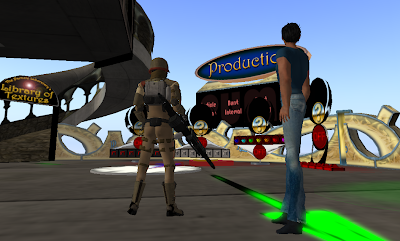
For the motivated learner, there is a copious amount of well-laid-out tutorial material to be found in centres throughout the environment. Splendid examples of these are the Particle Laboratory Learning Centre and the Ivory Tower Library of Primitives, where a learner can acquire knowledge and skills on the fundamentals of building and scripting.


It is at centres like these that both beginner and experienced developer can visit and gather pearls of
21st century wisdom on the construction of the digital fabric of Second Life.


Ka kite anō – Catch ya later

Tuesday, January 26, 2010

Elearning Patterns and Predictions

Kia ora tātou – Hello Everyone

In 1972 I took my first permanent teaching job in an elite Edinburgh secondary school. Just the year before, it had been a private school. James Gillespie’s High School (JGHS) always prided itself on its high standard of education.

A maximum class size was among many standards that JGHS maintained. It strove to have no more than 25 learners per class. The belief was that a finer relationship between teacher and learner could be attained. Through this practice, significantly better educational successes were achieved.

The number of scholars who left JGHS to take up
business careers, or went on to higher education, was proof enough of this accomplishment.

It was a fantastic start for me as a teacher to be with classes of this size. But it was certainly no preparation for the learning environments that confronted me in teaching positions I took up after that time.

In 1974, I had a form class of 36 learners in a school that maintained an average class size of 35.

An elearning counterpart

Almost 30 years later, research into educational achievement through elearning methods suggested that there was an optimum size for elearning groups led by a teacher.

In any group of elearners, there will always be those who can be considered ‘active’ – others who learn despite their apparent inactivity in engagement with a teacher or facilitator – and those who are neither active nor engaged significantly in learning. Time has to be distributed fairly in attending to the needs and wants of each these groups.

An e-teacher who has more than 15 to 20 ‘active’ learners in a group is always extremely busy. When the number of active learners increases much above 20, strategies have to be developed and practiced to cope with the constant learner-teacher activity that inevitably occurs in those environments.

Symptoms of stress and exhaustion are inevitable in any teacher who succeeds in engaging enough learners so that the active group comprises much above 25. My own experiences of this have been confirmed by those of my colleagues teaching in e-environments similar to my own.

A recent experience


Recently, I’ve been actively engaging in discourse with groups of people in Second Life (SL). In the months that I’ve assiduously studied in this networking environment, the number of ‘friends’ in my Friends List has slowly increased. The size of my list is now well over 60.

Within that group is a sub-group of 15 to 20 friends who actively use instant messaging (IM) to contact me whenever I am online. It is a great experience to network with people in this way. Not all of this is done locally – that is to say, my avatar is not necessarily appearing on the same screen as the avatars of those who are IMing me.

Of late, I have found it difficult to be online while following any intended
single pursuit. Two weeks ago, I became an ISTE docent, as avatar Kallan. In adhering to the expected commitment that comes with this office, I discovered that my group of ‘active’ friends caused me significant concern when attending to docent duties on campus.

At first, I was torn between being seen to be ignoring my friends, while attending to a duty which I enjoyed. Even sending messages of apology to IMing friends was an activity that I found distracting while attending to docent duties.

I’ve since learnt from other colleagues in similar SL situations that they often simply ignore the incoming IMs during the time that they are occupied with more immediate activities. Obviously they too have difficulty reading and responding to incoming IMs when engaged in other cerebral activity.

Elearning environment

In translating this to the elearning environment, I can see clearly how a teacher can become stressed and overworked. There is the part that is played by commitment. There is also the aspect of prioritisation.

Who gets priority from the teacher in a learning environment?

When a teacher is actively assisting several learners together, how does she cope when a learner puts forward
, out of the blue, a desperate plea for help?

What strategies can she employ to ensure that this learner, who may well be one who has never before communicated directly with her, gets the necessary immediate support?

What provisions must administration provide in a school to ensure that the number of active learners in a teacher’s group is kept to a manageable level?

How can administration ensure that teachers are not forced to adopt strategies to disengage themselves from needy learners in order to protect their own stress levels?


Ngā mihi nui – Best wishes

Sunday, January 3, 2010

Second Life Scripting Colour Code Explained

Kia ora tātou – Hello EveryoneOpens a new window in Koru
I thought I’d start the year off with a colourful post. I’ve been doing some building in Second Life (SL) recently. I got stuck when I came to interpreting how the colour codes work when scripting some effects.

Perhaps I should explain for those who are not so familiar with SL.

All of SL, including the avatars that frequent it, is constructed from what are known as prims, or ‘primitives’ – polygonal three-dimensional shaped objects, like the ones Kallan demonstrates here.

Of course, not all that can be seen in SL is made entirely from these primitive shapes alone. They can be distorted by an effect, called sculpting, to reshape, or ‘tortured’ by changing their shape and size by other means.

Painting things in SL
Opens a new window in Koru
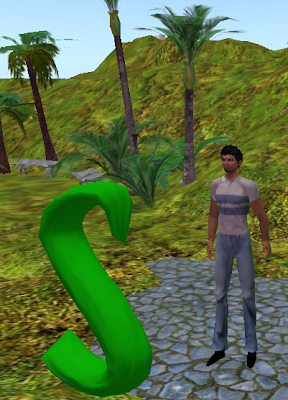
Colouring, or painting prims can be done in at least two ways. Choosing a single colour by using the colour picker, is a way of painting. The S-shaped sculpted sphere, above, was coloured this way.Lara
Another is selecting a texture, which is really an uploaded image, and using this to give a defined pattern or intricate detail to the prim.

The picture here shows my friend Lara wearing a pendant that is decorated and coloured using this texturing method.

The standard RGB colour code is used. Each colour is defined digitally (8-bit) by its Red, Green and Blue components – shown as numbers between 255 and 0, in so-called vector arrays.
Colour Picker

The code for white is (255, 255, 255) and for black is (0, 0, 0). All other available colour combinations in the colour picker occur as permutations between these two vectors.

Scripts

Opens a new window in KoruOne way of imparting effects to objects in SL is by using scripts. In Lara’s candle, for instance, she uses a script that gives the wick the effect of a flickering flame.

When it came to scripting, I was completely baffled at first by colour codes and how they worked. Lara, showed me that an arithmetical code is used in scripting – different from the 8-bit coding used for colours in non-scripted prims.

The arithmetical code embraces a similar RGB range of colours, with some minor limitation in the range of hues available.
The RGB components are represented by numbers between 1 and 0, instead of 8-bit digital numbers between 255 and 0.

An easy conversion

Lara explained it to me this way:

Whereas 255 is the maximum number allowable in the 8-bit digital code, the corresponding maximum number is 1.0 for scripts and for some other uses in SL.

This means that any RGB code has to be converted to the equivalent code before it can be used in a script.
The numbers in the 8-bit digital codes must be divided by 255 to be corrected for use in scripting.The code for white used in script becomes < 1, 1, 1 > and the script code for black becomes < 0, 0, 0 >.


sapgreen(48, 128, 20)

The arithmetic in the code conversion for sapgreen is as follows:
    48 converts to 48/255 = .19

    128 converts to 128/255 = .50

    20 converts to 20/255 = .08

So sapgreen 8-bit digital code (48, 128, 20) becomes < .19, .50, .08 > .
Another example is blueviolet. Its 8-bit digital code is (138, 43, 226). The code for the colour used in script is < .51, .17, .89 >.The same process can be used for any other colour expressed in 8-bit digital code.


I am grateful for assistance and advice given to me by Lara.


Ka kite anō – Catch ya later

Tuesday, September 29, 2009

A Session in Snapshots – Networking and Learning

Tēnā koutou katoa – Greetings to you all
Arriving at the Workshop
I had intended that the post Connected World in Second Life would be my last in the series on Second Life (SL)
this month. Well, I just have to squeeze in another.

Opens New Window Southern GeorgiaBeing a new ISTE member and an avid enthusiast for learning,
I happened to touch down on ISTE Island yesterday and met up with friend and fellow educator, Louise Borgnine.

She was assisting with the first of a series of intermediate sessions for educators in SL facilitated by
Southern Georgia.

The objective was to learn how to do things that will enhance teaching presentations in SL. The venue was over at Brahma.

Being new to all of what is SL, and in much need of the associated skills, I accepted Louise’s advice to teleport to the workshop.

Southern Facilitating the Workshop
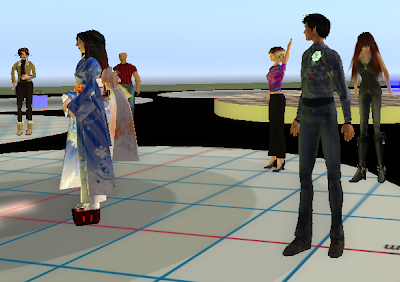
The number of attendees was impressive. I must say that I found the facilitators extremely helpful. When I got stuck (and I did!) there was no end of assistance ready at hand. That’s what good keen educators are like I guess. Always ready to help a willing learner.

Something else impressed me, and that was how wonderful it was to arrive at a distant venue, be attending a session with people from different countries, and be greeted with the customary formalities without having to shift out of my ergonomic chair.

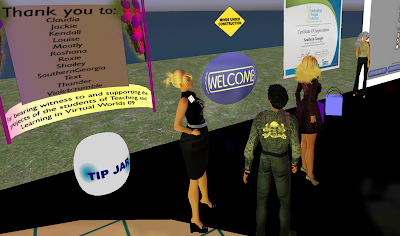
Workshop ParticipantsKallan, wearing his ISTE student badge

There were other features that made me feel welcome. It was a participatory session. I was recognised by the facilitator by name, and he acknowledged me being there more than once. That was something special for one who is so new to SL and feeling a bit anonymous.

TuxedoThen there were the facilitators, among them docent Tuxedo, who was kind and helpful. She was especially helpful when I dropped my laptop and got left behind. Tuxedo helped me pick it all up, and got me started again and following Southern’s instructions.

This was no ordinary workshop, yet it had the presence and feel of a real life workshop.

I learnt a lot. I even got some session notes to take away, as well as a free digital TV presentation screen, which I managed to get working.

“What’s with SL?” I hear my readers say. What’s possessed Blogger in Middle-earth to let himself be led astray by all this virtual reality stuff?
I read some comments
to that effect on a post only a day or so ago.

Southern GeorgiaNo. I don’t think I’m being led astray here. It is the reality of virtual conferencing – no less contrived than video conferencing, with a lot more freedom to move about and participate.

We had a participatory session at the end when Southern rallied us to flex our new-learnt skills in a game of look and see
– an active finish to a rigourous session in using the camera facility in SL.

A transparent dice box, suspended in mid virtual space, rolled the dice for us to observe and call. It wasn’t easy, for we had to navigate our cameras in which ever direction was called, to declare the numbers on the dice. It was fun – as much fun as I have had at many well run training sessions in real life.

The Transparent Dice Box
Next day, I dropped into the ISTE Conference Centre to be greeted yet again with a welcoming smile, this time from docent Mo Hax. He was kind enough to chat and pass on to me his useful site on SL.

These people are volunteers. They are trained educators and they are teaching their hearts out in SL. I might just drop in on another session some time soon. What do you reckon?

related posts - > ( 6 ) ( 5 ) ( 4 ) ( 3 ) ( 2 ) ( 1 )

Ka kite anō – Catch ya later

Friday, September 25, 2009

Trilogy

Tēnā koutou katoa – Greetings to you all

I have three announcements about things that will be happening in the blogosphere next month. The first is an appeal to all bloggers to contribute to Blog Action Day 2009.

1


“Blog Action Day is an annual event that unites the world's bloggers in posting about the same issue on the same day on their own blogs with the aim of sparking discussion around an issue of global importance. Blog Action Day 2009 will be the largest-ever social change event on the web.”

This year’s Blog Action Day is on 15th October, the issue being Climate Change.


Bloggers are encouraged to write about climate change in the context of how it relates to the topic of their blog. To help you start thinking, hop across to the Blog Action Day site where there is listed a few ideas about how you might connect climate change to things you might write about on your blog.

Please contribute to this worthy cause by registering your intended post title at http://blogactionday.org/
and publishing your blog post.

2


George Siemens, Jay Cross and Tony Karrer have recently announced the first ever LearnTrends 2009 Innovation Awards. The intention is to attract nominations from all parts of the globe.

“These awards are designed to recognize the products, projects and companies that represent interesting innovations in the use of technology for Corporate / Workplace Learning and Performance.”

The deadline is 30 October. To apply for an award you must complete the Submission Form.

If you wish to find out more, leave a comment on Tony Karrer’s site, or drop him an email at akarrer@techempower.com.

3


My third announcement is to do with Blogger in Middle-earth's nomination for the Blog-o-the-Month award, sponsored by the International Society for Technology in Education (ISTE).

The announcement and polling place is at ISTE Island's Blogger's Hut in Second Life.

So fly across to Blogger’s Hut on ISTE Island now, and register your support for this blog. If you need to register with Second Life first, the registration is easy. I recommend it.

Blogger in Middle-earth has the blue square on the polling board.
Pick up your avatar and teleport to Blogger’s Hut.

Ka kite anō – Catch ya later

Wednesday, September 23, 2009

Connected World in Second Life

Tēnā koutou katoa - Greetings to you allA Dancing Night Out Maka, Huntress and Kallan enjoying a night out dancing

This is the last of a series of September posts summarising some of what I’ve learnt while looking around Second Life (SL).


Exploring SL from the elearning perspective, there is a range of features that facilitate communication, making it an accessible networking tool.

Here are the features I’ve found most useful during the 3 weeks I have been exploring in SL:


Local chat and voice


Local Chat This feature provides synchronous text or voice communication. In local text chat, selecting the range of communication provides a means of control over the ‘loudness’ of the chat.

Normal chat can be ‘heard’ within a virtual range of 20 m from the participant’s avatar. A whisper cuts the range to 10 m, whereas a shout extends it to 100 m (SL).


Instant Message (IM)

Instant Messaging provides a direct means to communicate across SL between two avatars. This is useful if there's a need for close communication between two avatars when in company. It has global range in SL and permits avatars to chat asychronously if need be.

Avatar profile

Avatar Profile
There are often delays in chat when avatars meet for the first time. This is mainly due to the customary practice of mutual avatar profile checking during an initial conversation.

There are sections or tabs in the avatar profile where useful information can be put by the avatar’s owner.

Since most of this added content is viewable by others, it pays to give careful thought to what’s entered that is viewable by the 'public'. It can be helpful to those you meet and save a lot of misunderstanding.


Drop-box transfer between inventories

Inventory
Each avatar has its own Inventory – an accumulated ordered series of virtual commodities. These can be images (Textures), text files (Notecards) and sound files (Sounds) or more particularly .wav files and other items such as scripted objects that have specific functions in SL.

Drop-box on Profile
A simple click-and-drag from the inventory of the giver to the drop-box of the recipient permits a copy of the item to be transferred across SL.

Media Browser


Media Browser
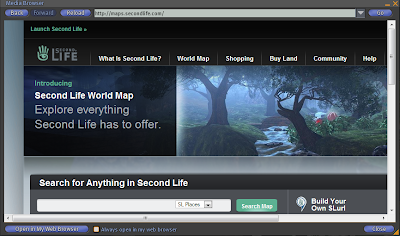
A built in browser provides ready access to the Internet direct from SL. As well, the Media Browser can be set so that the browser on the user's PC opens by default. I found this a useful function as it permitted a separate browser window to be opened on the screen giving greater flexibility of use.

Ratings in SL


On 15 September 2009, Linden Lab successfully separated the "adult content" from the general grid. This is a welcome move, for business people and educators using SL, towards a safer and pleasanter environment. It is also a good move for the reputation of Second Life.

( 7 ) < - related posts - > ( 5 ) ( 4 ) ( 3 ) ( 2 ) ( 1 )

Ka kite anō - Catchya later

Saturday, September 19, 2009

Deeper Than Any Sea – A Second Life Adventure

Tēnā koutou katoa – Greetings to you all
Huge sponges of millennial growth and height;
And far away into the sickly light,
From many a wondrous grot and secret cell
Unnumbered and enormous polypi
Winnow with giant arms the slumbering green.
Alfred Lord Tennyson

My love of fantasy has taken me deeper into Second life (SL) than I’d imagined. The distinction between reality and fantasy becomes more diffuse with every minute I spend in these regions. Coming back to RL (real life) is a bit like walking out to a daylit street from an exciting and gripping movie. It puts a new perspective on reality.

The effect that SL has on the mind can be powerful if the imagination is energised. For a few minutes after logging off, I wonder if real life isn’t all virtual too. It makes me think again about what some people say about violent virtual games and the effect they may have on the real life behaviour of some people.

But like every other thought stimulation, SL is just another influence. Persona and personality are two entirely different things.

Real adventure

A recent sojourn into SL found me a delightful companion, Zylle (zill).

Like me, she is new to SL but she has a little more experience and that is useful. We share our interests and our fascination for SL in conversation, while we show each other around islands that we'd discovered in the short time since we were rezzed.

part of Kalepa

The other night we took off to the volcanic island of Kalepa, one of Zylle’s favourite spots. It is an enchanting place with lots to explore, including a sail in a gondola and a journey on a huge enchanted feather.

On our second visit to the island, she took me on the Da Vinci Gardens Indiana Jones Adventure.


Here we entered the lobby, close to the entrance to the tomb of the Pharaoh where the Sarcophagus and treasure chamber lay.

Among the rich assemblage of Egyptian statues, treasure chests and ornate accoutrements, were opportunities to actively participate in snake charming, or try a spot of belly dancing, supervised by the resident genie-of-the-lamp.


Kallan watching Zylle belly dancing

Our quest for the treasure chest was fraught with unimaginable peril.

Zylle had to teleporte me to safety from the deathly pit of cobras and avatar-eating spiders at least twice. I wasn’t at my ease in those circumstances and had to keep saying to myself, “this is SL!”


We found the treasure chest eventually, but unfortunately neither of us could lift any of the treasure it contained. Getting back out to the sunny sands of Kalepa meant retracing our steps! I was relieved to get out.

While looking around outside, we spotted Felixx, the developer of Kalepa! We identified him by his name tag as the owner of all that we had seen in Kalepa.

We approached him, and after brief introductions, he kindly showed us around. Felixx teleported us to his customer service depot where we had a chat and shared a few of our interests.

Felixx meeting Kallan and Zylle

I think he was taken with our interest in his work. He gave us the link to a recent video made in Kalepa, starring Alissa Moreno, singing and accompanying herself on piano.


I got the impression time was running short for Felixx. He had lots to get on with, yet he continued to show us around.

When Zylle explained that we’d been to Sunken Atlantis, he asked, “Did you take a ride on the sea-horses?” We hadn’t.

So off we went, teleport-fashion, to ride the sea-horses in the “slumbering green”.

Kallan and Zylle on the sea-horse chariot

Felixx took a snapshot of us as we rode into the depths, and bid us farewell. This journey was amazing, for it revealed the true beauty of Felixx’s animations.


He explained that he first got into building in SL when he'd been out of work for some months, during which time he taught himself the ropes, while building his amazing fantasy land.


He told us that, as a student, he'd studied Biochemistry. He had a PhD in Genetics. I could see where his love for detail in nature came from.

A shipwreck, a lost treasure chest and a visit from a giant octopus set the scene for much adventure.


The next evening, we were in Hawaii and met Pawn who had been newly rezzed. As dutiful avatars, we helped him with some of the basic skills in SL, and a few more tricks, not that I knew much! Swimming underwater with the dolphins was a great introduction to having fun with animation in SL.

Zylle and Pawn swimming with the dolphins

But Kalepa is obviously the place to go for ‘real’ adventure. So off we went, only to meet Felixx, once again! He so much wanted to demonstrate what he could do to entertain us and had us fascinated as he scripted the crocodiles to fight with each another.

Zylle and Kallan look on as Felixx scripts the crocodiles

Isn’t Zylle’s hair wonderful? She decided she needed a complete change after losing her hair while playing chess with Pawn earlier.

Felixx’s power with scripting allowed him to work magic with the Sarcophagus of the Pharaoh.


Kallan, Pawn and Zylle watch as Felixx scripts the Sarcophagus

Later, we decided to take up Felixx’s earlier advice to visit Mars! We’d spent too much time on the seahorses the evening before to enter the underwater spaceship that takes us to Mars from Sunken Atlantis.

It was count down . . . - 3, - 2, - 1, - 0 . . . “We have lift off!”


The journey was somewhat rocky. But with me in the controls, what would you expect? When we landed, we decided it was better that Zylle took the controls on the Mars buggy! Did you know that’s there’s water on Mars? And all sorts of fantasy plant life?


And mushrooms! Or are they Marsrooms?
For Jaba the Hut?


Zylle got us safely to the observation tower, where we took a drink from the bar, relaxed a bit and enjoyed the view.


Throughout the adventure, at the back of my mind I was making mental notes on the potential Second Life had in providing a platform for elearning. Its networking potential, for me, is implicit.

In a flight of fantasy, one need not wonder if even romance is possible in Second Life.


post editor Zylle
( 7 ) ( 6 ) <- related posts - > ( 4 ) ( 3 ) ( 2 ) ( 1 )

Rangimarie