Showing posts with label thinking. Show all posts

Saturday, December 4, 2010

The Value of Instruction

Kia ora tātou – Hello EveryoneThe Value of Instruction
“A long time ago, in Newsday for November 15, 1994, Billy Tashman said with reference to a large, government-sponsored field test of different instructional approaches: ‘The good news is that after 26 years, nearly a billion dollars, and mountains of data, we now know which are the most effective instructional tools. The bad news is that the education world couldn’t care less.’
The same holds true today." James Kauffman

When I first began teaching, I bristled with the desire to instruct, inspire, coach, and enlighten. I’d just been through Moray House College of Education, Edinburgh, where my tutors and mentors truly recognised the worth of excellent instruction.

Yet for the past 30 years and more, I have felt like a disillusioned school teacher who is old fashioned, out of date and not really understanding what’s happening in education.


The other day, a good friend and colleague passed on to me a recent article from Teachers College Record, by James Kauffman. It was written as an introduction to his recently published book,

The Tragicomedy of Public Education:
Laughing and Crying Thinking and Fixing
.

As I read through Kauffman's article, I recalled how I felt when I read Shelley Gare’s book,

The Triumph of the Airheads and the Retreat from Common Sense.

I experienced déjà vu at every page.

James Kauffman is Professor Emeritus of Education at the University of Virginia in Charlottesville.

In his review article, entitled Reforming Public Education: A Tragicomedy, he explains how some people, working within education, fail to recognise the most important factor in improving learning:

“Truly ridiculous statements about reforming schools have been made by generally intelligent people who happen to botch thinking about education. Too often, their silly statements are taken seriously, making matters worse. Some would-be reformers ignore what produces most learning — instruction.”

Kauffman draws attention to all the areas of stupidity in education that I’ve complained about, for decades . . .

. . . about improving teaching:

“They might say we need better teachers without defining “better.” People aren’t necessarily better teachers because they’re smarter, know their subject better, or have taken more courses. We need standardized tests, but good teaching isn’t easily measured as “value added.” “Better teacher” doesn’t necessarily mean “higher average pupil gain score.” Good instruction is defined by what a teacher does.”

. . . about pursuing change without recognising what needs to change:

“On January 2, 2010, Kevin Huffman published in The Washington Post his heartfelt opinions about how to reform education, including suggestions that we recruit talented teachers and fire bad ones, base policies on student achievement, and get parents to demand what’s best for their children. He quotes a U.S. Senator from Colorado, who says that the education system must change, but he doesn’t say how. Any change will do? Sorry, Kevin and Senator, with all due respect, we don’t need just any kind of change. Unless it’s the right change, we’ll get nowhere.”

. . . about the
misunderstanding and misuse of statistics:

“One reason the “thinking” of so many earnest reformers is tragicomic when it’s taken seriously is that you can’t have all of the children (or teachers or any other group we measure) reaching any percentile higher than the first group any more than you can have all of the children (or teachers) above average.”

. . . about setting education goals that are absurdly unachievable:

“No Child Left Behind (. . .) set the goal of universal proficiency of students by 2014. That goal is a will-o’-the-wisp that anyone else who understands the most basic mathematical-statistical realities knows is impossible.”

. . . about teaching methods inappropriately applied to all learners:

“Direct, systematic instruction is more effective than other approaches like “discovery learning” (essentially, letting kids find out for themselves) and a lot of the other popular but failed ideas about teaching. Go to www.adihome.org/ to find out more.”

. . . about using test scores to judge success.

Kauffman lists his criteria for judging success:

  1. effective instruction,
  2. students’ engagement in productive activity,
  3. homogeneous grouping for instruction,
  4. positive emotional climate,
  5. clear school-wide expectations,
  6. positive support for desired behaviour,
  7. involvement of parents and communities.

Check out:

http://www.youtube.com/watch?v=GpAFlbncygM

The Tragicomedy of Public Education: Laughing and Crying Thinking and Fixing,
James M Kauffman, FULL Court Press, 2010
– ISBN 1-57861-682-4

The Tragicomedy of Public Education – DESK COPY


Ngā mihi nui – Best wishes

Wednesday, August 11, 2010

An Apology To Stephen Hawking

Tēnā koutou katoa – Greetings to you allLink to image of Lake Taupophoto courtesy Jack Allan

In April 2009 I wrote a futuristic verse. It was a contribution to meet
Bud the Teacher’s deal to write a poem a day for the whole of that month. The verse looked only a little way into our possible future.


In the last stanza I predicted that Stephen Hawking might never have had a chance to say what I assumed had been running through his mind.


“It’s been a long time since Cataclysm.
They said in the beginning it might be
quite a journey. And so we are all here
in one form or another. No one knew
it would be so simple to start it off.

Even
Fermi didn’t, though more than most
he had the insight. ‘So where are they all?’
was what he put to them, knowing full well!

Fermi? He’s over by the supernova.
Can’t get him away from it. Addicted
they say – he always was fanatical.
Apparently he was among the first
to congratulate Hawking when he got here.

Hawking knew all along of course. It was
only a matter of time. And before
he let it all out it was far too late.”


I may have been wrong about Stephen's timeliness. I hope I was.
If so, I offer him my sincerest apology.


Let’s hope that Stephen’s advice is timely, to assist us to survive so our successors can tell a different tale a few hundred years from now.


Ngā mihi nui – Best wishes

Tuesday, January 19, 2010

On Creativity

Tēnā koutou katoa – Greetings to you all
Opens a new window at Chakryn Forrest, SL
I took my daughters out for a coffee the other day. Just before we left, Hannah who is age 19 and the older of the two, stepped out of her bedroom looking like a Vogue model. I was charmed that she took time and effort to change before going out for coffee with her old dad.

“I like your outfit, especially the belt”, I said as we got into the car.

“Two dollars in a second-hand shop”, she quipped with a cheeky smile.

That’s one way a second year Art student at AUT demonstrates her creativity to the world – by choosing appropriate clothes to dress smartly on a minimal budget.

Did she have to study Art to express her imagination this way? Certainly not. Anyone can do it if they have a mind to.

But Hannah worked very hard to secure her place in her course at AUT. When she studied Art at High School, she created many different things. Not everything she did was as successful as she’d like it to have been. But she did it all the same. It all contributed to her portfolio – time after time.

    To me, the difference between the artist and the non-artist
    is that the artist is the one who does it.
    – Helen Garner

If a thing’s worth doing . . .

When my son, Jack, was to be married a few years back, I wrote a waltz in honour of his lovely Irish bride, Ailish. She had told me that she loved dancing to waltzes. As it happened, she liked the tune I wrote for her. I commissioned a local Irish dance band to play at the wedding.

A musician friend of mine who was a member of the band obviously didn’t like my waltz. When the band was rehearsing it under my supervision, he asked me why I composed stuff like this.

I explained that the alternative was that I did nothing at all. Then the bride would not have her own waltz for her wedding day. He quietly picked up his violin and played the music
beautifully.

Creativity has to be nurtured

    Creativity is so delicate a flower that praise tends to make it bloom, while discouragement often nips it in the bud. Any of us will put out more and better ideas if our efforts are appreciated.
    – Alex F Osborn

The connection between Art and creativity is so intimate, it is almost impossible to define a difference between the two. One thing is clear, and that is that creativity has first to exist before Art comes into being. Creativity tends to be the easier to recognise, while identifying Art can often be an elusive and subjective assignment.

Schools have a big part to play in encouraging creativity in learners.
But they are not the only important influences, and this has been demonstrated by the work of some of the world’s greatest artists, many of whom were influenced by factors well beyond the precincts of the school grounds.

The importance of what is within us

The mind inhabits a complex organ. The self has to be nourished from within. Two undoubtedly brilliant artists in two discrete disciplines, who lived their lives in different countries and in separate centuries, had very similar views on what nurtures and brings out creativity from within. Check them out.

    Go cherish your soul;
    expel companions;
    set your habits to a life of solitude;
    then will the faculties rise
    fair and full within.
    – Ralph Waldo Emerson

    When I am . . . completely myself, entirely alone . . . or during the night when I cannot sleep, it is on such occasions that my ideas flow best and most abundantly.
    – Wolfgang Amadeus Mozart


Rangimārie - Peace in Harmony

Friday, January 15, 2010

On the Hypotenuse

Tēnā koutou katoa – Greetings to you all
Pythagorean Squares
    The area of the square on the hypotenuse of any right-angle triangle
    is equal to the sum of the areas of the squares on the other sides.
    Pythagoras' Theorem

I was hopeless at Mathematics when I began High School. Teachers despaired at my ineptitude. But I had a natural interest in Science.

It was mainly due to good Scottish teaching, and a genuine willingness on my part to engage in learning, that I studied Mathematics to a level that let me reach the highest academic levels in Science.

It was also due in part to the curriculum I followed. I believe that it taught me how to think. It wasn’t that it taught me to think. I could do that. It taught me how to think, and to be able to think in specific ways.

In the 1970s, I taught High School Mathematics to senior level.

Recently, I have become familiar with fundamental changes in the way mathematical thinking is taught in High School in New Zealand.
I suspect that these are similar to changes in the Mathematics curricula in other western countries.

Get it right

The Euclidean proof of the useful Theorem of Pythagoras was one of the things I had to learn for my early qualifying examinations at High School. My mother learnt the same proof when she attended High School.

Euclid’s proof was taught in New Zealand schools until changes were made in the curriculum towards the end of last century (
20th). It is now supplanted by what I’d call a non-proof. What young minds are required to study about the Pythagorean Theorem in New Zealand today is certainly not a proof of it.

Euclid’s proof is based on the properties of rectangles and of triangles that are each of the same shape and size – as well as associated geometry ideas involving these shapes drawn between parallel lines. There are several hundred proofs of this fundamental theorem. Some are outlined in Wikipedia. A few I learnt at High School.

All of the proofs I learnt permitted me to understand, not only how the Pythagorean Theorem can be proved, but also what it is to know the significance of a universal proof. It is a way of thinking that permits a learner to appreciate that a proof needs to be watertight.

What does it prove?

Euclid’s proof can be applied to ANY right-angle triangle, not just a few special triangles. Therein is the difference between what used to be taught and what is now taught.

In High School today, a learner in Mathematics is instructed on how to show that a given right-angle triangle has the Pythagorean property. The instruction is not about any right-angle triangle, but applies only to a particular right-angle triangle that the learner draws.

Essentially, learners follow a recipe that shows that the Theorem may work for their triangle. It provides no real understanding of proof.

Here’s what they are instructed to do:


Counting Squares
Learners in Mathematics are shown how to draw a right-angle triangle on a grid, using simple mathematical drawing equipment. They are also shown how to draw squares on each of the three sides of the triangle. By counting the number of grid squares that make up each of the squares, they can show that the Theorem is followed approximately.

Higher thinking

While this recipe permits the learner to practice skills in using drawing equipment, it provides no understanding of a mathematical proof.
It does not even show conclusively that the Theorem works.
However carefully it is done, not every attempt at adding the squares will show that the Theorem is precise. Check out the squares shown above.

One can argue over the need for the knowledge of how to prove the Pythagorean Theorem. But the significant learning is nothing to do with that knowledge. The thinking skills learnt that permit the learner to understand what a watertight proof is all about are really what are far more useful and relevant to higher thinking skills.

This is the whole point of teaching the proof. It has the potential to permit the learner to realise the significance of a theorem that can be applied universally, and why it has this property. It is a way of thinking analytically that is not being taught today.


Ka kite anō – Catch ya later

Monday, November 30, 2009

Science, Context and Humour

Tēnā koutou katoa – Greetings to you all
Card Stack in Jabberwocky
When was the last time you laughed at a joke? Where did you hear it? Was it on TV? Or was it on a video clip or podcast?


Susan Greenfield says, “Everything that happens to you will be seen in terms of previous experiences.“

Your brain “can see one thing in terms of something else and that’s your unique perspective”, even when it comes to appreciating a joke.

Here’s what she says:


If you are a scientist or if you are just interested in Science, you may also be familiar with the erroneous opinion that Science is humourless. A joke is a cognitive jolt based on your previous experiences. This jolt can happen even if these experiences are to do with Science.


So let yourself go! Abrogate your sense of self and have “a cognitive time” with some Science humour from Brian Malow.


Ka kite anō – Catch ya later

Wednesday, November 18, 2009

Common Sense

Kia ora tātou – Hello EveryoneCommon Sense

In his book, Where Have All The Leaders Gone, Lee Iaccoca claims common sense as one of the Nine Cs of Leadership.

The Ninth International Symposium on Logical Formalizations of Commonsense Reasoning, Commonsense 2009, took place this year to explore one of the long-term goals of Artificial Intelligence, that of providing computers with common sense.

Stephen Downes claims common sense is what’s needed to avoid or prevent some Internet fraud.

In 1776 Thomas Paine published anonymously a best seller 48 page pamphlet, Common Sense, challenging the authority of British rule in America.


Have you ever thought about what makes up common sense?
Have you ever tried to explain what common sense is?

Seemingly, it’s an awareness, like the ability to judge temperature, recognise directions close to the vertical, or the talent for dress sense.

Difficult to measure

We hear a lot about common sense today. It’s something that every school teacher admires. Possessing common sense seems to be one of the key attributes for achieving success – in any walk of life.

Each of us has a quantity of it – some of us have more than others.
Yet it is extraordinarily difficult if not impossible to measure, let alone define. We are more often made aware of common sense as an entity by its absence than through its occurrence.

Intelligence & noticing the obvious


The brightest and most knowledgeable among us can succumb to a lapse of common sense. Even trainee doctors can suffer a lack of it. When it comes to recognising simple clues, it’s clear that what’s required is more than just expert knowledge or even skill.

One of the most celebrated American scientists, Linus Pauling, undoubtedly possessed a fair amount of common sense in his day.
His researches and passion for what is right earned him Nobel prizes in two disciplines.

Common sense drove him to pursue research into vitamin C and the common cold in directions that have since been proven unequivocally fallacious. This is not a criticism of Pauling. I have a huge respect for all that he did in his life. But his efforts show the illusive nature of common sense and how it can direct or mislead decision making.

Is it instinctive?


If common sense is innate, does this mean that it cannot be acquired by someone who begins life with a less-than-average amount? This idea suggests that it’s like the gene for eye-colour – you are stuck with whatever calibre of common sense you had at birth.

There’s a lot to suggest that common sense is instinctive. In action it tends to be intuitive rather than contrived. Generally the common sense decision is not brought about through a process or processes involving logical thinking strategies, though the use of these cannot be discounted when common sense is brought into play.

Can it be learnt?

If it isn’t an inborn trait, how can a person ensure that a useful amount of common sense is acquired?

I’m only too aware of the rhetorical nature of these questions,
but I’m going to ask them anyway:

  • Is it possible to teach/learn common sense?

  • Can common sense be assessed?
    If so, how can it be measured?

  • Should common sense be included as an essential part of the school curriculum, like literacy and numeracy?

Ngā mihi nui – Best wishes

Saturday, October 31, 2009

The Ubiquitous Question – a reflection on learning

Tēnā koutou katoa – Greetings to you all
Mirroring the Question - artist ken allan
“. . . unless you speak up... you will not be learning . . .”

I often wonder if our current education systems drive us to make invalid assumptions about how learning happens. I’m talking about educators here, not necessarily members of their learning communities.

Curious though it may seem, I learnt lots as I bumbled my way through high school. Not because I was especially able or bright.

I had an annoying knack of being outspoken when I couldn’t understand things. I hated not knowing what was going on. I asked questions.

The teaching moment

Fortunately, I had good teachers. They recognised the teaching moments that I presented to them – on a plate. I gained the respect of my teachers, probably solely because of this attribute of asking questions, for I certainly wasn’t a model student.

Good teachers admire learners who ask pertinent questions. It makes them feel wanted. Hence their intolerance of impertinence, I guess.

Asking a question offers a teacher the opportunity to fulfil that so-often-difficult-to-attain goal of the pedagogue. The goal is to teach relevantly. While it’s true that learners tend to engage more in learning when they interact during a ‘lesson’, I’m not so sure that speaking up or even asking a question is necessarily exclusive for learning to occur.


Questions and answers

One dated definition of education is ‘the ability to learn from a book’
(this implies the educated is still learning). You can’t ask a book a question. Today, we like our educated learners to learn from the Internet, using searches, networking and the like.

It’s presumed that these media permit the learner to ask questions. The belief persists that asking a question – or even just speaking up – is so very necessary for learning to occur.

I’ve always thought of thinking as a stream of thought statements and questions, asked and possibly answered in the mind. My assumption is that a thinker asks questions of herself or himself and that’s what initiates further thinking.

Lying in bed, just awake, on a Saturday morning, having no plan pending for the unfolding day, my thoughts might go something like this:

    “Shall I get up now? Or will I just lie here blissfully embalmed in the cosy bedding for half an hour?

    I wonder what the weather’s like? Perhaps I could get the garden dug? Or maybe give the shed that coat of paint?

    Ah, but isn’t it nice to lie in on a Saturday morning?”
This sort of discourse assists me to learn about how I feel. It can figure how the day that’s just beginning can become a part of my life. So yes, my assumption about asking questions still works. Even if I learn nothing of what’s happening outside my head, I can learn something about myself.

Assumptions on learning

So why do teachers assume that no learning happens without questions being asked? I think they are referring to what I call active questions, spoken or entered in a txt or email, or other such method of communication between two or more people. There is an assumption that the question has to be aired.
But I am puzzled at how the idea fits with learning from a book.

It’s a point of view I’ve come across before, that of the lurker who never engages, never interacts and never asks questions. The inference is that the lurker never learns.

This is not the opinion of Nonnecke and Preece, who actually coined the phrase, Silent Participants for learners who lurk. They claim that learning can take place despite no participation from the learner. My own experience aligns with their research findings.

Etienne Wenger refers to community members who do not speak up as Legitimate Peripheral Participants. He recognises that learning happens even if the participation is only peripheral, that is to say, the learners don't speak up.

Teaching, learning and assessment

Teachers are geared to assessment. Often they feel compelled to possess written evidence that a learner has reached an objective before they are convinced the objective has actually been learnt.

Assessment is forced participation on the part of the learner. Without engagement at the time of assessment, it could be construed that nothing can be achieved in an assessment test. Yet not achieving is hardly unequivocal evidence that learning hasn’t happened.

A principle upheld by designers of resources for distance learning is that if the student hasn’t been asked a question about a learning objective, and responds with the correct answer, the objective hasn’t been learnt. Prompting the learner to respond in this way gives the teacher an opportunity to record that learning has occurred. It tends to subscribe to the tick-box mentality, but, at least, it is a recordable event.

Questioning a way to learn


I’m not entirely opposed to the suggestion that questioning is a way to learn. Nor am I questioning the idea that learners will learn nothing if they don’t ask questions. My hunch is that questions are asked in the mind all the time. The trick of learning relevantly lies in asking the right questions.

Students who always have questions, and put them, will learn. They can ask them out loud or online, to a teacher or to another learner. Or they can ask them in their own mind. As long as learners keep asking questions, there will be answers given in return and they can learn from those. This is especially the case if learners know a thing or two about metacognition, even if they don't know the word.

Do learners have to ask their questions directly? To a teacher, for instance?
Do you think learners will not learn unless they speak up? Or can they learn without asking questions? What’s your take on learning and participation?

Ka kite anō – Catch ya later

Tuesday, October 20, 2009

Binge Thinking

Kia ora tātou – Hello Everyone
Opens a new window on The Big Question
This month, The Big Question on the Learning Circuits Blog is to do with New Presenter and Learner Methods and Skills.

Multitasking is now every presenter’s problem. Tony Karrer posits, “that there are things that presenters and learners should do to address this.”

Multitasking is binge thinking. It has the potential to distend the capacity of the brain so that normal thinking to do with any one task, including learning, becomes severely impaired. Tony says it all here.

Scott Flansburg is a supreme example of how a person can perform amazing calculative feats. He executes thinking skills that traditionally command extremely high concentration levels and all the thinking power that permits this. His unique ability to close down areas of the brain normally associated with other peripheral tasks makes him a matchless unitasker.

Thinking tires the brain

I am convinced that people often shut down areas of their brains automatically to make it easier to think. For instance, it is now known that when making decisions, the brain’s executive resources can be taxed to an extent that cognitive ability is considerably impaired. To prevent this happening in some situations, fast track routines are adopted.

Too much decision making over a short space of time literally tires the brain. Do people make decisions when attending a presentation? You bet they do, if they make a genuine attempt to learn from it.

PowerPoint and other potential vagaries

So why is it that when the audience is supposedly concentrating on the single task of learning, the presenter insists on giving them a series of tasks to perform synchronously? Cognitive overload associated with the misuse of PowerPoint has become a talking point. It is an issue because it’s real.

Learners well know that when the presenter reads the text from a PowerPoint slide, the best thing to do is to shut the eyes and listen.

So why is the text on the PowerPoint slide in the first place? For the presenter? No! It’s there because the presenter knows nothing about cognitive overload. A better way is for the presenter to shut up and let the learner do his or her own reading.

Take note

Tony refers to backchannel as a distraction for the presenter. I’m not surprised he finds it distracting. It is nevertheless an inevitable activity if learners are engaged in taking notes, by whatever means they use.

Through years at school, university and attending hundreds of seminars since then, I have learnt to take notes while giving nearly full attention to a presentation. It’s one multitasking practice that I’m good at. But not everyone has this skill.

What I’ve found often helps is if the presenter provides printed notes on the PowerPoint bullets – before the presentation. This frees up the brain when it comes to taking notes. I just write my additional notes on the PowerPoint printout.

Cognitive engagement

But there is another aspect to presentation – and that is of intent.

What does the presenter really want the learner to take away from the experience? If the seminar has a sales pitch, it may be better not to dwell too much on the facts and details that a learner may take away.

Research has shown that the verbal content of a presentation, whether in speech or text, is only a small part of the total message conveyed to the attendee. How often has a conference goer raved about a ‘keynote’, reporting that the best thing about the presentation was its entertainment value?

What if the presentation was entirely lacking in entertainment, yet the same factual information was presented? Herein may lie a pedagogical message.

Entertainment provides two important features to the learner. It provides the necessary breaks between learning tasks and prevents the possible onset of cognitive overload brought on through multitasking. It also adds interest and factual significance by association.

Rangimārie - Peace in Harmony

Saturday, October 3, 2009

So You Have a Major Project! Where Do You Start?

Tēnā koutou katoa – Greetings to you all
Major Project
I’m on leave this week. I decided to paint the bathroom. This was no small undertaking for me. Not the painting – the decision!

I’m no great shakes as a painter. I do the job thoroughly though, which is why I won’t get someone in to do it. But I’d rather watch TV.

This is the third time I’ve painted our bathroom in almost as many centuries. So I know what’s involved. But for me, it’s still a major project. Where do I start?

Around the scraping, sanding, swearing, stepladder and pots of paint,
I have to organise the family. That includes one loveable teenage daughter. Bathrooms are it for teenage girls, and we have only one bathroom. The strategy needed to coordinate even a small family around an arguably useful bathroom-being-renovated is a major project in itself.

Pale Sky Blue seems like a good colour for the walls – Oriental Bay, that’s the tint! It’ll match the nearly new shower and window curtains that everyone’s so fond of. We’ll get some new vinyl for the floor – replace the vanity mirror and everything will be hunky-dory.

I’ve forgotten where I put the old paint-roller and tray. Yes, I could really do with some new paint-brushes. There was a hardware sale advertised in the Weekender. Perhaps I should pay the store a visit and have a look. And there was the advert we saw on TV last night. Pity I didn’t take a note of the dates. Maybe there’ll be an ad on TV
now.

So you can see that I have a problem starting a major project!

Where to start?

At home and at work, I’ve had lots of major projects that I’ve deliberated over. One thing has come clear to me over the years. Procrastinating gets me nowhere when it comes to the major project.

So where do I start?

The answer is . . .
anywhere.

With a task like this, postponing the inevitable just runs away with the valuable time I need for scraping, sanding, swearing and messing about with stepladder and pots of paint.

So I get into town and buy the paint. Return home, change, grab the scraper and sandpaper and start preparing the walls.

"What about the family and access they have to the bathroom?" you say. Needs must. They’ll just have to make the best of a bathroom-being-renovated the same as I will.

So that’s it really.

Where do you start a major project? The answer is 'anywhere'. Oh, a bit of planning won’t go amiss. But it’s the same with planning. In fact, for some projects, just the planning becomes a major project. So you have to draft a plan.

Where do you start with that? Anywhere!

It’s the starting that’s the thing.

The weight
on the mind of any major project can be profoundly burdensome. And a project doesn’t really have to be all that big for it to be considered major. Take writing this blog post for instance. I really wasn’t up to writing a post today. I’d just finished nursing my aching back after painting the bathroom ceiling. But where did I start?

Anywhere!

I just have to get started, that’s all. Sometimes starting a major project can be as difficult as completing the rest of the project!

Ka kite anō – Catch ya later

Wednesday, August 26, 2009

You Think You Can Multi-task?

Tēnā koutou katoa – Greetings to you all
Multi-tasking
You’ve probably read all about it. People who multi-task are no good at anything they do while multi-tasking, other than switching from one task to another.

That’s what the latest report says from a study by Stanford University. This is backed by findings published in the Proceedings of the National Academy of Sciences. Is there anything new here?

Fashionable

What’s new, or relatively so, is a fashionable idea that multi-tasking is a real cool thing to do, that doing two or more things at once can be effective. Anyone young and mentally agile can multi-task effectively.

Not!

Where did this come from? This myth that some people, that anyone can effectively multi-task?

17,800 hits

In October 2001, Marc Prensky claimed that so-called digital natives “like to parallel process and multi-task”. This line has been quoted ad nauseam since then, to the degree that You have to multi-task! has become a work-place maxim.

A Google of the quoted phrase is likely to return at least 17,800 hits! Check it out.

Almost everything I read to do with multi-tasking seems to subject me to a brain-wash-like repetition that there are two species of people – those who can multi-task and those who cannot. On a number of occasions I have been told verbosely that these groups fall into the respective categories of so-called digital-natives and digital-immigrants.

Tragic statistical evidence

A recent legislation in New Zealand will outlaw driving while using a mobile phone, whether txting or in audio-conversation. That is unless dispensation is given for hands-free usage for specific purposes. Many other countries have already brought in similar legislation.

The decision to legislate was based on the tragic statistical evidence that people, no matter what their age
no matter what their mental ability, are incapable of giving their all to the important task of driving a vehicle when busy with another mind-engaging activity, such as using a phone. The move has considerable support from industry.

Thank goodness the legislators have managed to get it right. They have recognised that there can be serious consequences to assuming that when we see young kids engrossed in playing with new technology, their brains must work differently from their parents.

I am heartened that at least the concepts of so-called digital-native and digital-immigrant are shifting. Some of the changes come from people who are younger than half my age. That makes me feel good.

related post - > ( 1 )

Ngā mihi nui – Best wishes

Wednesday, July 8, 2009

Curiosity and Learning

Tēnā koutou katoa – Greetings to you allCuriosity and Learning
“We are all born with an innate need to learn so as to make sense of, and learn from, our experiences. The question is why do so many students lose this natural disposition?" Bruce Hammonds

Bruce Hammonds’ opening statement and question in his recent post What do we all need to be lifelong learners? made me wonder why the mechanism for learning is there in the first place.

While I don’t entirely disagree with his supposition about the innateness of learning, I question the innateness of a need to make sense of experiences the way he suggests.

One way of rationalising the existence of the learning mechanism is that it evolved for survival. Learning what's good to eat and what's not so good would certainly assist with this. Learning to recognise dangerous situations as well as environments that are safe for settling for the night, or for raising offspring, would likewise tend towards a continued existence.

These abilities to learn are innate, and it is understandable how they may have arisen through evolution. But learning from experience, as an innate tendency, is less of a drive to want to learn. It is more a mechanism for survival. To have a drive to learn needs more than just instinct. It needs curiosity – a compelling urge to want to find out.
Cats Eyes
Curiosity killed the cat


That ‘curiosity killed the cat’ is well known.
In order to seek a learning experience, one needs the drive of the explorer, a curiosity that might be associated with a bohemian tendency to stray away from the safety of the pack.

Curiosity is not always good for survival, however, and it could well be why this trait is not so prominent in some as in others. Part of the curiosity that humans display at an early age can get discouraged by parental action, justified by the idea that curiosity may incur danger.

At first sight, the characteristics of curiosity and learning appear to oppose one another when it comes to survival.
But, curiosity coupled with a keen tendency to learn is what all teachers look for in their students.

A complement to learning?

Could it be that curiosity evolved as a feature complementary to the development of the learning mechanism? Curiosity certainly seems to stimulate learning in the young child. Several education principles encourage curiosity at an early age, advocating that it permits the unimpeded development of the child.

Though curiosity may be thought of as being instinctive, it has an almost random aspect to it that makes it different from many other mammalian characteristics. This complex quality of curiosity prevents it from being categorised as a true instinct. It is not innate in the traditional sense, for it is neither a behaviour that’s learnt, nor is it necessarily influenced by the environment.

A strategy for finding out?

What can trigger curiosity, however, is a stimulus that suggests the existence of something unknown. Just watch a cat when it senses movement in a clump of long grass. In situations like this, the creature becomes engaged in a series of actions that appear to be strategies for finding out.


The curiosity that’s experienced by scientists, explorers and the like, and that drives them to search into the unknown, is often stimulated through chance observation. Yet the conscious act of being curious when these situations arise does not occur in these people by chance.

Curiosity and creativity

The importance of curiosity to creativity is implicit. Creativity is a curiosity to explore innovative thought. Curiosity is also important to those who are lifelong learners. It is what drives them to continue learning.

Might it be that the ability to be curious or creative cannot be imparted to everyone? Or are these abilities that should be encouraged at all ages, so that their occurrence in each individual, however scant, can be best put to use in learning throughout life?

Could it be that it’s not ability to learn that’s lost in the young as they progress through school, but the curiosity that drives them to learn that is suppressed?

I affirm Ken Robinson’s opinion that schools can kill creativity.


 Ka kite anō – Catch ya later

Thursday, June 25, 2009

Do You Believe?

Tēnā koutou katoa - Greetings To You AllBelief and the Brain
In recent months, there has been discussion in the blogosphere over the attributes and cognitive powers of the brain. This month, Clive Shepherd has completed a splendid series of posts on John Medina’s Brain Rules, documenting clearly his own interpretations of the book.

I have not yet read Brain Rules, but I’m grateful to Clive for his explicit summaries and interpretations. Whichever way you look on it, plainly, the brain is a wonderful organ.

My late comment on Clive’s post speculates that the aspects he analysed and reported from Medina’s book did not include an important feature of the brain, that being it’s power to believe. In this post I put forward some thoughts around the idea that the faculty of presumption, in the contexts of observation, perception and reason, is a feature of the brain that can shape the way we learn and also affect the way we think.

What is belief?

Beliefs are formed through our experiences from the moment of birth. Wikipedia describes ‘belief’ as, “the psychological state in which an individual holds a proposition or premise to be true.” It further explains that “mainstream psychology and related disciplines have traditionally treated belief as if it were the simplest form of mental representation and therefore one of the building blocks of conscious thought”.

Philosophies to do with belief are complex and varied. Some might even argue that belief is one of the cornerstones of philosophy. Many of the features that are associated with belief can also be attributed to, or have close counterparts in the strange and capricious emotion of trust.

Authority


The weight of authority can be a useful lever in forging belief but it can also be flawed. For as much as it may be argued that authority can be an influencing factor in learning, it is the action of the brain of the learner that permits an authoritative influence to be successful or otherwise.

History is strewn with examples of recalcitrant learners who earned the displeasure of their authoritative teachers. Yet authority has also fashioned and propagated belief, and learning through that belief, in the intelligent minds of many scholars. This has gone on for hundreds of years - some of it quite fallacious.

Misconception and erroneous belief

Teachers hope for learner minds that are pliable and mobile. In many disciplines, tutors select their students from young children, it being well known that suppleness of mind prevails in the young.

As a teacher, I’ve often been guilty of using a strategy that I call unteaching. Execution of this mode of persuasion entails dismantling possible misconception and seemingly erroneous belief in the mind of the learner.

A way to achieving this is brought about by revealing tactfully to the learner those aspects of their knowledge or beliefs that may be wanting or mistaken in some important detail. Once the major parts of the assumed learning obstacles are removed, the remnants are eradicated through the application of appropriate pedagogy.

Such action is nevertheless presumptive on the part of the teacher:
  1. that the original belief in the mind of the learner is flawed:

  2. that belief in the mind of the teacher is legitimate and authentic.
The presumption can take on an authoritative tone. Some look on it as imposed dogma rather than useful and principled guidance.

Whatever the interpretation, it’s the belief formed and held in the mind of the learner that has a powerful bearing on what is learnt and how that learning develops. This applies as much to a young child as to an experienced and mature employee in the workplace. The part that confidence plays in supporting belief is useful to learner and teacher.

Belief directs learning

If the learner’s belief is congruent to what's being taught, the teacher may have no problem. But if that belief is not aligned to what is taught a number of scenarios can arise:

– revelation by the learner in a new understanding

– active discussion about aspects of the learner's belief
(related to what's being learned)

– enlightenment of both learner and teacher through discussion
(sometimes the teacher learns more than the learner)

– no significant change in what the learner knows

– hardening of the learner's original belief.

Human perceptual psychology - believing is seeing

Clive reviews Medina’s Rule 10: Vision trumps all other senses.
He quotes, ”We do not see with our eyes. We see with our brains.
We actually experience our visual environment as a fully analysed opinion about what the brain thinks is out there.”

In short, our opinion of what exists is what we believe we see.

It relies on expectation, related to processes that occur in the higher levels of the brain. The perceptual experience initiated by what is observed is resolved by a complex series of processes in the peripheral and central nervous system.

The final interpretation is of a meaningful representation of observed events. Otherwise referred to as cognition, it involves memory and schema – a complex network of abstract mental structures that represent an understanding of what is perceived to exist.

Many so-called optical illusions draw on this aspect of perception. What is seen, interpreted and recognised through perception is believed.

The Ames Trapezoid, for instance is such an illusion in 3 dimensions. Another, in 2 dimensions, is the Fraser spiral shown below.

For as much as our perception tells us that we see a spiral, it takes a careful tracing of the loops with a finger to prove that the diagram is really a series of concentric circles – no spiral exists.

Fraser Spiral
Even then, we may not be convinced, and perhaps try the finger tracing test several times before conceding that what we think we see is just an illusion. Test it for yourself.
  • What do you think about belief as an aspect of the human brain?

  • What part does it play in learning?

  • Do you go through life testing your own beliefs?

  • Or do you accept the authoritative viewpoint of others?
( 2 ) << - related post

Ngā mihi nui - Best Wishes

Monday, June 22, 2009

Language, Thinking and Creativity

Tēnā koutou katoa – Greetings to you all
Language and Thinking - artist ken allan
A series of posts has recently nudged my interest in language and thinking. George Siemens, in his short post Tool making and language, drew our attention to Edmund Blair Bolles' post, The Idea of Language.

In it, Bolles posited that “the ingredients of speaking and toolmaking are similar. Both require a brain capable of complex imitation and a community that wants to share information. Toolmaking also requires hands capable of shaping tools, while speech requires a throat capable of vocalization.”

Different than chimps

Like the capability of making tools, the ability to use speech is an acquisition most humans own from birth. Peter Turney, in his post Meditation, Language, and Evolution, broaches the idea that meditation “seems to involve stopping or altering the internal monologue that usually fills our consciousness.” He posits that “this constant flow of language, is the main thing that distinguishes us from our nearest living relatives, the chimps.”

Peter thinks of the “human mind metaphorically as a chimp mind with language processing bolted on top.” But in the evolutionary history of humans, there must have been a time when language was a lesser part of our thinking and communicating. Even without language, our ancestors still had to think.

In order to think about complicated or complex ideas, humans today find a need to have the vocabulary of these in order to think about them and relate to one another.
I believe that our ancestors must have been experts at thinking abstractly. They would not have had a ready vocabulary to help them with their thinking.

Think vocab

Higher order thinking skills need vocabulary. But our ancestors, at the evolutionary stage I refer to, would not have had that vocabulary, nor even perhaps the language ability, but they still had to think.

Trying to think without vocabulary is difficult to do. But in a creative artistic pursuit, such as in music, or fine art, or even in poetry when thinking on the lines of J K Baxter’s matrix of a poem – not the words and form
the mind thinks abstractly and is facile in that mode. Language gets in the way of this facile thinking.

Many who are adept at this mode of thinking simply curtail the use of vocabulary. What Peter refers to as ‘language processing’ is simply shut down.
He sees advantages to "moderating the language layer" and suggests that "humans are in the middle of an ongoing evolutionary process; that language has not yet been fully integrated with our chimp cores."

Language may obstruct

I believe that language can get in the way of some modes of abstract thinking. Even the most highly skilled in the use of language have complained about the words getting in the way of what they wanted to express. William Wordsworth did and many poets have met this same impediment. Chicken-and-eggish though it may seem, it is understandable if you ascribe to the idea that words and language actually limit, rather than extend, some if not all forms of creative thinking.

Music extemporisation is a mode of thinking I’m familiar with. It is not unlike meditating. It has a similar calming and relaxing effect that is also prolonged, bringing about a feeling of at-one-ness most often met in playing jazz music, a genre based on extemporisation.

It’s curious that musicians who are site-readers and who are skilled in the notations and language of music, can often find it inordinately difficult to extemporise. I cite an example of this in Yehudi Menuhin, who had to admit that he could not improvise while he was dueting with Stephane Grappelli. That mode of thinking was beyond him, despite his undoubted superb skill with the violin.

Ka kite anō – Catch ya later

Wednesday, June 10, 2009

A Brief Look at Zone of Proximal Development

Tēnā koutou katoa – Greetings to you all
complexity and the brain
Lev Vygotsky (1896 -1934) was a pioneer psychologist who lived in Moscow. I have great respect for his studies and found his Mind And Society an absorbing read. One of the precious ideas he brought to us is what he called the Zone Of Proximal Development. I was reminded of this recently when reading Laurie Bartel’s post, Lev Vygotsky & ZPD, where she called for elaboration or clarification of ZPD.

Vygotsky had an interest in scaffolding, particularly in relation to learner development in vocabulary and language. He was fascinated with ways of determining the state of development in the young learner. He drew the distinction between what he referred to as ‘age level of development’ and the ‘developmental process’ in relation to ‘learning capabilities’.

Closer analysis

Vygotsky’s studies in this field suggest he firmly believed there was more to potential development in the learner than just what could be judged by observing what he called the learner’s actual development level. This is what can be determined presumably through analysis over a range of tests and other related observational parameters.

His argument was that what the young learner can do with the assistance of others is a better indicator of mental development than what she can do alone. He made the unambiguous distinction between the assessable accomplishment of the learner when unaided and the observable performance of the learner when given assistance. His pithy summary is
The zone of proximal development defines those functions that have not yet matured but are in the process of maturation, functions that will mature tomorrow but are currently in an embryonic state.
Much of Vygotsky’s ideas were tempered by existing theory of the time and furthered by his insightful hypotheses based on his own observations. R G Tharp and R Gallimore proposed an expansion of Vygotsky’s zone of proximal development that involved further stages including the assistance that could be provided by the learner herself.

While Vygotsky spoke of developmental stages in the learner, he also posited that development is too complex to be defined by stages that disperse and become diffuse as the learner develops. As a result of this diffusion, previously identifiable stages can no longer be recognised in the learner.

Developmental Stages
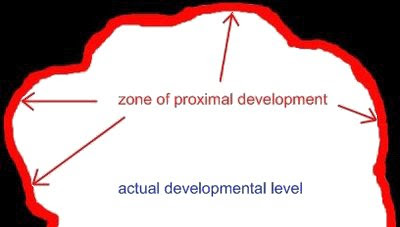
Rather than ‘development’ laying down a series of identifiable zones, as shown above, learning is more a broad frontier that advances progressively. The zone of proximal development at the periphery of the actual development level has a depth according to the level of potential development.

Zone of Proximal Development
“What is in the zone of proximal development today will be the actual developmental level tomorrow”.


Ka kite anō – Catch ya later

Saturday, November 15, 2008

Thinkers, Scientists or Mechanics

Kia ora tātou - Hello everyone
A map of brain activity according to TypealyzerMy brain activity while I write this post - according to Typealyzer.

Bloggers are generally categorised as thinkers, scientists or mechanics. That’s the conclusion I might have come up with when I decided to find out more about how Typealyzer categorises blog sites listed in my RSS Reader.

Michele Martin, Stephen Downes, Amy Gahran, and others wrote posts on the latest Web2.0 download for performing a Myers-Briggs analysis from a blog address. Stephen declared (I think with tongue in cheek), “The fact that my site turns out to be INTJ - exactly as I test consistently on the Myers-Briggs tests - is coincidence. Right?”

Data validity:


The inference is that data from a blog site can be used to determine the personality of the writer. Hmmm. This could have implications to do with data validity, if a blog site was used to categorise the person who writes posts on it.

I decided to do a bit more exploring. What I found gave me food for thought. By the way, the Typealyzer put my blog site in “The Thinkers” category. The picture above is supposed to be my brain activity while I write this post.

Anyone who has visited my blog and inspected my blog roll will be familiar with some of the bloggers whose names I list here. Yes. You’ve probably already worked out what I did.

Site analysis:

I went through the list of blog sites in my RSS Reader. I took each site and pasted its address into Typealyzer. It didn’t take long. A few sites incurred errors for one reason or another and couldn’t yield any data. There were other sites I visit less often that I left out of this study.

Apart from Mathew Needleman, whose site yielded “ISTJ The Duty Fulfillers”, here are the sites listed according to the names of the bloggers associated with them. I have deliberately listed their names in some sort of random order.

A table of blogger's names arranged according to Typealyzer analysisAdmittedly, this analysis is entirely anecdotal. The sites were certainly not chosen at random for they are all selected from my RSS Reader.

What could it all mean?


I mused over the results. The most prevalent sites were the INTJ and INTP types. Of all the least likely personality types I’d meet in a crowd of 100 people, the INTJ and INTP would be among them (according to Myers-Briggs USA inferential statistics). In fact, together they would represent just over 5%. That’s 5 people, in a room of a random sample of 100!

I also wondered about the sheer lack of IS types other than the mechanics who seemed to be almost as prevalent as those in the two other groups. If they'd followed statistics, however, the mechanics should have been more numerous.

My selection?


I recalled Michele Martin’s posts on homophily and wondered if it was something to do with my choice of blog sites. Have I been unconsciously selecting blog sites according to their 'personality'?

Or is Typealyzer not really doing a valid analysis? Stephen Downes’ and Michele Martin’s evidence, in support of Typealyzer’s accuracy, seems compellingly convincing. Using USA inferential statistics, their claimed personality types are among only 2.1% of the population. Yet the group they are in is the largest group listed in my table. There are 13 other group types not listed here because I simply didn't find any more. Where are they all?

All sites in my blog roll are written by bloggers who have an interest in training or education. Could this be a factor, an artefact of how they are selected, that has put them into these exclusive groups?

One last thought. I was introduced to Amy Gahran’s site through Stephen Downes’ post. She found that her site returned “ENTP The Visionaries”. When I entered her site address on Typealyzer, the return was “ESTJ The Guardians”.

I wonder if I was holding my mouth right.

( 2 ) << - related posts

Haere rā - Farewell