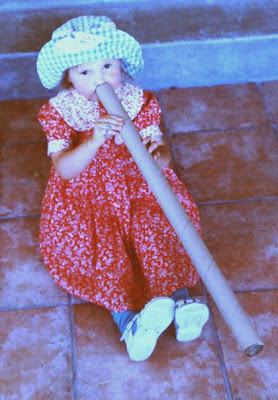
When Catriona was very little, she found comfort in a little bag of sweets. She rarely ate them, but would find pleasure in knowing they were there. She'd pick one from the bag, suck on it for a few seconds, then replace it, in the knowledge that she liked that sweet and could return to it for a suck later on. She did that with all her sweets, discarding the ones she didn’t like.
One of Tony Karrer’s 100 conversation topics is Ways that my children are learning that is significantly different from how I learn. This posts is about Tony’s topic number 25.
Have you ever been confronted with a technology and didn’t know how to use it? Y’know, the situation where you need to use the darned equipment but never had the opportunity to learn how to, and there’s no one around to show you. Now! When you’re desperate to use it!
It'll go bang! I find this happens to me a lot. I have to jolt myself into action to do some exploring, maybe push a button here or click a link there – tap the keyboard to see if anything changes. I have to push aside my fear that the screen might explode, or that smoke may come gushing out of the computer. I fidget and look around to see if anyone’s watching.
This is a fear that I’ve always had when trying out new things. I realise that it’s my fear of computers that drove me to want to find out more about them. They are fascinating things, computers. Too fascinating to leave alone, and yet too mysterious not to excite my fear that I might get pounced on if I play with them.
Perhaps it’s something to do with my upbringing in an age when technology was rich in contraptions. The Billy Connolly line, “You’ll poke your eye out with that!” doesn’t seem inappropriate.
“Leave it alone! You don’t know what you’re doing! You’ll break it!” These are all demon voices that shout from the past at me, when I venture to explore somewhere I’ve never been before at the computer. “You’ll go blind!”
Habits die hard:
I recall when I was teaching young typists to use what we called word processors, way back in the late 80s. These women were fascinatingly slick at typing - on typewriters. Yet they could not get their heads round the idea that the Enter key (labelled Return key then, funny enough) didn’t have to be tapped when you got to the end of the line, or that typos didn’t need correcting as you typed them.
I had a great time unteaching these young minds about all their habits. It was a lot of fun. It taught me that humans are creatures of routine. We follow practices and cultures, unquestionably. We become so committed to them that we’ll argue the point when someone suggests we shouldn't follow habit.
I introduced the typists to what I called the suck-it-and-see approach to finding things out on the computer and was met with looks of horror. "We would never do that," came the affirmation.
Across the barriers:
Young minds always catch me out with their direct thinking. And I’m not alone in this. Last year at the NetSafe Conference 2008, I listened to a presenter tell her story of a survey that had been constructed to fathom the practice and thinking of teenagers.
She told of a 14 year old girl who was asked the survey question, “Would you swap a blow-job for a mobile phone?” The girl immediately replied, “What sort of a mobile phone?” The thinking transcends the barriers – obviously!
I just found it!
I watch my kids with a new remote or computer game. It mesmerises me to observe the way they work. How is it, for instance, that with all the years of tuition, enquiry and practice I’ve had using PhotoShop, that my teenage daughter will find things on the application, within minutes, that I’ve never seen before?
I’d ask her, “Who showed you how to do that?” She would reply, almost insolently, “No one - I just found it.” She would have found it using the suck-it-and-see approach. But she would have had no inhibitions about ‘sucking’ to find out. Suck it and see:
Here's an exercise. The next time you are using a new application, or one that you're not too familiar with, lay aside half an hour to check out the menus. Most apps, like Word 2007 for instance, are quite extensive, but half an hour spent checking out the menus on a blank file can pay dividend.
If nothing else, it can help you learn the layout of the menus. With any luck, you'll pick up a thing or two about how to do things that otherwise would lie hidden, never to be found, till a teenage child - son, daughter or student - stumbles across it in minutes while fiddling around.
I don’t honestly think that this approach is anything new. In fact, I’d say that it is a natural fun way of finding out and learning. My feeling is that the baby-boomer learners, like myself, may carry baggage unwittingly, that inhibits them from using the suck-it-and-see approach as a first measure in learning.
Malcolm Gladwell’s Outliers has brought about an outpouring of interesting reviews. Some are lucid, some are not so; some are supportive and some are emotional. Some show distrust for the claims he makes.I wonder why there is such emotional feeling in so many of the reviews I’ve recently come across. The 10,000-hour principle is one particular aspect that seems to be taking a bit of a thump from some reviewers.
Yet the evidence Gladwell provides, and let’s not deny it, the past support for this not-new principle clearly points to its validity.
It’s true that Gladwell is making some sweeping statements in his book, but his arguments are compelling. It’s also true that if someone goes looking for evidence to refute any of Gladwell’s claims they are sure to find it (Goethe).
Looking for evidence:
As I read through Outliers, I found myself looking for evidence for and against too, and why shouldn’t I? From my own knowledge and experience, most of what Gladwell alleges about expert ability in musicianship alone seems to stack up.
But one has to take care when considering exactly what is meant by an ‘expert’; I will discuss one piece of evidence I found in support of this.Virtuoso violinist, Yehudi Menuhin was undoubtedly an expert on his instrument. I choose Menuhin because Gladwell does not mention him anywhere in Outliers.
A quota of hours:
Menuhin began to play the violin when he was 3 years old. He reached expert status perhaps before the age of 13, and continued to practice, perform and teach in the realm of the expert till near the end of the twentieth century. There was plenty of time between the age of 3 and 13 for Menuhin to have put in his requisite quota of hours to become one of the 10,000-hour experts.
Yet when I looked about for evidence of his inexpertness on the violin, it was not hard to find, even within his mature years as a world-class violinist. I had already recalled an interview I’d seen on TV when Menuhin admitted that the techniques required to play Scottish fiddle music were beyond him. These techniques applied especially to his expertise with the violin bow.
Recently, I’d also found a YouTube video where Menuhin admitted that he could not improvise while playing jazz and swing alongside Stéphane Grappelli - that Grappelli had to write the music for Menuhin to follow so they could perform together.
Yet Menuhin could improvise on his violin, there is no doubt about this. Improvising is part of the classical ‘training’ that all violinists go through sooner or later. He simply could not improvise in jazz and swing music. For as close as jazz music is to classical, the genres are significantly far removed from each other to compromise Menuhin’s expertise.
Clearly, the term ‘expert’, in the context of Outliers, has to be well defined before a cogent discussion can eventuate the pros and cons of the principles involved within the discipline of the expert.
Cooperation, collaboration and the common good:
Let me state here that in no way do I write this as a criticism of Menuhin’s talent as a musician or performer. I have admired his supreme musicianship since I was a child. I also feel that it says a lot for how Menuhin was as a person, that he came clean about his own deficiencies as a violinist. Few expert musicians would be so openly honest about their expertise on their own instrument.
Menuhin was willing to cooperate and work with his fellow expert musicians, in all aspects of their interests, their craft, their various instruments and musical disciplines. This is one message that I took from Outliers, that a successful society has to be built on collaboration for the common good, not just for the privileged or the elite.
It’s a Scottish tradition to tidy the home before New Year comes in. At the end of last year, I decided to follow this tradition on my blog. Come Hogmanay, otherwise known as Auld Year’s Nicht in Scotland, I’d tidied up newmiddle-earth.blogspot.com.
I brought all my post-labels up to date and created new ones that were relevant to topics covered in each post.
I updated the alt attributes on each image tag and removed the link-to-image that’s automatically added when it's uploaded into Blogger. Some months ago, I started taking these measures with all new postings.
I’d learnt that this provision was courtesy to the visually impaired who may choose to use a speaking browser - otherwise known as a screen reader (incidentally, I also removed Odiogo last year for I found it did not provide a significant advantage).
I checked links on all posts dated after 1 June 2008 to ensure that they were still active and relevant. There were some webs that had actually changed (their content was no longer relevant).
I found alternatives for the few that were in this group. There were others that simply didn’t work any more. I either found alternative sites to link to or I removed the offending links.
I’m used to using a link-checker on my work web at TCS. Incidentally, the entire TCS site is down at the time I write this post and has been since before the New Year. Consequently, none of the links on several of my resources posts work at the moment. Sooner or later someone will rectify this at TCS and all will come right – I hope.
No apparent luxury:
I do not have the luxury of a link-checker for my site in Blogger. I use the ‘check links’ facility in DreamWeaver on my development web site at work, but I can’t run my blog site through it. I’ve searched Google several times over the months and not found any quick link-checkers for blog sites. Latterly, I began to wonder how other bloggers checked the links in their archived posts.
I have 131 posts dated 2008 on my blog. Most have at least one link to another site. It may be to a blog site or a web page. In a few more months, I’m going to have a sizable lot of posts to look after, and a corresponding set of links to maintain.
It’s dead Jim:
There is nothing I find more disappointing, when following a link on someone’s post that looks like an interesting lead, than getting the dreaded ERROR 404 or other such ‘Web-site Not Found’ notice.
Web links have a half-life. They don’t necessarily last forever. Some break altogether, which means the unfortunate reader goes nowhere on click. It could be that the linked site doesn’t exist anymore, or that it’s been relocated, with no provision for redirection.
It could also be that the site has gone down, and that the fault may be rectified in the near future. I’ve found it pays to wait a bit before revising a dead link if it’s to a site that I can trust.
There’s life Jim, but not as we know it:
Sometimes the content on a site changes. As a result, the site may no longer be relevant to the context of the link in my post. While this rarely happens with links to blog posts, it is not an uncommon problem where links to web pages are used.
The need for vigilance in this regard is paramount when web links are used in elearning modules. Though the performance of the links on my blog is not as critical as this, it can be regarded by visitors as a reflection of my blog.
What is good practice?
When I find that links are faulty on my blog posts or web pages, I fix them by finding alternative relevant sites or remove the offending links in courtesy to my readers.
Am I being too fastidious in bringing old posts up to date? Does it really matter if old links don’t work anymore?
How do you check for broken links on your blog posts?
Have you ever thought of what it would be like to look up at the night sky and see, among thousands of brilliant stars, Herschel’s Jewel Box, or the beautiful Hercules star cluster?
This is the International Year of Astronomy.There is fascinating activity in an area of land in New Zealand, known as MacKenzie Country. Very little smoke or other pollutants rise to the sky from its less than 2000 inhabitants, so cloudless nights are abundantly rich in starlight.
Jet streams - high-altitude, high-speed wind currents - usually flow from the west at high speeds in the upper atmosphere and can spoil the view of the night sky. But there's no significant turbulence in the air above MacKenzie Country, for there is no jet stream near enough.
For these reasons, MacKenzie Country is tipped to host the first world heritage site in the sky.
Graeme Murray is the director of Earth and Sky Ltd, which has exclusive tourist rights at the Mt John Observatory, a main centre for astronomy research in New Zealand.
Murray’s dream is to establish a World Heritage Starlight Reserve in the MacKenzie Country by obtaining recognition and protection for sky in the region from the United Nations Educational, Scientific and Cultural Organisation (UNESCO).
My hopes and predictions for 2009 are few and simple.
I predict that the solid-state memory chip will be the biggest most influential factor in developments in 2009. It will pave the way for the revolution yet to come with the introduction of the graphene chip in the years before 2012. What broadband did for Internet use, the graphene chip will do for the proliferation of hand-held devices, but that is a year or so off yet.
Connectivity will be better that ever before simply because of the extra memory space permitting the whole caboodle, platform/operating system, to be downloaded with the software.Mash-ups will be the way to go, and used more than ever before and for similar reasons.
The ebook will further develop, expanded by the possibilities unleashed by the extra memory space permitted by the new and developing massive memory chips that are now available.
Social networking will continue to become more popular and the increasing popularity of the hand-held device to access the Internet will permit the use of social networking to burgeon. I suspect that the cellular networks and associated services will require major upgrading to cope with the huge increases in the use of the hand-held device.
Hopes for 2009:
Malcolm Gladwell’s 'Outliers' points the finger clearly at the worth and origin of the real expert. My hopes are that society will embrace the recent studies and understandings that have come to light about the worth of expertise – true expertise, not so-called expertise that’s adopted on a whim.
The skills and knowledge that come with true expertise will once again be recognised as an essential attribute for societal progress. The usefulness of content, that has been shaken almost off its foundation in the past decade, will once again be recognised in education.
There will be less sabre rattling about what is learnt from printed books and the like. Digitising text from existing printed books will continue and there will be (more) digital books written that will remain digital - those will not be available in bound printed form.
The digital novel will write the introduction of a new era.






 Posts


