This week I was introduced to the beta version of an elearning application I thought I was familiar with and that I’d been using for the past 6 months. I’ve seen one minor upgrade in that time.
Beta is one of the stages of development in software release cycles when the application is made freely available to users, well before the general release date. This practice allows software developers to gather general feedback on design layout and functionality. It also assists with the detection and monitoring of otherwise unknown faults.
I prided myself on my competence in using the generally available interface (not the beta). I thought I was at least as capable using it as I am in using many other applications on my PC. But I felt like a newbie when I attempted to use the beta release, even when I appreciated that there were evident improvements compared to the accustomed version.
This scenario is not uncommon. I often find that my apparent expertise on a computer disappears. And it’s not failing memory either. It can happen overnight when a new application version is installed or a so-called upgrade is made.
Give and take
I concede there has to be a balance between the need for a more attractive interface to impress new users who may otherwise be put off with what may appear to be a less attractive interface, and the necessity for regular users, familiar with features and layout of an application, to be able to utilise the new environment with relative ease.
But experienced users have the knowledge of functionality and feature. Though they may not know where to find these on the latest version of an interface, they will know to look for them. I feel grateful when I have this knowledge.
When I go looking for a feature or function, the prior knowledge that such a feature or function exists in the old version spurs me on to keep looking for it. I always hope that it hasn’t been listed with other, perhaps unrelated options or features to do with a different functionality.
What's given
Take the introduction of Word 2007, for instance. My expertise with a word processing application literally became virtual when I began working with Word 2007. It took me several weeks of use before I felt reasonably comfortable using the menus on the new release.
Even now, there are some functions I know must exist in that application that I can’t find – even using the help menus. How do I know they exist? From my knowledge of feature and functionality my experienced use of past Word versions has given me, of course.
What’s more, I had to find out that the Word 2007 default .docx files that could then be created on my PC were unlikely to be readable by others when I sent them as attachments. So a whole functionality, new to me and many of my colleagues, had to be sidestepped in order to achieve necessary connectivity, despite that functionality being given in the default file type.
It’s one of the vagaries of change. Despite the best intentions, things will evolve that aren’t necessarily helpful or useful.
What's taken
In future, the watchword is concept not know-how. The future expert is one who can take forward the conceptual framework of ideas, features and functionality and look for their equivalents in new circumstances.
The successful future machine, application or interface is one that can mirror these ideas, features and functionality in a way that permits them to be found intuitively by the expert.
This week I was privileged to see Scott Flansburg in action. He visited TCS and entertained a huge audience of staff while demonstrating his calculative ability.
He began with a few warm-up activities. How quickly can you add up a set of four two-digit numbers? Try this: A human calculator
Scott can give you the answer to the above sum quicker than you can read the first number. He can do complicated calculations, with huge numbers, that would challenge anything you, I or an expert accountant could do with a calculator.
He calculates at lightning speed and very rarely makes a mistake. And he’s proved it. He holds the world record for mental calculating.
Scott is an ordinary guy with extraordinary mental abilities. No slouch, he uses his smooth, motivational manner and enthusiasm for numbers – mathletics he calls it – to inspire and motivate young learners. At the moment he is touring schools in New Zealand doing just that.
Young mathletes
Fascinating his audiences by demonstrating patterns in numbers and in the properties and qualities of the array of single digits 0 through to 9, he is number crunching his way across the world, engaging young learners in taking an interest in Mathematics. He believes that there is nothing necessarily unique in the way his mind works – anyone can learn to use their mind the way he does. What makes Scott different from you or me? He explained a few of the differences in the ways he thinks when calculating. Basically he doesn’t use the memorised routines that are normally part of mental arithmetic. Times tables and addition tables assist us till situations arise where the tables run out. Beyond those, we resort to cumbersome hierarchical computational processes.
Memorising is limiting
Scott says that using memory in the traditional way for doing these manipulations is severely limiting. The ‘carrying figure’ and all that’s associated with it when adding lists of numbers is another aspect that Scott thinks slows you down. This is mainly to do with speed, accuracy and the way the mind works. With adding figures, he advocates toting columns of digits from the top. Starting from the left-hand column and moving right is more facile than the traditional right-column-first approach.
His ability is not unique, but his prowess of speed and accuracy puts him in a distinct position among many who demonstrate similar mental capabilities. Effortless
Plainly, Scott demonstrates the power of the brain to perform seemingly impossible and colossal computational activities, almost effortlessly, if used in special ways. And guess what - he doesn't multi-task when he's calculating! If there is a metaphor, I suggest the speed, agility and accuracy of the touch-typist who looks neither at the screen nor the keyboard, against the two-finger typist who looks down searching for the letters and aiming at the keys – that would be the level of my mental arithmetic.
I find it intriguing how blogging brings opportunities to think and learn but not always in an expected way. There is a collegiality that impinges on my thinking, how I learn and what I do.
While a lot of it is to do with blogging, it certainly isn’t limited to that practice. I was reminded of this diversity on receipt of a reply to an email, from my blogger colleague and friend, Tony Karrer, who aptly moved from the peripheral to the relevant in saying:
"On a different note - any thoughts on how deliberative practice relates to becoming something less than an expert. It seems like it should be applicable to all levels of achievement, but everything I'm reading is the study of becoming an expert. Is that just aspirational, or is deliberative practice also studied for quick attainment of proficiency?"
I assume that by ‘something less than an expert’, Tony means the level of competency that is needed by someone to perform a particular task properly – he uses the word ‘proficiency’.
While I tend to agree with Tony that the emphasis in many studies to do with learning / training / attaining proficiency seems to be prescriptive towards becoming an expert, I wonder if it is the true intent of these studies.
I suspect that the widespread and imprecise use of the word ‘expert’ has caused some erosion of its original meaning. Being highly proficient in tasks that are effected in doing a job properly does not mean being an expert. Nor does it necessarily have to lead to attaining that level of expertise. It’s all according to where the benchmarks lie for ‘proficient’ and for ‘expert’.
Expertise is harder to achieve
With the advancement of technology and associated practices, it is becoming increasingly more difficult for expertise to reach expert level. The matter of change, which can arrive every 6 months to a year, or even more frequently in technology, will limit the efficiency of any aspiring expert in reaching true expert level.
Changes in technology bring changes in business procedures. So the ‘expert’ is more likely to become someone who keeps pace with the latest updates rather than someone who, as in the past, truly reaches an expert level with knowledge of, application of and proficiency in the associated skills to do with these tasks. My impression is that there are fewer true experts in the workplace today than there were even 10 years ago.
Collateral damage
Printed manuals, or online help, designed to provide knowledge and give pointers on procedural skills cannot keep pace with these changes, so it becomes even more difficult for the aspiring ‘expert’ to reach a desired level of achievement. What come as a result of this are beliefs associated with the cheapened worth of any textual instruction, any information held in text in fact, be it printed or digitally accessible on a screen – part of the collateral damage that accompanies change.
Confidence and assertiveness, when together, are sometimes mistaken for competence and even higher levels of expertise. Experienced classroom teachers are familiar with the vagaries of confidence and assertiveness of young learners when it comes to acquiring expertise. The same unfortunate combination can often lead to lesser 'experts' among those who should have reached higher levels of achievement. Expert cover up
But what is even more unfortunate is that confidence and assertiveness are often developed as a cover for lack of expertise. It’s when the so-called expert has more confidence and assertiveness than expertise that incompetence tends to persist, and may even be fostered in the workplace.
However, quick attainment of proficiency is not fictitious. There are a number of strategies that can be used to permit this to happen. They're not new and they’re not rocket science:
identify the required base-knowledge/skills, foster strategies for these to be recognised as key, and provide avenues for their appropriate acquisition and practice
cull redundant and/or recursive procedures or procedural loops in workplace routines
provide incentive for revisiting and refining/updating key knowledge/skills/procedures (used to be called ‘training’) to clarify current understanding
foster a culture where its acceptable to ask questions to do with key knowledge/skills/procedures - in other words, it's OK not to be an expert.
The belief that working in teams makes us more creative and productive is so widespread that when faced with a challenging new task, leaders are quick to assume that teams are the best way to get the job done . . .
. . . Contrary to conventional wisdom, teams may be your worst option for tackling a challenging task. Problems with coordination, motivation, and competition can badly damage team performance. Even the best leaders can’t make a team deliver great results. But you can increase the likelihood of success—by setting the right conditions. – Harvard Business Review May 2009.
I stumbled across the article Why Teams Don't Work by Daine Courtu. Having been a coach, team-teacher, team-leader and also team member in many successful (and some unsuccessful) teams, I immediately pounced on the pages and scanned the content.
Courtu interviews J. Richard Hackman, Edgar Pierce Professor of Social and Organisational Psychology at Harvard University, and author of the book, Leading Teams.
Hackman, a notable expert on teams with a lifetime of experience in studying and working with teams, has an authoritative opinion that makes a lot of sense to me. He comes over as a straight thinker who cuts to the chase when it comes to matters about the worth of teams.
Hackman’s stance is that teams can generate magic (didn’t we always believe that?) though we shouldn’t always count on every spell working the way we’d like. In his book Leading Teams, Hackman rationalises five critical conditions governing the balance between success and failure:
"Teams must be real. People have to know who is on the team and who is not. It’s the leader’s job to make that clear.
Teams need a compelling direction. Members need to know, and agree on, what they’re supposed to be doing together. Unless a leader articulates a clear direction, there is a real risk that different members will pursue different agendas.
Teams need enabling structures. Teams that have poorly designed tasks, the wrong number or mix of members, or fuzzy or unenforced norms of conduct invariably get into trouble.
Teams need a supportive organisation. The organisational context – including the reward system, the human resource system, and the information system – must facilitate teamwork.
Teams need expert coaching. Most executive coaches focus on individual performance, which does not significantly improve teamwork. Teams need coaching as a group in team processes – especially at the beginning, midpoint and end of a team project.”
Aaaaaaah!I’ve just deleted the Recycle Bin from my Desktop!
My PC runs Vista. Unlike other versions of Windows, Vista has a pull-down list on the Recycle Bin with a Deleteoption as well as the Empty Recycle Bin option. If Delete is chosen, the Recycle Bin isn’t emptied – it is removed from the Desktop!
Fortunately, the Recycle Bin is not actually deleted, but the path to restoring it, although easy to follow, is not easy to find.
The first time I deleted it was traumatic but I found a tip on Google. There are millions on the Vista Recycle Bin!
It was only when it happened again that I realised that I hadn’t followed the advice I give to my students and colleagues on learning and practice. So the second time I had to do the Google search I made a careful mental note of the steps needed, and also to come back and check I could still remember them before I logged off.
Teachers today require a high level of ICT competency, in addition to their understanding of subject knowledge, pedagogy and teaching practice. But the 21st Century teacher doesn’t need much more in the way of basic ICT skills than a late 20th Century teacher did. Certainly keeping up with the latest ICT developments and updates is a part, but then, isn’t that always the case in ICT?
The need is for a clear pathway for the learner to apply the learning once delivered, by whatever means – conversation, professional development program, whether on-the-job or in a formal training class.
Cognitive apprenticeship
It is embraced in the so-called cognitive apprentice theory that experts in a skill often don’t consider hidden processes involved in carrying out complex skills when they are teaching/instructing newcomers.
Situated professional development programs can be used to make this happen, instead of defining a prescription for particular technology competencies that learners must have and be able to use.
Often, learners have difficulty learning raw content. They may not be able to see exactly how raw know-how can be applied as it may have no relevance to them at the time and so they don't learn and remember.
Situated learning that grounds learning experiences in the learner’s own practice may well be more successful and a situated professional development technology program can serve the needs of the learners’ specific technology within their own learning environment.
But learners can do a lot of this for themselves. Practice and metacognition
Whatever skill/knowledge/concept the learner has first learnt should be practiced soon as - the same day. This means that any training that is given should take into account the opportunity the learner may have to practice the same day and try out their newly acquired skill.
Mini projects that can be used by the learner after learning sessions always helps with this. This also applies to an on-the-job conversation where the learner picks up a tip or piece of advice that may well be useful to them in the future.
Learning to write little reminders when first shown something and then to practice it immediately afterwards is paramount to putting what's learnt into use and maintaining it. It is in the category of what’s called metacognition.
The mantra is learn and practice soon as.
As well, last thing on a Friday is a no-no for training/learning simply because of this whole principle of practice soon as. You can say ta-ta to what you're shown last thing on a Friday by the time Monday arrives. You rarely consolidate what you’ve learnt over the weekend!
When a helpful IT technician comes to show me how to do something on my PC on a Friday, I always say, “Can you show me on Monday? I’ll send you an email - I'll come round and you can show me then.” Then I send the email AND cc it to myself.
I recall some years ago getting computer training on the last days of the year! Forget it! I may as well have! Three tiers of technology competency
Acquiring technology competency has at least three components to it. They are to do with concept(c), training (t) and practice(p). Take knowing where to find the ‘attach and email’ function for instance.
The know-how to use the ‘attach and email’ function in Word 2007 comes with a bit of t & p and the end result is swifter and less cumbersome than other methods. But the ‘concept’ that a newly created Word document can be attached immediately to an email, and that the email application is invoked automatically while this process is being brought into effect is more than mere t & p.
The learner who has never met this idea is very unlikely to think of looking for the function on any new version of a computer application in order to use it. Thankfully in most instances the c comes with t & p but not always.
It’s not all just learning how to. My feeling is that there are at least 3 tiers of competency in any set of related skills:
concept - such as Send to Mail Recipient as Attachment (just get your head round the c idea)
knowledge that a function exists on the application/program used (t but also needs c),
knowing how to use it on a specific app/program (c and t & p).
You'll notice that practice always comes last but is no less important.
Remember the mantra? Learn and practice soon as(SNAP!)
Malcolm Gladwell’s Outliers has brought about an outpouring of interesting reviews. Some are lucid, some are not so; some are supportive and some are emotional. Some show distrust for the claims he makes.I wonder why there is such emotional feeling in so many of the reviews I’ve recently come across. The 10,000-hour principle is one particular aspect that seems to be taking a bit of a thump from some reviewers.
Yet the evidence Gladwell provides, and let’s not deny it, the past support for this not-new principle clearly points to its validity.
It’s true that Gladwell is making some sweeping statements in his book, but his arguments are compelling. It’s also true that if someone goes looking for evidence to refute any of Gladwell’s claims they are sure to find it (Goethe).
Looking for evidence:
As I read through Outliers, I found myself looking for evidence for and against too, and why shouldn’t I? From my own knowledge and experience, most of what Gladwell alleges about expert ability in musicianship alone seems to stack up.
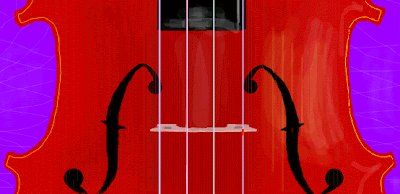
But one has to take care when considering exactly what is meant by an ‘expert’; I will discuss one piece of evidence I found in support of this.Virtuoso violinist, Yehudi Menuhin was undoubtedly an expert on his instrument. I choose Menuhin because Gladwell does not mention him anywhere in Outliers.
A quota of hours:
Menuhin began to play the violin when he was 3 years old. He reached expert status perhaps before the age of 13, and continued to practice, perform and teach in the realm of the expert till near the end of the twentieth century. There was plenty of time between the age of 3 and 13 for Menuhin to have put in his requisite quota of hours to become one of the 10,000-hour experts.
Yet when I looked about for evidence of his inexpertness on the violin, it was not hard to find, even within his mature years as a world-class violinist. I had already recalled an interview I’d seen on TV when Menuhin admitted that the techniques required to play Scottish fiddle music were beyond him. These techniques applied especially to his expertise with the violin bow.
Recently, I’d also found a YouTube video where Menuhin admitted that he could not improvise while playing jazz and swing alongside Stéphane Grappelli - that Grappelli had to write the music for Menuhin to follow so they could perform together.
Yet Menuhin could improvise on his violin, there is no doubt about this. Improvising is part of the classical ‘training’ that all violinists go through sooner or later. He simply could not improvise in jazz and swing music. For as close as jazz music is to classical, the genres are significantly far removed from each other to compromise Menuhin’s expertise.
Clearly, the term ‘expert’, in the context of Outliers, has to be well defined before a cogent discussion can eventuate the pros and cons of the principles involved within the discipline of the expert.
Cooperation, collaboration and the common good:
Let me state here that in no way do I write this as a criticism of Menuhin’s talent as a musician or performer. I have admired his supreme musicianship since I was a child. I also feel that it says a lot for how Menuhin was as a person, that he came clean about his own deficiencies as a violinist. Few expert musicians would be so openly honest about their expertise on their own instrument.
Menuhin was willing to cooperate and work with his fellow expert musicians, in all aspects of their interests, their craft, their various instruments and musical disciplines. This is one message that I took from Outliers, that a successful society has to be built on collaboration for the common good, not just for the privileged or the elite.










 Posts
Posts


