Showing posts with label reading. Show all posts

Monday, February 1, 2010

Standards, Statistics and Steps Forward

Kia ora tātou – Hello Everyone
Roundabout in Jabberwocky
It looks like John Hattie’s words of wisdom may well have been said in vain. Implementation of the New Zealand National Standards for primary and intermediate school pupils starts today.

School boards and principals are not convinced that there is much to be gained by applying the standards. They have numerous reasons for their beliefs. Many school boards are planning to boycott their use, which would be illegal.

Nevertheless, government approval has been given for the campaign to persuade communities and school boards of the usefulness of the standards, at an estimated cost of $26,000,000NZ.

The pros and cons

I listen to the arguments that abound in the national news, buzzing with the debate between the parties in favour of using standards and those against. Some politicians who were originally in favour of the standards are now arguing against them. I’m amused at what I hear.

Here’s an example. There is argument of dismay expressed about the 25% of children in New Zealand who are well below average in literacy abilities, an average which was no doubt considered when setting the literacy standards in the first place. The argument is that the introduction of standards will help those in that well-below-average group.

I wonder if some of the contributors to that argument can understand what a distribution is, and the significance of an average based on that same distribution. Misguided use of statistics, even by authorities, is not unknown in disciplines other than education.

People statistics

In the late eighties, the Plunket movement was very enthusiastic, as it is today. Mothers with newborn children can choose to be visited by a Plunket nurse who administers advice when needed and who makes regular checks to record the development of children under their care.

I knew a young family back then. Murray and Pauline who is a nurse, had a beautiful bouncing baby daughter. Both Pauline and her husband were petite people of delicate build and stature. At birth, Elizabeth was a small baby. The presiding doctors agreed she was normal for her birth weight. She was a healthy child who developed well in all respects.
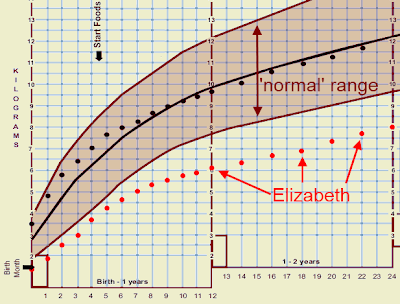

Child Development Chart

One day I walked round to see the family only to find Pauline quite upset. She’d just had a visit from the Plunket nurse who’d said that Elizabeth was well below average in both size and weight. Pauline had been told that she should ensure Elizabeth was given the food required to lift her weight into the ‘normal’ range.

Pauline felt insulted and annoyed. Her reasoning was implicit. A petite newborn from parents of small stature would be expected to grow into a petite child, and subsequently mature to a petite adult. Over the years we found that was exactly what happened.

Furthermore, Elizabeth’s potential to maintain this has been with her since birth. It comes down to the difference between body size and body development. These measurable quantities are not the same.

The Plunket movement in New Zealand do a deal of good work in monitoring and caring for the health and welfare of the very young from birth. But the interpretation
of the growth chart by the nurse indicated that Elizabeth’s data was being clearly misunderstood.

Academic parallel

There is a parallel in the academic progress of children who are developing normally. That’s not to say that a child who is below what’s considered ‘average’ at an early age won’t continue to develop to have useful and perhaps even above average abilities in the future.
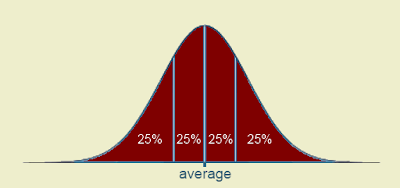

Bell Curve

But there is always going to be 25% of children who are well below average in literacy ability. Any standard based on what is expected of an ‘average’ child will indicate this when applied to a fair and random sampling from a nation’s children.

I applaud the arguments that are saying let’s improve the nation’s academic achievement through good teaching. Forget about assessment of the child at early stages as a comparison with what’s considered ‘average’. Let’s look towards progress and development in the child.

My hunch is that the introduction of standards will not bring about an understanding of what is good to look for in child development in literacy, numeracy or any other ability. Instead, it is likely to serve as a measuring stick for a whole range of things unrelated to child development.


Haere rā – Farewell

Saturday, August 15, 2009

The Un-trivial Story

Tēnā koutou katoa – Greetings to you all
Māui and his brothersDesign from the Māori fable of Māui and his brothers taming the sun
The Marae, Te Papa Museum of New Zealand

    Novelists and playwrights are done without it.
    The success of the film industry depends on it.
    Folklore is embedded in its construction.
    It is the basis for substantive contributions to world poetry.

    The Old Testament is so graced with it there is not a page
    in that book where it is absent.

    Its might is well known and celebrated by educators,
    instructors and coaches of all disciplines and in all cultures.

    It is the fascination of children, the bread and butter of
    storytellers, the potion used by keynote speakers
    and even the magic pill of bloggers.

Yet in an age when change is the watchword, the modest story remains steadfast and unvarying in its ability to capture the attention of people of all ages and in all walks of life. The conundrum is that it should be so commonplace and yet so potent.

How can this simple device still be so assiduously engaging?

Captivating

At a recent meeting I attended, the guest speaker
made an inelegant approach to the topic, was inept at choosing words appropriately and had a tendency to ramble. What saved the too long speech and made it memorable was a story told near the close of its delivery. I watched, fascinated as people moved from angles of repose to more attentive postures.

Designers of adverts use its arousing magic in a similar way to the speech-maker. Executed well in the manipulative exploit of advertising, it can result in awards being won, and not just for sales statistics.

Relevance

No other teaching device can bring context so uncontrivedly and adroitly to a teaching moment as the story. Whether written, narrated or depicted in scenes in a video, it has the knack of introducing a packet of learning incognito.

Through the conduit of the story, the whole of Māori folklore has been passed down to us by word of mouth, as were the traditional beliefs expressed in stories and songs of many other cultures.

Interest


There is an innate tendency in everyone to follow the passage of a story. The successes of the publishing and film industries are testimony to that, individually and jointly. What senses-able child in western society today does not know of Harry Potter?

For as much as adventure-games appear to captivate and engage participants with the matrix of the game, it is the unfolding escapade that captures the interest of players. They create and experience their own stories within the contexts of their games.

At the start of this century, my wife, Linda, learnt of the Sid Meier’s computer adventure-game Civilization III. Despite my total disinterest in adventure games at the time, she enticed me to partner her while she played out her first game. We chose to be joint advisors in building a British civilization ruled by Queen Elizabeth.

Being new to the rules and capabilities of CIV III, we had to learn a lot to help our growing civilization to survive. And did we learn a lot!

After a long struggle, successfully avoiding conflict after conflict, we won a cultural victory, according to the rules of CIV III, in building a virtual civilization on a resource-rich land-locked virtual continent. For as much as we have played the game since then, perhaps hundreds of times, we can still remember the thrill of our first CIV III adventure.

Imagination

My daughter, Catriona, is as familiar with ice-cream as she is with the Eye of Sauron in the
Lord of the Rings movie trilogy directed by Peter Jackson.

She was just 12 years old when she first took an avid interest in all that The Rings had to offer. Catriona saw the films and then read the trilogy by J R R Tolkien a year or so later. When I discussed the nature of the Eye of Sauron with her, I was astonished at what she knew.

“It’s not the same in the films as in the books”, she told me. She explained that the film depicted the Eye of Sauron held in a tower, but in the book it was like the eye of a spirit that was seemingly ubiquitous.

Catriona read Tolkien only after having seen the films many times over. Yet the image of the Eye of Sauron as depicted in the film did not interfere with her ability to imagine quite a different concept of it as read from the book.

This experience showed me how able Catriona was at discerning a screen depiction from its counterpart in the original novel. But it was also proof of the power of the written story to excite the imagination, even in the wake of a different mental image laid down by a series of scenes in a movie.

Memorable

I first learnt of Winnie-the-Pooh when I was eight years old, but not from a story read directly from one of A A Milne’s novels. My friend next door had a well-read older sister who delighted in telling stories to her younger brothers and anyone else who cared to listen.

In her own words she told the story that was later to become a favourite of mine and that I read to my children many times, “In Which We Are Introduced to Winnie-the-Pooh and Some Bees and the Stories Begin”.

Never underestimate the power of the story. Its unique ability to capture the imagination can make an everyday event memorable, add interest to an otherwise mundane activity, bring relevance to a teaching moment and wake up an indifferent audience.

Ka kite anō – Catch ya later

Wednesday, August 5, 2009

Pick the Strawberries! GPS Website Gold Rush

Kia ora tātou – Hello Everyone
Pick a Strawberry
If you enjoy Science, and don’t mind reading online, you’ll never be bored visiting LiveScience.com. There is always something there that’s new, interesting, innovative and worth a read.

You might say,

I know lots of Science sites. What’s special about this one?

Well, it’s set up like a blog. Each article is a post. You can comment on the posts and discuss their content with other readers and sometimes with the author.

You could say,

Science sites I know always have the same stuff.
I don’t want to read the same stuff all the time
.


LiveScience posts several times a day, so you’re never short of new things to read. You might then say,

What! Several posts per day! How could I possibly read all those?

You don’t have to. But I recommend you pop the address in your RSS reader rather than bookmark the site.

Just take your pick

The feeds are short summaries, so you can scroll
quickly through six or a dozen of them on your RSS reader to see what takes your fancy.

That’s what I do. Like picking strawberries – I pick ripe and juicy ones. There’s no way I’d sit and gorge them all. But I don’t have to. There will be another pick of fresh juicies to harvest tomorrow.

You’ll maybe say,

What if I want to see what’s gone before?

You can do that too. The site has a great archive and a fine search mechanism that’s easy to use. It also has categories that you can browse, for these tabs
are displayed across the header of the site:

New window link to Video Channels
They give access to the latest articles in the category of your choice.

What do I best like about LiveScience?


LiveScience is hosted by Imaginova, a leading digital and commerce company.The articles are well written, well sourced and invariably well provided with links to the source sites to give you more background information. It’s like a Science newscast, giving you the latest on the most recent that’s hit the news in the world of Science, with the opportunity to read more.

And it’s not all reading either. There are diagrams, displays and illustrations galore, often with informative videos or podcasts, appropriate and relevant to the topic.
link to New Window LiveScience
So if you’d like to taste today’s selection of LiveScience fare, check out this strawberry. You might toss the address into your RSS reader for future munching.

Go on! Spoil yourself.
Pick the strawberries!

pen
A Green Pen Society contribution

Rangimarie - Peace in Harmony

Saturday, July 25, 2009

What Do You Do When You Find A New Site?

Kia ora tātou – Hello Everyone
Baloney in a Magnifier
This morning I came across an unfamiliar site through a post-link I’d followed on a familiar blog. As usual, I did a perfunctory scan of the header and layout of the page. That took a few seconds. Then I got into reading the post. It was well written and the topic was fresh and interesting.

I was almost through the second paragraph when the inquisitor in me took my attention to look for the date of the posting. It wasn’t prominent nor was the post date easy to find. I flicked down to the comments section and picked the date of the first comment: October 21, 2008.

I resumed reading, having sorted in my mind the post’s place in time. About a third way through the text, I started inspecting
intermittently the blogroll, names of commenters, checking out links to other sites, while continuing to read. I recognised that I was looking for links to sites or blogs that I might know.

Priority

It was then I realised that I was subconsciously prioritising my time, and my reading, by checking out the authenticity of the writer before getting further into what was quite a meaty post. In particular, I was scrutinising what I had gleaned from the post so far, weighing that against what I already knew.

I recalled doing this many times in the past when I had come across commercial sites and others that might waste my time while reading cogent story lines that amount to nothing - or worse, pernicious propaganda. The ‘trust’ mechanism within me kicks in fairly rapidly these days. It tends to be vicious if I suspect my time is being wasted.

Do young learners need this?

It also occurred to me that the routine I’d just accomplished was one difficult to explain to a young learner who may need to discover a thing or two about appraising the authenticity of information found on the Internet.

By flitting through what to others may seem a jumble of unrelated checks, I sketch an overview of where the post lies in relation to what I already know. This amounts to my knowledge of the topic and associated writers or sites familiar to me, as well as the possible up-to-date-ness of the information likely to be proffered by the content of the post.

How do you recognise baloney?

My usual reaction to bogus information, once it’s identified, is
instantly to wipe all that I’d held in the temporary enquiry channel of my thinking to do with what I’d read in the post or article, and move on.

Over the years I’ve developed what Carl Sagan referred to as a baloney detection kit. It is only part of the routine I practice when checking out information or ideas new to me. It kicks in at an advanced stage for there is no need to use it if I’d already identified bogus information from perfunctory checks and judicious hunches.

    What do you do when you come across a post on a blog new to you or article on an unfamiliar site on the web?

    Do you use a routine to check out authenticity?

    What would you do if you found that all your commonly used checks and routines returned insufficient information for you to form a useful opinion about the authenticity of an article, or of the information contained there?


Haere rā – Farewell

Thursday, June 18, 2009

Why Do I Read Blog Posts?

Tēnā koutou katoa – Greetings to you allWhy Do I Read Blog Posts?
I discovered why I read blog posts this evening. I’d been sifting through several hundred posts that I’d managed to stack up on my RSS reader.

I was aimlessly skimming, culling, skim-diving, reading, passing and bookmarking, when I found that the main reason I read posts is really nothing to do with networking, nothing about blog tagging and in no way connected with a desire to participate.


In fact, for a nanosecond, I actually felt a teenzy-weenzy twinge of guilt that maybe, just maybe, I’d started lurking again – back to how I was when I wasn’t a blogger. Like I used to be when I read the web2.0 like it was web1.0.

I thought, no, I’m not lurking if I’m not stimulated to post a comment.

I thought, hey, does that mean that the post I’m reading isn’t engaging?

Well, of course it’s engaging, for I was totally absorbed in its content and had been for several minutes!


I proved I wasn’t lurking when I came to the next blog post in my RSS.
I immediately dashed in a comment. And in an instant I felt this whelm of relief. No. I hadn’t lapsed into lurking after all.


Not!

Of course I’d been lurking! To lurk is to be a passive observer - inert - non-participatory - a legitimate peripheral participant. Ah! Legitimate!
It doesn’t mean that I’m not thinking. It doesn’t mean that I don’t have an opinion. And it certainly doesn’t mean that my mind is so befuddled that I don’t want to participate.

It just simply means that I found the information on the site so fascinating, so absorbingly interesting that I didn’t want to be interrupted by a selfish, opinionated, egotistical act of writing a comment!

I wanted to think.


As it happens, the particular site I'd been reading wasn’t a blog after all, at least, not the sort of site that I'd call a blog, for I couldn’t have left a comment even if I’d tried to.

See if I care.


Why do you read blog posts?

Ka kite anō – Catch ya later

Friday, June 12, 2009

Why are tehse wdors esay to raed?

Kia ora tātou – Hello EveryonePenrose triangle
I was introduced to a fascinating phenomenon in 2002. Someone had pinned a note on the staff notice-board. My first thought on reading it was taht the tpysit had faleid to use the slelpckehcer. But the wolhe dumconet was wtirten lkie tihs.

It went on to explain that most people could read and make sense of writing, despite
jemubld ltertes in wrdos. As long as the frsit and lsat letter of each word did not sfiht their position, trehe was litlte preblom.

Text of this sort was not new to me. I was familiar with the writing of dyslexic students who were adept at constructing words, phrases and sentences like those shown here.

Jumbled-letter word messages caused a swell of activity in emails and on blogs at that time. Recognition
was facile for jumbled-words that were correctly positioned in text. More so than the cognitive gymnastics needed to make sense of text where the positions of correctly spelt words were jumbled in the same sentence.
The phrase, ‘too sense to muddled any make’, may demonstrate this.

Research


Speculation arose as to why most readers found it easy to make sense of jumbled-word texts. There then followed a flurry of research as academics looked into the psychology of the phenomenon. The term ‘jumbled-word effect’ was introduced.

One of the initial proposals was that the first and last letters were important to the recognition of words. Soon it was revealed that the first and last letters were not especially the ones used when recognising and reading jumbled-words in text. Further to this, particular words with their interior letters muddled in special ways were identified as being difficult to decipher.

When carefully disarranged words are chosen it is possible to construct sentences that are arduous to understand, as in the example:

A dootcr aimttded magltheuansr of a tageene ceacnr pintaet who deid aetfr a hatospil durg blendur.

More recent postings on blogs have perpetuated the ongoing debate about the phenomenon.

Other languages

Interest in the psychology of reading was stimulated by these curious observations, so much so that programs were created to jumble the interiors of words in texts, expressly for the purpose of creating material for use in further research. As well, investigations were conducted on possible occurrences of the phenomenon in other written languages.

Some findings are posted by Matt David of the MRC Cognition and Brain Sciences Unit. It seems that vowels, and their juxtaposition to consonants within the jumble, have some bearing on the readability of words. C
ompared to other languages, significantly fewer vowels than consonants are involved in the makeup of words in the Hebrew language.

Apparently Hebrew writing is rendered quite unreadable when the interior letters of its words are scrambled. This suggests that the presence of vowels and their position in the jumble of letters may indeed have some role in affecting ease of recognition of jumbled-words.

Ordered letter pairs

At the University of Maryland, Jonathan Grainger and Carol Whitney drew on the work of earlier researchers. They proposed that recognition of jumbled-words was sustained by what they referred to as ‘ordered letter pairs’ or ‘open bigrams’. The mind seems to latch on to particular letter combinations when recognising a jumbled-word.

A less academic perspective by The Escapist claims that the context of a word in text is more likely to assist its recognition than does the arrangement of the letters that make it up.

This is a plausible idea if the sentence or phrase,
rather than the single word, is considered as the unit of meaning. How often has a typo, where letters of a word are accidentally jumbled, escaped the eye of even the most scrupulous proof reader, by virtue of the meaning of the misspelt word being subsumed in the rest of the text?

Perhaps the mind uses a range of indicators in attempting to interpret meaning from jumbled-words in texts.

Who kwons?
Ngā mihi nui – Best wishes

Saturday, June 6, 2009

Where My Time Is Spent

Kia ora tātou – Hello EveryoneClock face on The Big Question
This month’s Big Question on The Learning Circuits Blog is
where is your time spent?” It paraphrases this in a series of more specific questions that saved me time in thinking up sub-headings for the sections in this post.

Where do I spend my time?

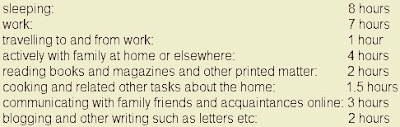
I think a more important question here is ‘when and how do I spend my time?' However, here’s the 'where', per day, based on normal weekday activities averaged over a 7 day period, not including holidays:

Chart of time spent
As you can see, I have a 28+ hour day. Short of pitching the world off its orbital path to accommodate all this, obviously there has to be some overlap. Indeed, to be realistic, this is what I find – not multi-tasking
but the ‘where’ tends to dictate this more than the ‘when and how’. When and how I spend my time is another matter.

How do I find time for all the relatively newer things
like reading blogs, twitter, social networks, etc?


In 2001, I discovered some useful things about myself. I learned more about when the best time is for me to think and reflect. I discovered that the early hours of the day was a good time to reflect on the day yet to come, and do some planning for that. The best and most convenient time for this is when travelling to work by bus.

For me this – together with its more relaxed counterpart, that of travelling home on the bus – provides an efficient use of otherwise wasted time. So it does two things. It gets me to and from work. It also helps me with the efficient use of my time at work and at home.

I might plan a strategy for tackling a ticklish problem at work to do with my learning group, for instance. Or I might have a bright idea for a blog post and have the time to think through different ways that it could be done. In fact, most of my initial thinking is done on the bus or at times like that where I've no option but to be there.

Good planning, of course, has to be flexible. When things don’t go to plan, a new plan must be drafted or the old one reshaped. Here’s when contingencies can also be mulled over while still in the planning stages – another efficiency trick. That way, not so much time has to be spent rethinking the one-and-only, platinum-plated, carbon-nano-tube-reinforced plan.

What am I doing less of today
than I was 3-5 years ago?


I don’t write so many letters. I spend more time writing equivalent emails and social networking to cover the same reasons for writing letters. With my older daughter, Hannah, at university and living in another city, I now spend time communicating with her through txting and Facebook and on the telephone.

This weekend, for instance, I took some photographs of my youngest daughter, Catriona, with my Sony digital. She was all set to be off to a Saturday night fancy dress party. I just had to catch a few pix of her.

Today (Sunday) I spent some time trimming the photographs and uploading them to Flickr and Facebook while chatting with Hannah online. This is one of the overlaps, in this case an overlap of family time spent with social networking and using digital technology.

Do I have less of a life with
all of these new things?


Most certainly and categorically not. In 2007 and at the age of 60, I had a hip joint replaced. That was in August. In October, my family whisked me off to Auckland to spend a weekend with them. I’d got rid of my sticks by that time and was able to hold a digital camera steadily enough to nearly fill 2 Gb of upload.

When I got home on the Sunday night I uploaded the digital pix to Facebook and used these in communication with family overseas.

Similarly in December that same year, when I was still inebriated with my new mobility, I took Catriona across the harbour on a ferry to explore Matiu-Somes Island. Once again, the digitals provided an incentive to blend relaxation with family and a bit of web2.0 technology.


The joy of the immediacy in using today’s technologies – my chat with Hannah while uploading pictures taken the night before – the rapid return to communicate pix taken on holiday immediately with family overseas – the fun of previewing pix that were taken on Matiu-Somes Island while returning on the ferry – do not detract from life.

At the NetSafe Conference July 2008 I stepped out to the shore of Lake Wakatipu at morning tea. I had my camera in my pocket and I captured a scene that has brought back memories of the short time spent at the lakeside. The playback is on Facebook and has been appreciated by family and friends alike.


But there are many moments of tranquillity that I have spent with others or in solitude without the accompaniment of technology - I am guilty of this. In those times I either leave the technology (digital cam – mobile phone) at home or in my pocket, switched off. I make the choice.

Haere rā – Farewell

Saturday, May 16, 2009

Hiv U evr wundird wot it wiz lyk B4 dikshinariz?

Hiv U evr wundird wot it wiz lyk B4 dikshinariz? Wen da wurdz wiz spelt NA way U lyk? An ya cud spel wurds difrint onda sem payj an nobdy nyu ye cdnt spel? Sumtyms a git emale letirs frm da kidis in skule an dey ryt lyk dis. Sumtyms i git txts frm da kidis onda cell an dey txt jis lyk dis. Its frendly cos dey txt jis lyk dey tok. Sumtyms i repli da sem wey an i gits a frendly txt back.
Das kyewl. Dat makes me feel wun o dey kiddis. Das kyewl 2.

So what’s with txt language? I notice that the e in ‘text’ is now dropped when referring to txting on a mobile, even in formal texts. The word is nearly new and is appropriate.

I sit close to several teachers of English in the office at work. They are cool people and although some are boomers like me, they all agree that language and how we write it is evolving all the time.

I have a special interest in language. It is so relevant to thinking and learning in a subject. It’s the bricks and mortar of being able to think.

When I was very young my reading and writing was atrocious - I’d no chance of spelling that word correctly either. My spelling was shoking. My mother, who was concerned about her son’s literacy, tried valiantly to entice me to read. She bought me novels. I read some but not much. I preferred to read comics. My mother disapproved of comics.

My grandmother, who was experienced and knew what her grandchild liked, would secrete a bundle of comics under the bedspread in my room for me to enjoy. She knew the worth of comics. She knew that ANY reading was better than none. She knew that it was the mind that needed the skill to lift the letters and words off the page and understand - that it didn’t matter if it wasn’t approved high school reading.

My reading skill was improved by me reading comics. Eventually I graduated to reading short stories and novels
and hundreds of books on Science for that was my interest.Hannah reading at the age of 5

Bo
oks have always been a part of my life since then. Linda and I read books, and our house is often a mess with them. Both our daughter's are avid readers.

My daughter Catriona, barely 3 years old and well before she could read, would take her favourite book down from the shelves in the hall.

She would sit and turn the pages. Sometimes she would sniff them. Sometimes she’d hold the book upside down when pretending to read it, for there were no pictures. That didn’t avert her fascination. It was one of my little books of poetry, the smallest book on the shelves. Catriona identified it as her book because of its tiny size. She never tore a page and always returned it to the shelf when she was finished playing with it.

When our children were both primary school age, our living room floor was always littered. In our house you could take your life in your hands by trying to walk across the living room floor in the dark. It was always littered - with books.

When Catriona was older, I would sometimes find her reading under the blankets with a torch when she was really supposed to be asleep. I just left her to it. She’s 15 now and has read every Harry Potter book published, some of them twice.

She has also read Tolkien’s Lord Of The Rings trilogy. I've seen the movies, but I've never read the Lord Of The Rings books. I found them hard to read.

Catriona uses txt language on her mobile all the time, yet she writes in near perfect English when she does her assignments for school. Her spelling’s not bad either. There’s a lesson to be learnt here
.

Ka kite anō – Catch ya later

Tuesday, March 3, 2009

Blogging In The Stocks

Kia ora tatou – Hello EveryoneKen in the stocks

Since my PC died, I feel as if my blogging has been put in the stocks. Funny enough, the lack of PC and drop in frequency of posts seems to have had an inverse effect on blog hits, for Google Analytics showed a definite rise in the past few days.

Graph and link to Google Analytics
Nothing to celebrate but it’s nice to know my readership hasn’t died just because my PC has.

But hey, with all this time on my hands, I find all sorts of other things to do at home.

Who needs a PC?


I was lent a copy of George Monbiot’s, ‘Bring On The Apocalypse’.
If ever there is a writer who will write great blog posts, he is. His book is essentially a collection of short essays (what Monbiot calls arguments) on six key topics of interest all written this century, some very recent:
Arguments With God
Arguments With Nature
Arguments With War
Arguments With Power
Arguments With Money
Arguments With Culture

Monbiot's new blog is on the Guardian’s web site – check it out.


I also listen to the radio a lot – always did.

Last Saturday, Kim Hill interviewed David Haywood, a New Zealand blogger who has earned such a reputation for his posts that he has been persuaded to write a book, essentially comprised of his blog posts, would you believe. If ever there was a writer to prove the rule about blogging clashing with authorship in print, Haywood wouldn’t be one. Check out Haywood's blog.


Ngā mihi nui – Best wishes

Thursday, January 15, 2009

This Is Not An Advert - It's A Rant

Tēnā koutou katoa – Greetings to you all
I’ve just read Dick Carlson's How to create amazing technical learning. It’s an ebook that contains a lot of down-to-earth common-sense advice. It’s a good read and hilariously funny, lightening what could otherwise be a rather boring topic.

Carlson gives some grunty tips on preparing and delivering training as well as pointers on how to handle a few aspects of a training company. It’s in a 72 page portable document format (pdf). Check out the link at the base of this post[1].

Techos hate them!

I like pdfs, and was surprised to learn that techos hate them. A couple of years ago, I had a really useful discussion with my son, Jack, who explained what it was about pdf files that irked the pants off techos.

I remonstrated at the time. On reflection, I now have to agree with Jack.


Some pdfs look good, smell good, feel good, but when you get down to using them as resources, they are inordinately difficult, if not near impossible to use. And there’s no excuse for this.

Hundreds of pages!

There are pdf resource ebooks that run to hundreds of pages but have no linked index or bookmarks to assist you to navigate the content.
I get lost and I’d give up on a lot of those if it weren’t for my dogged determination to learn the good stuff in them.


When I open an ebook, the first thing that hits me, even with some of the best, is the stunning quality of the huge images, the copious intros, and the trailing contents in the first, several pages. These are all very good for letting me know what’s in the book: I just get tired getting to the stuff.

As I scroll through the contents, I recollect the original intention of the pdf. It was to provide a way of sending a formatted electronic text that could be printed without problems to do with the exactness of how the printed end product looked.

Keeping up with the technology:

Since last century, Adobe has built some very useful and wonderful features into Acrobat. I won’t bore you with the details, but nearly all of those features come into their own when the pdf containing them is viewed from the screen.

These days, most pdfs are viewed from the screen, but they’re not made to be used that way. They’re designed as if they should be printed and read from the sheets. The problem is that the use of the technology has just not moved with the technology available.

Neither are resource ebooks meant to be read from start to finish. When I find a resource ebook that’s really useful, I have to open it in Acrobat and put in links, as well as bookmarks, to prevent me having cerebral blowout when I try to find things that are useful.

Content? Link it!

Even with a large ebook, it doesn’t take me longer than half an hour to put the links in. But it’s easier to do when the pdf is first made, and of course, I’ve no control over that decision. Content links, as well as bookmarks that can be opened from the left margin, can be planned when the text file is first created, and before the pdf is made.

Check out the links and bookmarks in this Content Developer’s Bulletin by Becta. It’s only an 8 page pdf. But it’s written for people who haven’t a lot of time to scroll through even 8 pages looking for the good stuff.

Wonderful resources:

There are links to these wonderfully information packed resources that are hard to navigate at the base of this post[1 - 3]. Check them out too. They all have great, useful information in them. It’s a pity it’s so difficult to find. There’s one that’s admittedly a report[2] and not really an ebook – but it has over 270 pages!

The writers of The eLearning Guild post some splendid ebooks on all aspects of elearning. They are truly wonderful and I recommend them to anyone interested in learning some good tips and skills. One of their books has 834 tips for successful online instruction[3]. It runs to 71 pages. I’ve used it a lot, and I kept going back to it, but only after I’d thrown it into Acrobat and bookmarked the sections.

I’m all for moving with the technology. Let’s use ebooks, yes, but let’s also have them made using the up-to-date features available with today’s technology, so that the functionality of the product is also up-to-date.

  1. Creating Amazing Technical Learning - Dick Carlson
  2. Enhancing Child Safety & Online Technologies - The Berkman Center For Internet & Society, Harvard University
  3. 834 Tips for Successful Online Instruction - The eLearning Guild

( 2 ) << - related posts

Ka kite anō – Catch ya later

Sunday, January 11, 2009

What Do You Do With A Fan Of Links?

Tēnā koutou katoa – Greetings to you all
A fan of post links
Have you ever thought of how you go about reading links in a blog-post or a web-page? A recent posting on Sue Waters' enviably informative site impresses me by advising bloggers to cite relevant information using links (hyperlinks), as long as it doesn’t mean going hyper with a fan of links. I go along with her reasoning. I also find comfort that she (a scientist after all!) is as fond of a fan of links in a post as I am.

Links in a post can be extremely useful. They can put you in touch with people you didn't know existed. They can also keep you up to date with things perhaps you should know about.

Most recently, there seems to have been an increase in the attention given to the ‘cognitive overload’ that accompanies sifting through burgeoning masses of information online – the dizzy headaches the hazy eyes – the lack of concentration the spinning head.

These symptoms are exactly what I experience when I visit a fan of links, one after the other, while also trying to follow the highbrow train of thought of the blogger who posted them.
Following up a fan of links baffles me! Link becomes a four-letter word.

Decision making can be exhausting:

Making decisions can tire the brain, apparently. But making decisions is exactly what you have to do while sweeping through a bevy of links, skimming through the accompanying articles as you go. When I do this, my brain constantly
has to come up with yes/no answers to a fan of questions:
  • Is this information going to be any use to me?
  • Should I know this?
  • Is it going to be any use to someone else?
  • Could this be useful for my students, say?
  • Should they know this?
  • Is what I’m reading important enough to come back to?
  • What’s it got to do with what the writer’s saying anyway?
I get up to about link 5, and recognising that I’m on the verge of blowing a gasket, I break - for a coffee. It's probably the best thing I could do.

One method I’ve used is to ignore the links altogether, at least in the first read. I bash on with what’s in the post or article to try and make some sense of it. This sometimes works.

But if there’s essential information cited through links, especially early in the text, and I know nothing about that stuff, I’m sunk. My brain runs out of steam when following the rest of what's there to read. My understanding wobbles. I effectively go nowhere when I try to continue reading.

I’ve then got to stop, retrace, and do some homework on the content in the links. This procedure is irksome, frustrating in the extreme, probably because by that time, I’ve got the old cognitive overload syndrome. Again. My head starts spinning.

There have been several postings recently on writing for skimming, notably Tony Karrer's, and there is certainly room for improvement in the way material is presented to reader/learners. But the need for the reader/learner to improve skills and strategies for coping with floods of new information is also becoming a major priority in the workplace.

But what's the best way of tackling a fan of links? If you have any thoughts on this, strategies or practices that you could share, please let me know. My head hurts.

Ka kite anō – Catch ya later

Friday, December 19, 2008

Let Me Count The Ways

Kia ora tātou – Hello Everyone
A Bookcase on the Scrapheap
The book and the paper it’s made from have recently taken a rap. The suggestion is that the book is outmoded. It's well past its use-by date in education and it's not environmentally friendly.

I like the book. Having had a lifelong association with the invention,
I realise my opinion inclines in its favour.
To be fair to the book in the context of learning, however, the reasons gathered in support of its removal or replacement should be related to its merits and demerits as a learning resource.

When weighing the stresses, it is difficult to assess its effectiveness against digital counterparts unless a few ground rules are defined.


Judged by its cover

It is unfair to pitch the book against such things as an online chat or a wiki. Whatever the equivalents of these technologies will look like in future, their application and purpose cannot be compared, with any relevance, to those offered by a book. Try comparing the virtues of a submarine with those of a helicopter and you’ll see what I mean.

Neither is it fair to condemn the book just because its content may go out of date. Data in a web-page, a blog post or even a tweet are just as likely to go out of date, and for the same reasons, with no likelier promise of edits to correct these.

What are the benefits and drawbacks?

The rate of use of paper throughout the world is now higher than ever; it rages wildly and at a mounting pace. But it’s not the book, textbook, printed educational literature or school note-pad that is mainly to blame for the burgeoning rate of paper production. Advertising, and the wasteful packaging of goods, contribute to more than half the global consumption of paper.

More trees

This does not detract from the volume of paper consumed for educational purposes. It is huge. A recent article on campus sustainability and paper consumption by Clark University, reported that 720 trees are harvested each year to supply printer/copy paper for that establishment alone. It may be just a leaf in a tome, but I have an eye for conservation, and that fact leaves me pondering.

Burgeoning content

Sheryl Nussbaum-Beach states, in her September video, that by the year 2020, knowledge could be doubling every 72 hours.

She claims that by that time, there will be no place for the book in schools, as it would be impossible for it to keep pace with the rate of knowledge growth. Setting aside issues of relevance to the school curriculum, knowledge delivered at its predicted rate of creation by 2020 couldn’t possibly be accomplished in book form. I wonder if any data management system could ever deliver knowledge at such a rate - and for what purpose.

Pictures, images and diagrams

In the twentieth century, advances in the printing industry brought vibrant colour to illustrations in books. Only in the last 15 to 20 years has such quality of detail and colour been viewable on the computer screen.

The digital device has the edge on the book, with the use of diagrammatic sequence, melting images, moving images or other animated schema. Especially in student learning, there is a growing need for the use of visual images as learning tools to promote student understanding.

Videos in particular can provide amazingly detailed imagery. With the animation technology available today, it is possible to view a 3D virtual journey through the chambers of the human heart, or to observe the journey through the intake and exhaust valves of the internal combustion engine.

As David Whitehead said in his speech on strategies for improving literacy, simply asking students to imagine (as a thinking/learning tool) may not be as successful as it was in the past.

One might be forgiven for thinking that this may be as a result of the use of explicit animated imagery, rather than other teaching tools that are perhaps more likely to exercise the imagination of young minds. For as limited as a book may be in depicting complex concepts in pictures, its practiced use has the power to stimulate the imagination.

Visuals with text

When creating a learning resource, there is a tendency to overuse the features available to the digital resource designer. While acceptable and effective page design has become a well-established skill in textbook writing, the same cannot be said universally of digital learning resource design.

The misuse of PowerPoint as a learning tool highlights the vagaries of incorporating voice with text. Their joint use accompanying displayed images or diagrams in a learning resource causes cognitive overload in the learner. It is difficult to achieve this with a textbook. Verbal and written information simply cannot be presented simultaneously unless the teacher speaks while the learner is trying to read.

Copyright moves quick quick to music

One of the wonderful things about books is their ability to be shared.
A book, when first sold, can then be lent, gifted or sold again – the so-called first-sale doctrine.


But for the existence of that principle, libraries, second-hand book and CD stores, as well as video rental outlets would be illegal. Though there have been several attempts made over the decades to place restrictions on the resale of printed books, actions restricting the sharing of digital equivalents have moved more fiercely. It seems that even the publishers of printed resources may now wish to cash in on this idea.

It was suggested in The Future Of The Internet III that copyright protection technology may dominate content control in 2020. A little less than a third of expert opinion surveyed agreed that this was a likely scenario.

The tractable e-book

As I said at the start of this soliloquy, I like the book. But the thought of a digital replacement still excites me. I’ve yet to get my hands on an e-book, like the Amazon Kindle. As Jim Henderson says:

"For this to go, there has to be buy-in by the publishers."

Haere rā – Farewell