
 Remember, remember,The 5th of November,The gunpowder, treason and plot.I see no reasonWhy Gunpowder TreasonShould ever be forgot.
Tonight is Guy Fawkes Night in New Zealand – and it will be Guy Fawkes Night in several countries on this day – potentially a fun night for most children and adults.
The history of its origin has been well documented.
The scene is a cellar, directly underneath the House of Lords (Parliament) London, early in the morning of 5 November, 1605.
In a few hours, King James VI/I, the British Parliament and many dignitaries will be in attendance for the opening of Parliament. Having learnt of a rumour of a plot to blow up the Houses of Parliament, the King has ordered a check of the cellars to be executed this morning.
Guy (Guido) Fawkes is quietly leaving the cellar, having just completed his undertakings and last minute checks on dozens of barrels of gunpowder, laid all set to explode in a couple of hours. Fawkes is apprehended by the guards and the stockpile of gunpowder is discovered.
Further investigations reveal that Fawkes and several of his accomplices had attempted to destroy Parliament in what is now known as the Gunpowder Plot.
The outcome of the trial that ensued in January the following year brought Fawkes and his cohorts to the gallows. The King ordered that the event be celebrated by burning fires all over the kingdom.
And so a tradition began for a customary annual celebration.
What intrigues me is the fierce adherence to the Guy Fawkes tradition in New Zealand, a country that is now colonised by many nationalities. What is more intriguing is that a significant portion of people who celebrate ‘Guy Fawkes’ in that country have no knowledge of the origin of this almost pagan custom. Many simply refer to the celebration as Fireworks Night.
What is even more astonishing is that it’s nearly summer in New Zealand at this time of the year. Skyrockets and exploding firecrackers (or bangers) are already banned as they are a fire hazard. It’s not uncommon for dwellings (predominantly of wooden construction in NZ) to be burnt to the ground or large areas of bush and scrub to be razed over the ‘fireworks’ season. In its country of origin, Britain, the tradition takes place during winter when there is a low fire risk.
Legislation already restricts the sale of fireworks to a brief period in November. There have been several moves in recent years to ban the sale of fireworks for use at private celebrations in favour of public municipal firework displays.
My family watch the city display from our living room window. The whole sky is lit with pyrotechnics over a period of half an hour.
Interesting isn’t it, that the fun aspect of a bygone, almost forgotten celebration should so fiercely dictate how people choose to conduct themselves? For me, a shift to a suitable mid-winter date seems obvious as a first move towards safer fun for all.
Enjoy the fireworks!
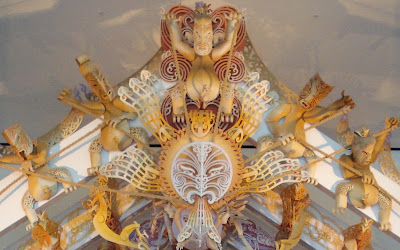 Design from the Māori fable of Māui and his brothers taming the sunThe Marae, Te Papa Museum of New Zealand
Novelists and playwrights are done without it.
The success of the film industry depends on it.
Folklore is embedded in its construction.
It is the basis for substantive contributions to world poetry.
The Old Testament is so graced with it there is not a page
in that book where it is absent.
Its might is well known and celebrated by educators,
instructors and coaches of all disciplines and in all cultures.
It is the fascination of children, the bread and butter of
storytellers, the potion used by keynote speakers
and even the magic pill of bloggers.
Yet in an age when change is the watchword, the modest story remains steadfast and unvarying in its ability to capture the attention of people of all ages and in all walks of life. The conundrum is that it should be so commonplace and yet so potent.
How can this simple device still be so assiduously engaging?
Captivating
At a recent meeting I attended, the guest speaker made an inelegant approach to the topic, was inept at choosing words appropriately and had a tendency to ramble. What saved the too long speech and made it memorable was a story told near the close of its delivery. I watched, fascinated as people moved from angles of repose to more attentive postures.
Designers of adverts use its arousing magic in a similar way to the speech-maker. Executed well in the manipulative exploit of advertising, it can result in awards being won, and not just for sales statistics.
Relevance
No other teaching device can bring context so uncontrivedly and adroitly to a teaching moment as the story. Whether written, narrated or depicted in scenes in a video, it has the knack of introducing a packet of learning incognito.
Through the conduit of the story, the whole of Māori folklore has been passed down to us by word of mouth, as were the traditional beliefs expressed in stories and songs of many other cultures.
Interest
There is an innate tendency in everyone to follow the passage of a story. The successes of the publishing and film industries are testimony to that, individually and jointly. What senses-able child in western society today does not know of Harry Potter?
For as much as adventure-games appear to captivate and engage participants with the matrix of the game, it is the unfolding escapade that captures the interest of players. They create and experience their own stories within the contexts of their games.
At the start of this century, my wife, Linda, learnt of the Sid Meier’s computer adventure-game Civilization III. Despite my total disinterest in adventure games at the time, she enticed me to partner her while she played out her first game. We chose to be joint advisors in building a British civilization ruled by Queen Elizabeth.
Being new to the rules and capabilities of CIV III, we had to learn a lot to help our growing civilization to survive. And did we learn a lot!
After a long struggle, successfully avoiding conflict after conflict, we won a cultural victory, according to the rules of CIV III, in building a virtual civilization on a resource-rich land-locked virtual continent. For as much as we have played the game since then, perhaps hundreds of times, we can still remember the thrill of our first CIV III adventure.
Imagination
My daughter, Catriona, is as familiar with ice-cream as she is with the Eye of Sauron in the Lord of the Rings movie trilogy directed by Peter Jackson.
She was just 12 years old when she first took an avid interest in all that The Rings had to offer. Catriona saw the films and then read the trilogy by J R R Tolkien a year or so later. When I discussed the nature of the Eye of Sauron with her, I was astonished at what she knew.
“It’s not the same in the films as in the books”, she told me. She explained that the film depicted the Eye of Sauron held in a tower, but in the book it was like the eye of a spirit that was seemingly ubiquitous.
Catriona read Tolkien only after having seen the films many times over. Yet the image of the Eye of Sauron as depicted in the film did not interfere with her ability to imagine quite a different concept of it as read from the book.
This experience showed me how able Catriona was at discerning a screen depiction from its counterpart in the original novel. But it was also proof of the power of the written story to excite the imagination, even in the wake of a different mental image laid down by a series of scenes in a movie.
Memorable
I first learnt of Winnie-the-Pooh when I was eight years old, but not from a story read directly from one of A A Milne’s novels. My friend next door had a well-read older sister who delighted in telling stories to her younger brothers and anyone else who cared to listen.
In her own words she told the story that was later to become a favourite of mine and that I read to my children many times, “In Which We Are Introduced to Winnie-the-Pooh and Some Bees and the Stories Begin”.
Never underestimate the power of the story. Its unique ability to capture the imagination can make an everyday event memorable, add interest to an otherwise mundane activity, bring relevance to a teaching moment and wake up an indifferent audience.

Māui and his brothers taming the sun -
The Marae, Te Papa Museum of New Zealand Māori tradition is steeped in folklore. It is a culture I have much respect for and I see strong similarities with the Celtic traditions in Scotland, the land of my birth. I’d like to share with you some of the aspects of Māori culture and folklore that are significant to me.
The section I belong to at The Correspondence School (TCS) is called Poutama. We chose this name when restructuring began, with the regionalisation of TCS early last year. I feel privileged to belong to a wonderful section of teachers in Poutama. I’m very proud of our name which comes from the name for an ancient Māori wall design.
Poutama
The Poutama design is a type of tukutuku, a traditional Māori art form. They form part of visual storytelling in Māori culture.
Tukutuku are decorative woven or carved panels that are part of the traditional wall construction used inside Māori meeting houses.
In ancient lore, poutama symbolises an ascent made by the folk hero Tawhaki (pronounced tafaki) to receive the three baskets (kete) of knowledge from the gods.
They are:
- te kete-aronui - basket of knowledge that helps us,
- te kete-tuauri - basket of knowledge to do with ritual, memory and prayer,
- te kete-tuatea - basket of knowledge of evil or makutu, harmful to us.
The interpretation of the word poutama is one who protects and supports his family sub-tribe and tribe, as in a chief or rangatira.
The construction of poutama symbolises the steps to progress in education and the endeavour to improve - the planning of a child's future - by parents, family and tribe. It is believed to be the ultimate mark of a leader.
The legends of Māui
I have always had a fascination for folk legends. Most Māori legends possess a strong principled or educational aspect. Perhaps this is why I found the legends in Māori folklore particularly absorbing.
Among some of the most attractive are the tales about the Māori half-god, Māui, who was abandoned at birth and later reunited with his family. Māui is depicted with his four brothers in the photo at the head of this post.
Here is how I tell the legend of Māui, how he was eventually reunited with his mother and family, and given his name.
Māui-tikitiki-a-Taranga
Māui wrapped in the topknot of Taranga
Little Māui, baby Māui,
Wrapped all in the tikitiki,
Sleeping on the white wet sand.
Swept the wind up on the beaches,
Swept the ripples, swept the tide-spray,
Hair and seaweed tied the bundle,
Lightly tied the bundle neatly.
Swathed in seaweed, bathed in sea-spray,
Lifted by the tide-wave gently,
Buoyed up on the foamy bubbles,
On he slept as waves were bobbing,
Poor unwanted baby Māui,
Bobbing out to sea.
Still he slept, the little Māui,
As the cruel and hungry sea-birds
Watched the bundle gently rocking,
Rocking on the sea.
Then the kindly sky-god Rangi
Saw the hungry sea-birds hover,
Hover near the baby Māui,
Bobbing out to sea.
Swiftly Rangi hailed the mountains,
Mountains with their white hair gathered,
Gathering the white hair rolling,
Rolling out to sea.
Swift they lifted little Māui,
Lifted on the plumes of white hair,
Hair twined with the tikitiki
High above the sea.
There the kindly Rangi raised him,
Taught him all his wondrous magic,
Set him on the rolling white sand,
Wet sand where Taranga left him.
Then the old man Tama met him,
Took him as his son, his own son,
Told him of his four fine brothers,
Told him of their mother's homeland.
Showed him all he knew as nature,
Where the streams run fast and steeply,
How the bees hive, how they gather,
How the birds dive, how they hover,
Where the fish swim fast and fleetly,
All that he had known.
Then the youthful Māui learning of the homeland,
Yearning for the brothers living with their mother dear,
Left the old man Tama by the rolling white sand,
Crossed the western hills to the wooded plain so near.
Lightly fell the footstep quieter than the silence,
Slipping like a shadow through the shady underwood,
Entering the whare in the family's presence,
Past the smoking fire to where the pitiless mother stood.
Presently Taranga called on all her young ones,
Called on them to join her around the smoking fire,
Counting as they joined hands, counting she had five sons,
Four sons and a strange one dressed in strange attire.
Holding near a fire-brand to the littlest brother
Taranga leaned forward and asked from where he came,
Māui said 'I'm Māui, and you are my own mother',
'These four are my brothers and Taranga's your name'.
Little Māui told them what old Tama told him
Of the baby Māui laid asleep upon the sand:
Shrouded in the seaweed, chilly crown and cold limb,
Rescue, and the sea-birds, and kindly Rangi's hand.
Māui named his brothers and told them all their secrets,
'You are our little Māui!' cried Taranga,
Clasped him to her breast as her hair hung round in ringlets,
Named him little Māui-tikitiki-a-Taranga.
Many other Māori legends can be found on the Māori in Oz site.
This April is National Poetry month in the US.
I have been hopping across to Bud the Teacher and attempting to invoke the muse. It is a wonderful site and Bud is prompting us to write some poetry every day this month.
If you are poetically inclined and would like to write a line or three,
I encourage you to nip across to Bud’s site. Go on. Give opportunity to your muse.

Way back last century, farmers in Scotland sometimes used a pumpkin or turnip for the head of a scarecrow. Chosen for its size, shape and colour tone, such vegetables could look convincingly like a human face. Perhaps their use for this dates back to early primitive times. I’d like to think it did.
The Celts also used pumpkins and the like to frighten off superstition.
Maybe the features of a face were fashioning by cutting holes in the hollowed out gourd. Perhaps a primitive candle, made from animal fat and plant fibre, could have been used to serve its function as a lantern – who knows?
I can recall the first time I saw a pumpkin lantern as a child. It was Halloween. Carried by one of a group of children, walking after dark along the dimly lit Scottish street where I lived - this was really scary to me. I can imagine how this, otherwise lifeless piece of carved vegetable, with its eerie ghoulish appearance, could conjure up fear in someone viewing it from a distance.
According to Wikipedia, the Celts believed that “the head was the most powerful part of the body containing the spirit and the knowledge”. For this reason, belief was that the pumkin had the power to ward off evil spirits. It puts quite a different perspective on the term pumpkin-head!


 Posts


