Friday, July 18, 2008

Calling All Bloggers - When Do You Post?

Tēnā koutou katoa - Greetings to you all
When To Post

I’ve been blogging for a couple of months now. It’s still very new to me. I’ve looked at all the blurb. Read Sue Water's posts on the 'blog theme'.
Learnt about designing good blog headers. I've read about finding images for posts and understood all that about copyright. Learnt about Technorati. I've sorted out my comment settings. Set up my RSS feed and got my comment tracker working.

I've scoured the blogosphere for sites on what makes a good blog. Found out how to write good posts and how to improve those and become more effective at writing them.

I even set up and started using Google Analytics. That was a bit of an eye-opener. At least it was when I eventually learnt the basics
and got it to work!

One thing escapes me though, and I know this should seem a bit obvious. But I’ve never come across any advice on when to post.

But if you think about it, there is probably an optimum time to publish. There seems to be optimums for everything else. Perhaps there is some strategy behind publishing at just the right moment. Maybe the phases of the Moon have something to do with success.

I’ve noticed, for instance, that some reputable bloggers post two or more posts on the same day. I often wonder. . . is there some strategy behind this practice? Or have they just been saving them up to impress other bloggers by publishing three posts on different topics, all at once? Apparently Isaac Newton wrote his famous Principia and sat on it for twenty year before he published. Maybe he knew something about the strategy of publishing at the right time – who knows?


I usually publish a post when I’ve written the draft, edited it a few times and checked it in Preview. Though that doesn’t show me everything I want to see, at least it tells me something about where on the screen the text and images will appear. It also saves me having a fit if I post and then discover some awful faux pas has just hit the fan.

Okay, I’ve just finished writing my draft on this wonderful idea I had for a post – done all the checking and everything, including checking all the sites in my RSS and done a bit of searching elsewhere to see who’s posted a post on the same topic.

But . . .

. . . when do you post?

Tuesday, July 15, 2008

How do I know what I think till I see what I write?

Tēnā koutou katoa Greetings to you allFractal thought patterns.


A recent post by Ken Stewart, entitled Why Do You Write? prompted me to write my usual post-type comment.


Writing does three things for me:

1- It helps me organise my thoughts

When I think, I usually have two or three thought-threads running through my mind. Sometimes more. Sometimes they get mixed together, not so that I'm confused necessarily, for I can cope with that.

It is more of a prioritisation, for I find it difficult to prioritise competing thoughts that are nevertheless parallel on a topic. The thought-threads become less tangled when I write them and edit what I write.


2- Prioritising my thoughts sparks further thought

By prioritising my thoughts in a visual way I engage other ideas and thoughts that are in the background. Some are as if they were in the subconscious, others vague and indistinct come into sharper focus.


There are many parts of the brain that lie unused or that are used almost exclusively for specialist jobs, such as the visual cortex to do with sight and parts to do with processing hearing. Studies have shown that blind people use the visual cortex despite not being able to see.

Is it possible that sighted people can use this 'visionary' and sophisticated part of the brain for other purposes than processing visual responses from the retina? Perhaps the visual cortex is invoked, not necessarily in just processing visual responses, when a person sees their thoughts in a written, visual form. Who knows? But when my background thought-threads are written down, I can list them alongside more conscious thought-threads.


3- Writing puts to rest serendipitous thought-threads


There is an old saying “sometimes I sits and thinks, and sometimes I just sits”. I find it difficult to do the latter for thought processes take over when I try to just sit. Some of these go on in the background of my mind all the time. The psychologists tell us that this is normal.


When I become conscious of these thought-threads, I try to make sense of them. Writing helps me do this, for it does 1- and 2- above. When these are processed through exhaustive cycles of writing and editing, it is as if the thoughts are put to rest. I can sleep on them.

The famous and ancient poet John Donne wrote:

. . . he tames it, that fetters it in verse.

Could it be that the sentiment behind Donne's line is what this last point is all about?

Ka kite anō - Catch ya later

Monday, July 14, 2008

Complexity Science and Social Media Learning

Tēnā koutou katoa – Greetings to you all
a fractalRather than march into the Infinite, explore the finite in all directions -
Johann Goethe

Complexity Science is a relatively new study. I was introduced to it early this year at a NZCER sponsored seminar in Wellington on Complexity and Education. Some of this post is written from the notes I took, with a focus on learning through social media.

What is Complexity Science about?
Complexity is difficult to define and there is no unified definition. Complexity research in education is a way of studying learning systems. The study of complexities is really about its objects of study rather than its modes of investigation. It’s to do with what's studied not how it's studied. Complexity Science is the study of complexity systems.

The presenters, Brent Davis and Denis Sumara, outlined in broad terms the properties of complexity systems with specific reference to education. They suggested that Complexity Science can and should be embraced by educators and educational researchers as a properly educational discourse.

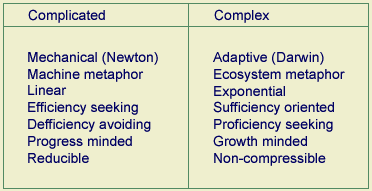
Among important points emphasised were the distinctions between ‘complicated’ systems and ‘complex’ systems. When the properties of complicated entities and their complex counterparts are compared there are similarities and differences. I summarise some of those here:

data table
In a complexity system there is no centre to speak of, nor is there a periphery as such. Complex systems are decentrally networked and are said to be decentralised.

model of a network
If there exists anything identifiable that is like a centre in a complexity system it is wherever you happen to be within the system, either actually or metaphorically.

Social learning that develops through interaction between members of a community has qualities that categorise it as a complexity system. This relates to the learning that happens within the community in distinction to the learning achieved by an individual, though that too has properties that resemble those of a complexity system.

Learning systems:
adaptive
A complexity system has two key qualities that can be used as identifiers, one of which is described as adaptive. Davis describes this quality as being more like Darwinian evolution than Newtonian mechanics. A system with this quality resembles a living system more than it does a mechanical system, for it has the ability to change its structure - it can transform.
emergent
The other key quality is described as emergent. What arises within a complex system is a synergy from the activity between and within its individual components so that the effect of the whole is greater than the sum of the single effects from each of its parts.

Systems that exhibit these key qualities, adaptive and emergent, are described as ‘learning systems’.

We often read of how learners create their own version of knowledge through social interaction. In doing this, learners are creative in their own way. Creativity speaks through the spontaneity of emergence and through the power of self-organisation within a community. It invariably develops through evolving processes within a community.

Self-organising and self-governing:

Social learning activities tend to be emergent and self-organising. They also tend to be self-governing, in much the same manner as the movement of a shoal of fish. In this way, rational understandings can arise through social learning without the need for a central controller.

In studies of the way individuals integrate into a community, Etienne Wenger and Jean Lave report, “initially people have to join communities and learn at the 'periphery'. As they become more competent they move more to the ‘centre’ of the particular community. Learning is, thus, not seen as the acquisition of knowledge by individuals so much as a process of social participation.”

Self-transforming:

Social learning activities can be self-transforming, so that the way learning responds to a situation is determined by the learning itself, not the situation. Learning does not respond mechanically to a situation. Instead its response depends on previous learning and can be unpredictable as a result.

A simple and metaphorical example of this is what happens when a bull confronts a group of people walking through a field. The response of the group will depend not only on the previous experiences of the individuals but also on the previous experiences of the group itself.


Social learning does not operate in static situations. If interactive activity stops, the learning also stops.

Studies on virtual communities:

Recent studies on different types of virtual communities are significant in that driven, assigned working groups show less of the qualities of a complexity system than do virtual communities of practice (CoP). These findings are important to the application of learning through social media where efficiency and effectiveness are critical to success.

Assigned work teams:

Studies on assigned virtual work teams showed the same variations that are found in studies on groups in education. Patricia Sobrero reports that some groups “sometimes failed to develop the social capital needed for trust and joint decision-making. This led to increased competition and failure. However, the successful virtual teams were found to be high performing, and they provided value to organizations for learning, research, product development, and cost-benefit to the organization. Research found that teams often disbanded after the task or product was developed, and the learning, social capital, and intellectual capital built, dissipated.”

Communities of practice:

On the other hand, virtual communities of practice, where groups of people share a concern or passion for something they do, show a greater degree of permanence. Sobrero reports that they tend to be self-organised, self-governing and develop “social learning that crosses structures, cultures, organisations, time, and space to learn from each other, develop new knowledge, and continuously improve know-how”.

( 5 ) ( 4 ) ( 3 ) << - related posts - >> ( 1 )

Ka kite anō – Catch ya later

Sunday, July 13, 2008

A Message from Middle-earth on ItCanSay

Kia ora tātou! - Hello everyone!
Picture of Ken


Michele Martin's
Web 2.0 Wednesday task was to select a Web 2.0 technology from a list of 100 useful technologies on a College@Home post, 100 Helpful Web Tools for Every Kind of Learner.


It was serendipitous and quite coincidental that Michele posted her Web 2.0 Wednesday task just as I had written a post on technowhelm citing the same web site.

I must admit that I got rather wrapped in some of the technologies. Many are quite technical. I spent a lot of time trying things out.


Facebook was one of the Web 2.0s listed. I already have a Facebook account, so I downloaded one of my zaney mug-shots I had on a Facebook photo-album and put it on this post.

ItCanSay is a technology that converts text into audible speech. It permits it to be saved as a wav or mp3 file. What I liked about the software was its simplicity and ease of use.

My plan was to write a message and upload it to my blog. But the plan had to be re-jigged! Blogger accepts only video files. Not to be outdone I recorded a video file while playing back the wav file and uploaded the resulting mpg to this post. The video is. . . em . . . of our black cat, Boots, stalking a black rat out the back garden - at midnight.


( 8 ) ( 7 ) ( 6 ) ( 5 ) < - other Web2.0Wednesday posts - >> ( 3 ) ( 2 ) ( 1 )

Ka kite anō - Catch ya later

Friday, July 11, 2008

Participation in Social Media

Kia ora tātou – Hello Everyone
Growth of a treeRather than march into the Infinite, explore the finite in all directions -
Johann Goethe


What attributes in a post influences potential participants to contribute?


Skellie, in her recent post, Bloggers: Watch and Learn, identifies the ways and means through which she believes bloggers can learn to write great posts that attract huge numbers of comments. She advocates studying “those who are already highly accomplished in the skill”.

She emphasises the need for immersion in “content that is optimised for social media” and in studying the techniques and strategies used by world-class bloggers.
Her final words on the matter are “never stop watching and learning.”

Most bloggers have lots to learn

If Skellie is right, and I have no reason to believe otherwise, then clearly I have a lot to learn about blogging from that point of view. So have most bloggers who write the posts I read.

In deference to potential participants, the most influencing factor in creating participation appears to be how the post is written. In the light of discussions recently taking place in the blogosphere relevant to encouraging participation in social media, can we afford to overlook the significance of this as a factor central to the effectiveness of such encouragement?

Why doesn’t everyone in an online group contribute?

What encourages participation in social media?
( 5 ) ( 4 ) ( 3 ) ( 2 ) << - related posts Ka kite anō – Catch ya later