Tuesday, July 7, 2009

eTeaching? eLearning? What’s the Difference?

Tēnā koutou katoa – Greetings to you all
Zen Teaching and Learning
Last term I overheard a teacher conversation on pedagogy:

“It’s all about learning. You don’t talk about teaching anymore.”

I wondered about this. I thought, ‘what am I doing if I’m not teaching?’

It didn’t take me long to sort out the conundrum. It was to do with the perception of a teacher ‘filling jugs’ with learning. I’d never accepted this metaphor. I’d always believed that teaching was closer to learning than the metaphor suggested.

The conversation progressed and centred on the teacher:


There was an involved discussion before some resolution was found on the difference between knowing when something was taught, and recognising if something had been learnt.

Learning is explicitly to do with the learner. Isn’t teaching to do with the learner? Is there a difference between what’s taught and what’s learnt?

This post is about these two related spheres: teaching and learning.

How do you find out what’s already been learnt?

A good teacher asks questions. In introducing a new topic, searching questions are put to the learner to see what resident knowledge and skills abound. In doing this, the teacher may well find out what, if anything, is required to be taught.

It could be that parts have already been learnt. In which case, this exploratory conversation can serve as useful revision. It may also serve as an appropriate introduction to the next part of a lesson.

So it is (and should be) with elearning. By embracing the function of asking questions during an introductory part of a topic, the learner is permitted to establish where competency lies. Opportunity to tackle any associated learning deficiencies can be offered at this stage. Once a compatible group of competencies has been recognised, a learner should then be able to progress swiftly to the next sphere of learning.

How do you know when something's been taught?


The direct presentation of raw information in text or other visual data is so often confused with teaching. Coloured pictures, animations or videos, however well designed and accompanied by notes or other instruction, do not constitute teaching when displayed on their own.

So much more is needed to engage the learner, and to satisfy a learning objective through this engagement. The key to engagement is to ask questions or otherwise provide opportunities for the learner to participate.

There should be a pedagogical progression, interposed by strategic and appropriate occasions for the learner to take part in dialogue about what’s gone before. Exemplary answers are given if and when they’re needed. This so-called formative assessment achieves a number of things relevant to learning:
  1. assists the learner to think about the topic in context

  2. provides additional teaching for a learner who may not yet have grasped all of an idea or concept

  3. can confirm, and give the learner confidence, that learning is happening
So often in an elearning environment, less confident learners can be on track, yet be unaware of their own capabilities. Formative assessment can assist the able learner by providing assurance that what they have assimilated is aligned with the learning objective.

  • Through questions and associated dialogue a teacher can affirm that something has been taught; it must not be confused with what is learnt.

How do you know what’s taught has been learnt?

In the classroom, a series of questions making up a summative test, together with associated perfunctory aural questioning, can be used to establish the extent of knowledge and skill uptake.

Assessing some skills may require learners to demonstrate
visibly the extent of their expertise. This may not be easily achieved in a written test. Assessment of practical skills requires learners to manipulate equipment or make observations from these or to do both.

In elearning, summative assessment can be just as involved. The use of video streaming or video recording, so that learners can demonstrate a skill, such as playing a musical instrument or speaking a language, can be part of summative assessment. Where appropriate, these are incorporated into NCEA assessments of distance learners in New Zealand.

There is an art in designing elearning resources, as there is in teaching.
Learning and good teaching are in balance with one another.

When the student is ready, the master appears – Zen proverb
Ka kite anō – Catch ya later

Saturday, July 4, 2009

New Strategies? New Skills? A Big Question

Kia ora tātou – Hello EveryoneJuly's Big Question
Tony Karrer’s Big Question for July has a syntax that’s almost rhetorical: New Skills and Knowledge for Learning Professionals?

Does he suggest that, perhaps, there is nothing new in that field?
Or is he genuinely asking for innovative ideas on what skills learning professionals should have?

I couldn’t help thinking how taken aback I was at Tony’s reaction to one of my last month’s posts. I’d rattled it off almost like an email reply. When he said he had to walk through it and take notes, he got me thinking about what I’d written. I went back and read it through to check that he was talking about the same post. The first bullet in the closing list on attaining proficiency read:

  • identify the required base-knowledge/skills, foster strategies for these to be recognised as key, and provide avenues for their appropriate acquisition and practice

That’s all very simply put in a bullet. It’s the unpacking of what’s bulletised that I think Tony’s after when he asks his Big Question.
In thinking of the complexity of what is embraced in that bullet, a plethora of other lists, schemes and recent and not-so-recent ideas came to mind.

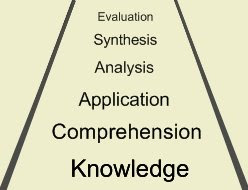
I often take a backward look at Bloom’s Taxonomy, for instance.

Bloom's Taxonomy
New skills?

If the above heirarchy of thinking skills is of any use to the young learner, it must surely be useful in some form to a professional who is still learning. Aren’t we all supposed to be lifelong learners? Isn’t that what our glorious learning journeys are
all meant to be about?

Just because the so-called lower-order-thinking-skills are fundamental to the others in the list does not mean that they’re to be neglected once the higher skills are attained. You may as well forget about tyre maintenance and just see to the fine tuning of a car engine before setting off on a long drive. When it comes to traction and treads, there are always new developments in the marketplace. So it is with knowledge in the professional arena.

The fundamentals of learning, understanding and application of knowledge don’t mutate simply because someone has learnt a lot.
Why relegate Bloom’s Taxonomy to the classroom? There’s a deal of wisdom there that can be applied to everyday learning in the workplace.

Timely reminders

Often the skilled and knowledgeable person needs to be reminded of some of the strategies that are at their disposal. Knowing what to do, and having the skills to be able to do it, are only part of what a professional needs in order to exercise initiative. The other and most important element is recognising where and when these knowledge and skills can be and should be applied. This takes practice and there’s seldom much time to do this in day-to-day routines.

How people think, and what that thinking is associated with, varies widely from person to person. It’s the context that’s often so important for specific thinking to occur if it's to happen at all. Innovators and naturally creative people rarely need tuition in the elements of how to be innovative or creative. Others new to these skills need relevant and appropriate contexts in order to flex their creativity and innovation.

Whether it is learning to touch-type, finding out how to embed a YouTube video in an announcements page of an LMS, or constructing a new strategy from peer feedback on a project, there needs to be a focus that includes:

  • the learner,

  • the relevant application of what’s to be learnt,

  • the available resources for use by the learner, and

  • the time allocated specifically for that up-skilling to happen.

Follow through is essential: that the learner has immediate, relevant and appropriate opportunity to practice what’s been learnt.


Relevant references:

Andrew Churches - Bloom’s (Digital) Taxonomy

http://edorigami.wikispaces.com/file/view/bloom%27s+Digital+taxonomy+v3.01.pdf


UNESCO -
Task Force on Education for the Twenty-first Century

http://www.unesco.org/delors/index.html
http://www.unesco.org/delors/fourpil.htm
http://www.unesco.org/delors/delors_e.pdf

Rangimarie - Peace in Harmony

Friday, July 3, 2009

Taupo

Tēnā koutou katoa – Greetings to you allLink to image of Lake Taupo
photo courtesy Jack Allan
Paul C's GPS theme for July is simple: "reflect upon a time when nature provided you with comfort, beauty, or inspiration."

In the centre of North Island, New Zealand, rests one of the world’s largest extinct volcanoes. About 26,500 years ago, the volcano erupted, ejecting over 1,170 cubic kilometres of material.

Over time, a series of smaller eruptions occurred, including the Hatepe eruption in the year 180. It was the most violent eruption of any volcano in recorded history. What remained after that cataclysm was a caldera that filled with water to become what we now know as Lake Taupo.

I visited Lake Taupo with my family in April 2004. We were privileged to stay at my wife’s aunt’s cottage on the northern shore of the lake, literally a stone’s throw from the waterside.

One afternoon, while returning from a walk along the lake shore,
I scribbled a dozen or so lines of verse. Here, after some minor tinkering, is the essence of what I wrote:

Taupo

The land was green once more before the lake
Was deep, its contours filled too well to mark
A place by: layer upon layer of ash-cake.
No bird looped near the waves that scoured the dark
And sintered shore-line. Fire had signed its will
And held its peace. And but for some release
At vents and fumaroles, the land was still,
With Earth and Sky well set to take their ease.
A crystal lake in a crystalline setting;
A billion waves; a billion inheritors.
No way is it a seeing and forgetting;
Truly, it’s a beauty fit for royalty.
Its enriched and well privileged visitors
Stand in awe of Taupo, and bow in fealty!


video and photos courtesy Jack Allan

pen
A Green Pen Society contribution

Ngā mihi nui – Best wishes

Saturday, June 27, 2009

Frugality

Tēnā koutou katoa – Greetings to you allfrugality
Without frugality, none can be rich,
and with it very few would be poor.
- Samuel Johnson -

Last week the New Zealand Lotteries Commission handed out over $36,000,000 to the winning ticket held by a syndicate of four people. Before the draw, there was speculation in discussion on radio and television, on the Internet and elsewhere as to what the winners might do with the money during the rest of their lives.

Evidence on the life and history of past multimillion winners suggested that an amazingly large proportion of them managed to spend the lot within less than two years. The adage, “penny wise, pound foolish”, seems to ring true.

Frugal return?

I was brought up in the 50s and 60s. In those years I acquired education enough to understand what was meant by the ‘use-once-throw-away society’. I was a bit of a handyman in my teens. My mother called me Tinkerer. I took apart broken appliances that people had discarded, primarily to see how they’d worked and to establish why they didn’t.

If I managed to fix something, and curiously that happened on occasion, I usually gave it back to its previous owner. There were two reasons for this. One was that my mother disliked me hoarding ‘stuff’. The other was that often I got some small reward for my effort. I still possess an oddly hand-painted vase given to me 50 years ago by a grateful neighbour whose clock I'd mended.

Planned obsolescence?

There came a time when fixing things was more difficult. Clusters of individual components of manufactured goods were gradually replaced with sealed ‘black boxes’ hard to dismantle, difficult to repair and even more challenging to reassemble. They were key to the functionality of the contraption to which they belonged. Apparently they were selected to malfunction one after the other, with perhaps only a few weeks between each carefully planned event.

Replacing a ‘black box’ was unbelievably costly. Most faulty ‘black boxes’ ended up in the landfill still intimately connected to their associated appliances. When considering repair, buying a brand-new version of the appliance was often an attractive option in view of the expense-free term of use guaranteed to the owner.

As more of the componentry in gadgets became modularised, the day-to-day maintenance of the material world I lived in continued to become costlier. There came a need for greater incomes at a time of plenty, when meeting that need was moderately easy to achieve.

Environment of plenty?

Variety became a feature of the available range of manufactured goods. It was essential to meet the demand of every whim of fashion, style, functionality, design and cost. Just take a look at any stretch of motorway during the rush hour. Notice the plethora of brand, shape, size and colour of cars, burning their slow petroleum trails to their destinations.

Society has inherited a legacy – a way of life that’s going to be difficult to maintain. And there’s more. The discarded products of the bygone boom-times are already impinging on the environment of plenty, so the experts say. Embedded in that legacy-way-of-life are philosophies and cultures that are seemingly reflected in what we see on the Internet.

Where did efficiency go?

I tinkered around with computers in the early 80s. One of the golden rules I learnt while writing computer programs in basic, was to do with brevity and efficient use of code. A computer with a random access memory of 640 kilobytes was a luxurious acquisition in those days – and it wasn’t cheap.

Today I upload optimised pix
of about 4 Mb each from my digital camera, to an app in the clouds that I didn’t pay for, at least not directly.

We have hand-held devices that boast hundreds of gigabyte memory capacity accessed with a stroke of a finger. We’re told of the coming Graphene chip that promises 100 to 1000 times the speed and capacity of present-day microchips.

The last time I scoured cyberspace for data on the abundance of (free) web2.0 applications, I gathered handfuls of sites. Each of them boasted several dozen to a hundred links to web2.0 applications. Most recently, in my fevered attempt to find a single alternative to PhotoShop, I found dozens of free download offers for applications that claimed most if not all of the functionality I needed.

Time of plenty?

People everywhere celebrate a time of plenty. Most of us find comfort in abundance. In particular, we feel that limited choice is too restrictive,
a way of thinking that, for some, has been tuned by MS apps providing numerous different routes and methods to do exactly the same thing. The principle seems to be, ‘why offer a hundred ways to do something when you can offer it in a hundred and one?’

I wonder about this aspect of the culture that exists in western society. We know that we cannot continue to pursue the abundance that’s invariably presented, recognised, consumed and discarded. We know that continuing to do this returns a series of unwelcome consequences, some of which are
perhaps yet to be revealed.

Maybe we should give more thought to frugality?

pen
A Green Pen Society contribution

related posts - >> ( 2 ) ( 1 )

Ka kite anō – Catch ya later

Thursday, June 25, 2009

Do You Believe?

Tēnā koutou katoa - Greetings To You AllBelief and the Brain
In recent months, there has been discussion in the blogosphere over the attributes and cognitive powers of the brain. This month, Clive Shepherd has completed a splendid series of posts on John Medina’s Brain Rules, documenting clearly his own interpretations of the book.

I have not yet read Brain Rules, but I’m grateful to Clive for his explicit summaries and interpretations. Whichever way you look on it, plainly, the brain is a wonderful organ.

My late comment on Clive’s post speculates that the aspects he analysed and reported from Medina’s book did not include an important feature of the brain, that being it’s power to believe. In this post I put forward some thoughts around the idea that the faculty of presumption, in the contexts of observation, perception and reason, is a feature of the brain that can shape the way we learn and also affect the way we think.

What is belief?

Beliefs are formed through our experiences from the moment of birth. Wikipedia describes ‘belief’ as, “the psychological state in which an individual holds a proposition or premise to be true.” It further explains that “mainstream psychology and related disciplines have traditionally treated belief as if it were the simplest form of mental representation and therefore one of the building blocks of conscious thought”.

Philosophies to do with belief are complex and varied. Some might even argue that belief is one of the cornerstones of philosophy. Many of the features that are associated with belief can also be attributed to, or have close counterparts in the strange and capricious emotion of trust.

Authority


The weight of authority can be a useful lever in forging belief but it can also be flawed. For as much as it may be argued that authority can be an influencing factor in learning, it is the action of the brain of the learner that permits an authoritative influence to be successful or otherwise.

History is strewn with examples of recalcitrant learners who earned the displeasure of their authoritative teachers. Yet authority has also fashioned and propagated belief, and learning through that belief, in the intelligent minds of many scholars. This has gone on for hundreds of years - some of it quite fallacious.

Misconception and erroneous belief

Teachers hope for learner minds that are pliable and mobile. In many disciplines, tutors select their students from young children, it being well known that suppleness of mind prevails in the young.

As a teacher, I’ve often been guilty of using a strategy that I call unteaching. Execution of this mode of persuasion entails dismantling possible misconception and seemingly erroneous belief in the mind of the learner.

A way to achieving this is brought about by revealing tactfully to the learner those aspects of their knowledge or beliefs that may be wanting or mistaken in some important detail. Once the major parts of the assumed learning obstacles are removed, the remnants are eradicated through the application of appropriate pedagogy.

Such action is nevertheless presumptive on the part of the teacher:
  1. that the original belief in the mind of the learner is flawed:

  2. that belief in the mind of the teacher is legitimate and authentic.
The presumption can take on an authoritative tone. Some look on it as imposed dogma rather than useful and principled guidance.

Whatever the interpretation, it’s the belief formed and held in the mind of the learner that has a powerful bearing on what is learnt and how that learning develops. This applies as much to a young child as to an experienced and mature employee in the workplace. The part that confidence plays in supporting belief is useful to learner and teacher.

Belief directs learning

If the learner’s belief is congruent to what's being taught, the teacher may have no problem. But if that belief is not aligned to what is taught a number of scenarios can arise:

– revelation by the learner in a new understanding

– active discussion about aspects of the learner's belief
(related to what's being learned)

– enlightenment of both learner and teacher through discussion
(sometimes the teacher learns more than the learner)

– no significant change in what the learner knows

– hardening of the learner's original belief.

Human perceptual psychology - believing is seeing

Clive reviews Medina’s Rule 10: Vision trumps all other senses.
He quotes, ”We do not see with our eyes. We see with our brains.
We actually experience our visual environment as a fully analysed opinion about what the brain thinks is out there.”

In short, our opinion of what exists is what we believe we see.

It relies on expectation, related to processes that occur in the higher levels of the brain. The perceptual experience initiated by what is observed is resolved by a complex series of processes in the peripheral and central nervous system.

The final interpretation is of a meaningful representation of observed events. Otherwise referred to as cognition, it involves memory and schema – a complex network of abstract mental structures that represent an understanding of what is perceived to exist.

Many so-called optical illusions draw on this aspect of perception. What is seen, interpreted and recognised through perception is believed.

The Ames Trapezoid, for instance is such an illusion in 3 dimensions. Another, in 2 dimensions, is the Fraser spiral shown below.

For as much as our perception tells us that we see a spiral, it takes a careful tracing of the loops with a finger to prove that the diagram is really a series of concentric circles – no spiral exists.

Fraser Spiral
Even then, we may not be convinced, and perhaps try the finger tracing test several times before conceding that what we think we see is just an illusion. Test it for yourself.
  • What do you think about belief as an aspect of the human brain?

  • What part does it play in learning?

  • Do you go through life testing your own beliefs?

  • Or do you accept the authoritative viewpoint of others?
( 2 ) << - related post

Ngā mihi nui - Best Wishes