This week's Day in a Sentence is shaping up to be a real Toondoo follow-the-leader event. And what a leader! Kevin Hodgson led the scene with a fantastic idea in a comic: 
Gail followed suit with a double whammy:

Not to be outdone by buzzy Illya who decided to have a break and sniff the flowers:

while Bonnie put up a Big Show:

put to music by Anne

a sound second only to Ken's fireworks . . .
that unfortunately put him on the Moon and the blast probably didn't do anything for Jo Hawke's SOL testing for he said this,
"Those cartoons are great! I tried to make one for mine, but it lagged too bad, and I got frustrated. So I'll write it out instead:
Students were in and out of class all week for SOL testing, and the only way to figure out who was *really* absent was to spend a good quarter of a class sorting through multiple PDF attachments of rolls and then checking the list of students who didn't actually show up -- for all three sessions each day! And we get to do it again all this week, too!"
Update 11 May 09
Then Gail H said,
"I wish that I could design a cartoon that would make visible the two-way tug many teachers must feel because they are torn between "test-prep" pressures and the desire to offer their students 21st century venues for learning."
Here's my best effort Gail. Maybe you could improve the captions at Make Beliefs Comix.com.


Kevin Hodgson (aka Dogtrax) is having a week off DIAS. He is great at writing and designing comics.
Let’s have a rave-up while he’s out!
So let yourself go!
Put on your funniest persona, and write your side-splitting
Comic in a Sentence!
 Get your giggle-pot bubbling, chuckle out your day in a sentence, and post your words in a comment here. Your hilarious product will be posted E O T W.
(For those who'd like to follow Kevin's innovative example, here's the link to ToonDoo).
Do have a virtual slice of my blog’s birthday cake.
One year has passed since I made the decision to attempt a spot of blogging. It has been colourful and worthwhile. So has the learning, which is great, for learning is still my goal. I have Michele Martin to thank for all this for it is she who enticed me into taking part in the Comment Challenge in May 2008.
 During this past year I published 193 posts on newMiddle-earth Blogspot. According to Google Analytics, people from 73 countries visited Middle-earth in the last month – a total of 1352 visitors. The most visits came from USA (529) followed by New Zealand (342) of which 325 came from Greater Wellington. The actual numbers shown here indicate relative estimated ratios rather than actual visits, since I didn’t collect data on RSS use.
 I have 10 loyal followers from countries throughout the world.
I got a lot of help, and by different means, from many of the visitors to Middle-earth. ‘Visitors’ means YOU!
I take this opportunity to thank you for following this blog and for your support.
What have I learnt?
It is difficult to say, even at this stage, precisely what has been the most useful thing learnt. A lot of that learning has been about me, and I don’t mean that in a navel-gazing way. Nevertheless, there are observations that I feel are notable and I’ll list those here.
Google Analytics and PostRank
I was introduced to Google Analytics (GA) and later to PostRank (PR) and found that, as expected, data gathered from GA on the popularity of posts correlates well with ratings gathered from PR. While there are differences, these two data gatherers complement each other. I learnt that the popularity profile of a post created a tail over time and that the fatness and length of that tail bore some relation to the ongoing interest that visitors had for the content of the post.
Blog persona
 I came across the Web2.0 application Typealyzer and learnt that posts I’d written had the persona of a thinker. There was a lot of discussion throughout the blogosphere on the worth of Typealyzer.
I found that most who knew about it misunderstood what it was reporting. I learnt they held the erroneous belief that Typealyzer was analysing their personality type rather than the persona of what they wrote and posted on their blog.
Telling a story
I learnt the merit of telling stories in posts and found that among the most popular posts were those that tell stories for they had the longest and fattest tail in their popularity profile. Posts that do this invariably reach a high rating on GA and PR often within a few days.
The example post Blogging, When A Thing Is Worth Doing Badly, which has held its PR rating since January 2009, shows this trend.
Reading Ease
I was introduced to the concept that writing can have a quality known as reading ease according to the Flesch scale. So I researched the use of Flesch Reading Ease in Word. I later analysed the writing of other bloggers who, incidentally had favourably high Flesch ratings and prodigiously popular blog sites.
90:9:1 rule and so-called community
The rather contentious 90:9:1 rule seems to be obeyed quite well on newMiddle-earth Blogspot. From a total of 1352 visitors in the past month, a count of 13 visitors submitting 25 comments closely follows the order expected from the 90:9:1 rule. Other similar periods examined using GA yield comparable ratios.
While this may seem trivia to some, for me it represents confirmation of the difficulty involved in soliciting participation in so-called communities, notably those that are referred to as learning communities. Anyone who has followed my posts on themes to do with communities will perhaps understand that it is not by coincidence that this theme is threaded through my posts from the first month I began blogging.
Who are the commenters?
A significant observation about my commentsphere is that, almost without exception, commenters are also bloggers. The supposition is that people who do not have their own blogs will visit and read rather than participate in discussion. However, it’s also improbable that all visitors who do not leave a comment are not themselves bloggers.
Post topic and content
I found that posts about my commentsphere and the people that are likely to contribute to it, also reached predictable high ratings. This was one of the first observations I made when I set up GA on my blog. I can predict with an unerring accuracy that a post about the commentsphere will soar in its ratings.
Elearning - an exceptional topic
I was delighted to find that posts specifically about elearning, carry substantially high ratings in both GA and PR. A giant among those is The Elearning Apprentice, posted in October 2008, which has a fat tail that pulls a rating matching that of recent also-rans.
Another extraordinary post in terms of its popularity characteristics is Working With Online Learning Communities, which has such an amazingly even visitor rating from day to day, it has not varied significantly since the tail first took shape.

Highly complex
As absorbing as all this gathered data is to me, I am still quite unable to make logical sense of the characteristics of ‘my part’ of the blogosphere. I suspect that it is highly complex and likely to be even more so because of the varied nature of the post topics that I choose to write about. I concede that my range of topics is eclectic enough to cause me a considerable headache if I try to make too much sense of some ratings.
Why am I interested in ratings?
My original intention was to study communities in the blogosphere with the purpose of understanding more about what engages learners. I’ve never lost interest in that study. I’d always hoped that post ratings in GA, PR or other such analytical data gathering tool would provide me with avenues for studying community engagement. They do provide some of these, but the data is far more complex than I first envisaged.
The more I observe and learn about community engagement, the more absorbed I become in it. Communities and their complexity are fascinating things.
An exceptional opportunity
What I find is fascinating about my commentsphere is the huge variety of personalities and the backgrounds of the people who I regularly commune with, either through their comment on my blog or on their own blog. They range from colleagues who, like me are interested in sharing ideas on teaching and learning to business managers, from academics working at faculty in universities to CEOs of companies, from consultants in elearning to school principals.
Within those groups of wonderful people are blog-colleagues who I first met in the blogosphere when on the Comment Challenge in May last year. Among them:
Andrea Hernandez, who has been supportive of me blogging from day one - I wrote a post, about one of her goals for the year which she has adhered to,
Bonnie Kaplan, who reminded me most recently in a comment of the fun we had during the Comment Challenge,
Sue Waters, who sent me a series of emails recently while we collaborated to track down a virus and who was one of the Comment Challenge organisers,
Tony Karrer, who invited me to join the eLearning Learning community to which I now regularly contribute,Virginia Yonkers, who is one of my most frequent commenters and a great blogging companion,
Kevin Hodgson, who emailed me yesterday to ask if I’d mind hosting a Day In A Sentence on my blog again. It’s an opportunity not to be missed. It’s all about people.


Informal learning happens in many ways. Brent Schlenker’s post
Is There No Room For Informal Learning? highlights the variety and usefulness of avenues through conversation. Tony Karrer spoke of ‘conversation learning’ in an earlier post and developed this in his Conversation on Conversations.
A recent discussion with Zoë Westhof on the problems that authors encounter when writing their thoughts made me consider how people might go about voicing their ideas during a face-to-face conversation.
Ideas a priority
For the author of a twitter line or a blog comment, the same conflict of prioritisation of ideas can occur than if it’s a company report that’s being drafted. The author may have several ideas waiting in the mind when the first phrase is unfurled in writing. During this time, a shuffling of ideas in the mind of the author may occur; some of those may dissolve while new ones emerge.
These thoughts may not necessarily be ones that would make any sense to the reader if expressed consecutively. A good writer understands this conflict and goes about the editing process during thinking and on the written script at appropriate times throughout the writing process.
Arena for spoken ideas
But speaking in conversation can be different than all of this. While the author may have to wrestle with an array of thoughts when writing, the conversationalist has also to accommodate the intervening audible ideas of others. In particular, the spoken conversation has the additional and sometimes limiting factor of time and the mandatory aspect of personality.
Any spoken conversation is an arena for the participants' competing thoughts. The personality composition of any conversation is a major controller of the outcome of that exchange, whether it is between reunited friends in the corridor at a conference, a heated discussion between members in a board room, or an audio conference during a radio interview.
Clearly, the personality make-up of any group discussion is a significant outcome-determining factor for that event. The time honoured book I’m OK You’re OK describes ranges of possible personality controlled situations that may occur during conversation.
That capricious window of opportunity to voice an idea during a spoken conversation can often elude the conversationalist and leave the thought unsaid. An important idea may not be heard, let alone thought about by the other participants, and it remains for its owner to wait for another opportunity to put the idea. Similar circumstance may occur in a chat room environment but the window of opportunity is less capricious and is usually always there.
Down to earth digital
For the conversationalist who chooses to chat in a twitter exchange or on a wiki, or who opts for the more leisurely terrain of a blog post, less urgency exists to prioritise thoughts before voicing them. What may be lacking for some in that environment is the rush of adrenaline to push to be heard, to prioritise to a fine arrow-point the words and phrases that are to be voiced and to wait for the opportune moment to thrust the gist forward. The phrase, ‘making a point’ summarises this situation.
For those like me who can summon that urgency at keyboard or txt-pad, the time to do the saying and the personalities of participants do not necessarily present barriers. What’s lacking is the opportunity to speak directly and with style to the faces of chosen conversationalists.

 section from the Ranginui Door, Te Papa Museum, WellingtonTell me and I'll forget; show me and I may remember;
involve me and I'll understand. - Chinese proverb
There have been a few recent posts on an artefact known as the Learning Object - in particular, two by Karl Kapp, Library of Learning Objects and Learning Object Interview.They gave me confidence that what I'd learnt and worked with for the past ten years was not entirely forgotten by others in the field.
The Reusable Learning Object (RLO) or (learning object) was born out of pedagogy, imagination and the technology of the 20th century. It soared almost triumphantly into the 21st century, only to run out of airspeed, stall and nosedive to almost virtual oblivion.
True to the original intensions of its inventors, the RLO has been metaphorically dismantled and rebuilt in different forms. Many of these revamped objects were renamed ‘learning object’.
Others were satisfied to bear the term ‘learning resource’ or other such derivative, such as ‘digital learning resource’, for fear of being associated in some way with the crashed and, as some would have it, disgraced Learning Object.
All this happened a few years before I wrote this article, first published on Futurelab in April 2008. The article was given a favourable review by Stephen Downes. The review, article and its host site were severely criticised, I believe unfairly, by a postmodernist who really didn’t appreciate what the article was attempting to offer.
Here is the text, for those who may be interested to read the history and development of the digital learning resource. Some links to resources are now no longer current.
Links to sectionsWhat is an RLO?
Classification of learning objects and I D theory
What is contained in the RLO?
Granularity
Metadata, storage and retrieval
Learning objects should be practical
Immediacy, interactivity, learning and engagement
Design, development and quality maintenance
Checking out the future
References
What is an RLO?Have you ever learned how to activate a setting on a mobile phone by studying one of its animated tutorials? Did you at one time make use of online instruction to learn to touch-type or increase your typing speed? Perhaps you were once privileged to operate the controls of a flight simulator as part of the training to become an aircraft pilot. If your answer to any of those is yes then you have benefited from using a learning object.The learning objects referred to here, and others like them, owe much of their success to one common aspect of their design: feedback that is relevant to the immediate circumstance of the learner - the hallmark of a good learning object. This discussion paper is about the learning object, its design, development and appropriate use as one of the many components in the portfolio of applied e-learning tools and strategies available to the 21st century teacher[1].Early last century simple mechanical devices were invented to help with learning. The 1960s saw computers assist with traditional learning methods such as face-to-face language instruction. A sophisticated blend of technology and pedagogy was developed for this - computer assisted language learning or CALL[2] - that is still in use today.
In the late 1970s it was recognised that digital learning devices could be precision designed to afford specific and objective learning in many areas within a huge range of educational topics. Provided the fabric of their construction was carefully designed, such devices could be accessed almost anywhere at any time and on a variety of electronic media.A device fitting some or all of these descriptors is broadly termed a digital learning object. It came into its own with the advent of the internet in 1992. Use of the fundamental principles behind learning objects has been raised to a level of maturity through the work of organisations such as MERLOT (Multimedia Educational Resource for Learning and Online Teaching)[3], a free and open resource involving a large online community in the development of learning objects for higher education hosted by the California State University System.
Classification of learning objects & ID theoryThe question of what a learning object should consist of has been a matter of considerable discussion over the years and there are various prescriptions for this[4]. A learning object can be described simply as any digital resource that can be used to support learning. It includes anything from a digital photograph to an elaborate combination of components that instructs and provides practice examples.
David Wiley put forward a taxonomy for classifying learning objects and proposed an instructional design theory for their construction and application[5]. The individual components of learning that together lead to the desired learning outcome have characteristics that can be used to choose a possible learning pathway. Instructional design theory deals with the essential links between what is to be learned and how to select the most appropriate pathway for the learning.
Wiley proposed three constituents of effective learning object implementation:- an instructional design theory
- a learning object taxonomy
- prescriptive linking material.
The latter defines the relationship between the instructional design theory and the taxonomy and by this means permits the selection of suitable learning objects. His pithy summary for this is, “for this type of learning goal, use this type of learning object”. Wiley details these strategies in his dissertation on learning object design and sequencing theory (LODAS)[5].Learning objects can be transportable and reusableThe perception that a learning object could be designed to be used in a number of contexts initiated the idea that it should also be made so that it is transportable. A device so built is termed a reusable learning object or RLO. Warren Longmire summarises the content of a reusable learning object[6]:In an environment in which context is scalable and adaptive, the ideal RLO content is:
- modular, free standing and transportable among applications and environments
- nonsequential able to satisfy a single learning objective accessible to broad audiences
- coherent and unitary within a predetermined schema so that it is easy to catalogue the main idea or essence of the content
- not embedded within formatting so that it can be repurposed within a different visual schema without losing the essential value or meaning of its content.
He describes the RLO as having two necessary factors, content and its metadata tag, the latter being a collection of information important to the cataloguing of the RLO for subsequent storage in a way that permits its ready identification and retrieval from a repository. Longmire also suggests the need to contextualise learning objects, for without context they can become “confusing, misleading, or utterly meaningless”, and he proposes a series of strategies for doing this[6].
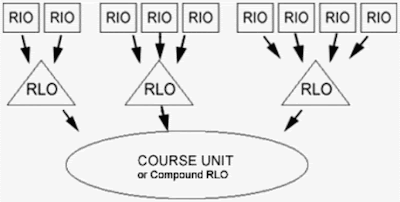
What is contained in the RLO?A good learning object is like a well-made brick. It has components, each providing a quality to the overall function, prepared according to defined standards so that their combination can fit an objective purpose within a defined context. If designed correctly it can be used in a related context without the need for alteration, hence the term reusable. While this ideal is important to the life and application of the RLO, the fashionable preference is that it can be repurposed or contextualised when used within diverse contexts.Cisco Systems used a schematic approach to describe the structure of the RLO, defining the reusable information object (RIO) as a component that has similar properties to the RLO[7]. The RIO consists of static, animated and interactive content including text, diagrams, pictures and videos as well as practice examples and assessment items. Each RIO is built so that it supports the objective of the RLO. Cisco's RLO has a structure that fits Longmire's summary.
 Cisco also developed a strategy for building and implementing the RLO - the primary learning approach is identified to determine what the RLO should contain and this prescription then serves as a plan for its design and construction. Suggested optimum componentry includes an overview, summary and assessment - between five and nine RIOs, though this range may vary widely in practice. A series of RLOs can be constructed according to a pedagogical strategy to form part of a course, or to build a compound RLO.
GranularityThe smallness of each component part, and the number of these incorporated into the whole, relates to what is called the granularity. Though the term is widely used in the context of RLO design and development, there appears to be no clear-cut definition for it. Collis and Strijker describe granularity as “just one of many issues related to learning objects that have different meanings and implications in different organisational contexts”[8].Granularity has administrative implications when considering matters related to the cost of production and also the data retrieval of each part. In relation to the size of the RLO, granularity has also pedagogical implications especially if it has insufficient componentry to be considered a suitable unit of learning. The RLO should be neither too large in comparison to the size of its components nor too small to perform the pedagogical function in meeting its learning objective.
Simplicity of design applies as much to the construction of a good learning object as it does to folding a well-made paper dart; size and functionality need to be optimally balanced for the learning object to be on target.Metadata, storage and retrievalFor a learning object to be stored and later retrieved easily, it must be catalogued or labelled using metadata, essentially data about information. Criteria for defining metadata and the number of related attributes within it vary according to the specification used. The label or tag, known as the metadata tag, contains digital information that identifies all the important properties of the learning object.
When a learning object is selected from a repository its many parts are brought together according to the attributes chosen from its metadata tag. In this way the appearance of the object when displayed may be tailored within the limits of the metadata criteria and according to selected preferences on retrieval. Learning objects that form part of a programme of learning are stored in a repository or repositories accessible by a learning content management system (LCMS)[9] suitable for processing the learning object metadata (LOM)[10].For LOM to be useful it must adhere to an unambiguous specification of which there are many, including those defined or used by Dublin Core[11], SCORM (Shareable Content Object Reference Model)[12], The Le@rning Federation[13], MERLOT[3], CLOE (Co-operative Learning Object Exchange)[14] and IEEE (Institute of Electrical and Electronic Engineers)[15]. The IEEE Learning Technology Standards Committee has established a set of internationally accepted open standards for learning object metadata adopted by other organisations.Learning objects should be practicalThe learning objective must be suitable for the application of a learning object, and for some purposes there are limitations no matter how well the learning objects are designed. The pursuit of such tools to meet associated learning objectives in these cases will very likely prove fruitless. For instance, it is clear that a learning object cannot be a substitute for a chat-room discussion. Nor would it be fitting to offer one as a replacement activity where the learner is required to collect data from a series of location cams, especially if the gathering process is important to the learning.
The learning object employs a wide range of audio, video, animation and interactive technologies and is perfectly suited to e-learning. It is especially useful for introducing the learner to concepts difficult to present in text, static diagrams or pictures, or where it is difficult or dangerous for the learner to view a particular event such as the separation of chromosomes in the dividing nucleus of a living cell[16] or the Strombolian eruption of a volcano[17].
When the learner is finished interacting with a learning object, what is important is not the impact of a clever animation or an impressively dynamic video, but the learning that's imparted, and the relevance of that to the circumstance of the learner. It must furnish the learning objective that was on its designer's notebook and it should be memorable for that alone.
Immediacy, interactivity, learning and engagementWiley recognised that interactivity is a vital attribute of an effective learning object as “engaging learners, making them active participants in the learning experience, is key to having them meet the learning objective”. Interactivity brings immediacy to the learning through instant feedback and lights the spark[18], but its importance is frequently overlooked during the design phase of a learning object.
Though it is rarely the province of a learning object to process learner activity or to perform summative assessment, the information that may result from these is what most teachers look for to establish if learning has taken place. Yet in potential learning situations the learner is often out on a limb wondering what, if anything, has been learned.
Authors of early textbooks realised the worth of passive feedback in questions that had answers at the back of the book, alerting the learner to the need for further study when required. Recently, metacognition – thinking about thinking – in relation to the learner thinking about learning has become a fashionable teacher consideration[19].
With respect to these matters the importance of immediate feedback to the learner on what has been learned and what needs to be learned cannot be underrated. And while it is true that opportunities for learner feedback and formative assessment do not ensure that learning happens, their presence allows the learner to evaluate learning progress and they can also stimulate engagement[20]; herein must reside one of the requisites of a well-designed learning object.
Design, development and quality maintenanceLearning object development is no longer constrained by the dictates of those with expert technical knowledge and specialist ability. The steady arrival on the market of new authoring tools permits teachers with little technical know-how to design and create learning objects for themselves. But a most important role of the experienced teacher is in the selection and application of effective learning objects.
It appears that these tasks, as well as those to do with building the resources, have fewer problems if careful thought is given at the design stages well before construction begins. Margaret Haughey and Bill Muirhead[21] found that “incorporating all accessibility features into all learning objects made the learning objects more complex to develop, more costly to create and in limited cases adversely affected the overall design of the learning object. An alternative was to develop separate purpose-built learning objects for learners with specific special needs.”
They put forward a case for developers addressing additional accessibility criteria on an object-by-object basis. Haughey and Muirhead also contend that the trend towards learner-oriented inquiry puts less emphasis on teacher pedagogical orientation and that this shift may favour a more learner-centred approach in the future use of learning objects.Leppisaari and Vainio[22] posited that “collegialism” among those engaged in learning object development is also valuable for maintaining the pedagogical quality of object content. This opinion is also held by MERLOT[3] where resources are peer-reviewed to ensure quality standards, and by CLOE where recognition is given to the special value of peer reviews in learning object development. CLOE suggests guidelines as well as a model for the peer review process[23].
Rachel Smith offers a cornucopia of invaluable ideas, tips and advice in her comprehensive paper, Guidelines for Authors of Learning Objects[24]. She upholds the principle of learner choice, maintaining that “an object that presents content in an appealing setting, inviting learners to explore at will, is more interesting than a single-path, linear, 'click here to proceed' format. If the only choice is when to click the 'next' arrow, it is difficult for learners to feel ownership of the learning process.”
She gives sound planning suggestions for building cohesive, well-integrated learning objects:Offer multiple paths or branches for learners to explore. Allow learners to choose which path(s) to follow rather than forcing them down a particular path. Draw a conceptual map of the learning object showing relationships between ideas, content, or sections. As you create the object, make sure those connections are available as path choices.
Smith suggests various avenues for presenting learning objects including “a single learning object to reinforce or provide practice for a topic; sometimes several conceptually related learning objects are provided to explore a topic from different angles or in greater depth. A common way to 'combine' learning objects is to provide an assignment that includes a list of links to the different objects and guidance as to the order in which they should be accessed. Learning objects may also be integrated into a course using a learning management system (LMS) to create and manage the links between objects.”Checking out the future
While the popularity of computer gaming continues to grow and interest deepens in the use of computer games as legitimate means for learning[25], new avenues open for the RLO to continue its development as an e-learning tool. There is no reason, for instance, why games can't be designed to meet all the desired attributes of RLOs.
There is also scope for e-books to provide platforms where RLOs can exist as aptly as coloured pictures do in printed books, perhaps fulfilling some of Pithamber Polsani's hope for the development of the e-book to move “beyond the text-centric approach and concentrate on designing participatory environments”[26].
Here the potential is rich for the RLO to establish its niche, illustrating pages of learning in interactive and engaging ways never to be found in traditional textbooks. Who knows? Games designed as learning objects may soon find their way onto portable play-stations, MP4 players and even mobile phones.References1. http://www.futurelab.org.uk/resources/publications-reports-articles/web-articles/Web-Article948
2. http://en.wikipedia.org/wiki/Computer-assisted_language_learning
3. http://taste.merlot.org/
4. http://itdl.org/Journal/Sep_04/article02.htm
5. http://opencontent.org/docs/dissertation.pdf
6. now not available - http://www.learningcircuits.org/2000/mar2000/Longmire.htm
7. http://www.e-novalia.com/materiales/RLOW__07_03.pdf
8. http://www-jime.open.ac.uk/2004/4/collis-2004-4.pdf
9. now not available - http://www.learningcircuits.org/2002/apr2002/mortimer.html
10. http://en.wikipedia.org/wiki/Learning_object_metadata
11. http://dcmi.kc.tsukuba.ac.jp/dcregistry/
12. now not available - http://www.adlnet.gov/scorm
13. http://www.thelearningfederation.edu.au/default.asp
14. http://sedoparking.com/search/registrar.php?domain=on.ca®istrar=sedopark
15. http://ieeeltsc.wordpress.com/
16. http://www.cellsalive.com/mitosis.htm
17. now not available - http://volcano.und.edu/vwdocs/kids/fun/volcano/volcano.html
18. http://www.futurelab.org.uk/resources/publications-reports-articles/web-articles/Web-Article621
19. http://www.futurelab.org.uk/resources/publications-reports-articles/web-articles/Web-Article520
20. http://home.sprynet.com/~gkearsley/engage.htm
21. http://www.usq.edu.au/electpub/e-jist/docs/vol8_no1/fullpapers/eval_learnobjects_school.htm
22. http://www.caudit.edu.au/educauseaustralasia07/authors_papers/Leppisaari-Poster-405.pdf
23. now not available - http://cloe.on.ca/peerreview.html
24. http://www.nmc.org/publications/learning-object-guidelines
25. http://acrlog.org/2007/06/06/serious-games/
26. http://jodi.tamu.edu/Articles/v03/i04/Polsani/








 Posts
Posts


