Do have a virtual slice of my blog’s birthday cake.
One year has passed since I made the decision to attempt a spot of blogging. It has been colourful and worthwhile. So has the learning, which is great, for learning is still my goal. I have Michele Martin to thank for all this for it is she who enticed me into taking part in the Comment Challenge in May 2008.
 During this past year I published 193 posts on newMiddle-earth Blogspot. According to Google Analytics, people from 73 countries visited Middle-earth in the last month – a total of 1352 visitors. The most visits came from USA (529) followed by New Zealand (342) of which 325 came from Greater Wellington. The actual numbers shown here indicate relative estimated ratios rather than actual visits, since I didn’t collect data on RSS use.
 I have 10 loyal followers from countries throughout the world.
I got a lot of help, and by different means, from many of the visitors to Middle-earth. ‘Visitors’ means YOU!
I take this opportunity to thank you for following this blog and for your support.
What have I learnt?
It is difficult to say, even at this stage, precisely what has been the most useful thing learnt. A lot of that learning has been about me, and I don’t mean that in a navel-gazing way. Nevertheless, there are observations that I feel are notable and I’ll list those here.
Google Analytics and PostRank
I was introduced to Google Analytics (GA) and later to PostRank (PR) and found that, as expected, data gathered from GA on the popularity of posts correlates well with ratings gathered from PR. While there are differences, these two data gatherers complement each other. I learnt that the popularity profile of a post created a tail over time and that the fatness and length of that tail bore some relation to the ongoing interest that visitors had for the content of the post.
Blog persona
 I came across the Web2.0 application Typealyzer and learnt that posts I’d written had the persona of a thinker. There was a lot of discussion throughout the blogosphere on the worth of Typealyzer.
I found that most who knew about it misunderstood what it was reporting. I learnt they held the erroneous belief that Typealyzer was analysing their personality type rather than the persona of what they wrote and posted on their blog.
Telling a story
I learnt the merit of telling stories in posts and found that among the most popular posts were those that tell stories for they had the longest and fattest tail in their popularity profile. Posts that do this invariably reach a high rating on GA and PR often within a few days.
The example post Blogging, When A Thing Is Worth Doing Badly, which has held its PR rating since January 2009, shows this trend.
Reading Ease
I was introduced to the concept that writing can have a quality known as reading ease according to the Flesch scale. So I researched the use of Flesch Reading Ease in Word. I later analysed the writing of other bloggers who, incidentally had favourably high Flesch ratings and prodigiously popular blog sites.
90:9:1 rule and so-called community
The rather contentious 90:9:1 rule seems to be obeyed quite well on newMiddle-earth Blogspot. From a total of 1352 visitors in the past month, a count of 13 visitors submitting 25 comments closely follows the order expected from the 90:9:1 rule. Other similar periods examined using GA yield comparable ratios.
While this may seem trivia to some, for me it represents confirmation of the difficulty involved in soliciting participation in so-called communities, notably those that are referred to as learning communities. Anyone who has followed my posts on themes to do with communities will perhaps understand that it is not by coincidence that this theme is threaded through my posts from the first month I began blogging.
Who are the commenters?
A significant observation about my commentsphere is that, almost without exception, commenters are also bloggers. The supposition is that people who do not have their own blogs will visit and read rather than participate in discussion. However, it’s also improbable that all visitors who do not leave a comment are not themselves bloggers.
Post topic and content
I found that posts about my commentsphere and the people that are likely to contribute to it, also reached predictable high ratings. This was one of the first observations I made when I set up GA on my blog. I can predict with an unerring accuracy that a post about the commentsphere will soar in its ratings.
Elearning - an exceptional topic
I was delighted to find that posts specifically about elearning, carry substantially high ratings in both GA and PR. A giant among those is The Elearning Apprentice, posted in October 2008, which has a fat tail that pulls a rating matching that of recent also-rans.
Another extraordinary post in terms of its popularity characteristics is Working With Online Learning Communities, which has such an amazingly even visitor rating from day to day, it has not varied significantly since the tail first took shape.

Highly complex
As absorbing as all this gathered data is to me, I am still quite unable to make logical sense of the characteristics of ‘my part’ of the blogosphere. I suspect that it is highly complex and likely to be even more so because of the varied nature of the post topics that I choose to write about. I concede that my range of topics is eclectic enough to cause me a considerable headache if I try to make too much sense of some ratings.
Why am I interested in ratings?
My original intention was to study communities in the blogosphere with the purpose of understanding more about what engages learners. I’ve never lost interest in that study. I’d always hoped that post ratings in GA, PR or other such analytical data gathering tool would provide me with avenues for studying community engagement. They do provide some of these, but the data is far more complex than I first envisaged.
The more I observe and learn about community engagement, the more absorbed I become in it. Communities and their complexity are fascinating things.
An exceptional opportunity
What I find is fascinating about my commentsphere is the huge variety of personalities and the backgrounds of the people who I regularly commune with, either through their comment on my blog or on their own blog. They range from colleagues who, like me are interested in sharing ideas on teaching and learning to business managers, from academics working at faculty in universities to CEOs of companies, from consultants in elearning to school principals.
Within those groups of wonderful people are blog-colleagues who I first met in the blogosphere when on the Comment Challenge in May last year. Among them:
Andrea Hernandez, who has been supportive of me blogging from day one - I wrote a post, about one of her goals for the year which she has adhered to,
Bonnie Kaplan, who reminded me most recently in a comment of the fun we had during the Comment Challenge,
Sue Waters, who sent me a series of emails recently while we collaborated to track down a virus and who was one of the Comment Challenge organisers,
Tony Karrer, who invited me to join the eLearning Learning community to which I now regularly contribute,Virginia Yonkers, who is one of my most frequent commenters and a great blogging companion,
Kevin Hodgson, who emailed me yesterday to ask if I’d mind hosting a Day In A Sentence on my blog again. It’s an opportunity not to be missed. It’s all about people.
Some weeks ago I was moved by a series of posts by Tony Karrer, pertinent to keeping track of posts, indexes and other ancient, twentieth century artifacts. I’d admired his Blogging Guide for First Time Visitors, which included an index. I had been thinking about starting a blog index of my own when I read about his decision to revise his current guide page.
A blog with an index:
I’d never seen a blog with an index before I saw Karrer’s, so I thought I’d perpetuate the idea. After all, nothing ventured, nothing annihilated, as Bill Bryson puts it. My blog had got to that critical size when, if I had not started an index, the initial task of setting it up would soon have been in the too hard pile. I’m glad I built it when I did.
There was some minor initial discussion about the index post when it was first launched, and that was okay. I’d already decided to keep track of how things went. As expected there was some initial interest when I announced the index. The major bump shown on the graph above is almost entirely due to the announcement post.
Here’s my stats so far according to Google Analytics - from Jan 12th 2009 when it was launched, to the present (Fri 6th Feb).
 I had backdated the index page to 1 May 2008, a date before I’d even started blogging. The reason I did this was because I wanted to be able to find the post easily in Dashboard, as I would be updating it regularly. The other was that I didn’t want it picked up by the RSS Feed, and it wasn’t. Instead, my announcement page was RSSed and this meant I could track the real stats on visits to the index page from Blogger in Middle-earth.
Analysis:
Activity on the Index Page was interesting to analyse in Google Analytics. It showed me that people actually used it, for a significant number of views of the page looped to the page itself. This would correspond to visitors using the links on the Index Page, to the two main index lists before making a selection. A Time on Page of nearly 3 minutes is a telling indication of the usefulness of the index post.
Further to this, I was also able to see what people were looking for. There was some noticeable interest in listing posts according to label, and this has continued – Change, Complexity and Peace were popular list selections.
Used Regularly:
I was also heartened that people used the index on a regular basis. Apart from the initial expected flurry of activity, the page settled down to what amounted to a day-to-day visitor service, which was what was intended.
I keep the index up to date – not a difficult task to do. Eventually, I will cull some of the less popular listings, using PostRank (PR) ratings to help me select those. They won't be lost, for they will be picked up in the label listings.
Hopefully it will be easy for me to keep this index in trim, while at the same time providing some assistance to those visitors who want to peruse it.
PostRank rating favourable:
The PR rating of the Index page is currently coming in at an honourable high number, which is surprising. This shows that it's being linked to, rather than just visited, which is favourable. It’s actually showing a PR rating of 10 on my page widget (see screen-shot below).
I’m aware that there is a difference between the displayed rating numbers on the right side-bar widget and what I can view at the base of my screen from the PostRank Firefox Extension as shown here. If anyone can throw some light on why there should be a difference in these numerical reports from PR, I’d be keen to learn.


I’m testing a theory. Google Analytics has been running on my blog for a clear month. I've been carefully looking at the data gathered over time and trying to make some sense of it.Looking for patterns
I look for patterns in terms of what my ‘target audience’ might be interested in reading from my blog. There certainly hasn’t been any earth-shattering evidence so far, but there are some signs and patterns that suggest a few things might be worth considering to do with what attracts visitors and draws comments.Admittedly I haven’t got an especially wide range of topics, but within my own interest in education, and blogging about it, I’ve tried to be as diverse as possible with my post topics. Further to this, within the expected variation in frequency of visits over time, the popularity of the site has been fairly constant while the data was gathered and examined. I lay no claim to the statistical significance of data gathered from over 550 visits and 1950 page views from 384 visitors - only that some trends are suggested.
A popular post
In recent weeks the single most popular post on my blog by far has been 5 explanations of a Zen proverb, an essay based on a saying that relates to my own life experiences. It took off, and topped the charts only a week after it was posted. Day by day, other posts slowly crept up in popularity. It is still a popular post, and this continued popularity meant that I was able to use it as a control of sorts against other posts that could possibly compete with it in popularity.It was almost like watching a bubble sort in action. Slowly and systematically, every post related to one particular theme (and there were 4 of them) gradually worked its way up the list, each one pushing ‘5 explanations . . .’ down. And today, 21 Aug, that post has been superseded by all four posts. And the other popular theme? Google Analytics, and the analysis and blurb that I’ve written on what I’ve been fishing out from the data.It would appear that personal stories are popular – nothing new here. But the interest that was focused on statistical data from Google Analytics did make me wonder about what people in my commentsphere are interested in reading.
Why you might be reading this postMy hunch is that if you are reading this, you have an interest in blogging. In particular, your interest stretches beyond the topic, with the possible exception of the one implied in this post.I have left a space here, which I will update with stats I gather on the popularity of this particular post which, at the time of posting, would be the fifth, out of 62, that is to do with the same theme, namely statistical analysis of data on visitors to posts on this blog.Study now completed: (stats for this post last updated 29 Aug 2008)
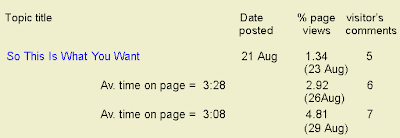
Thanks to Sue Waters' and Christy Tucker's tips, I can post some alternative data from AideRSS on the popularity of these posts. Here's my so-called Best Posts list, recorded 28 Aug 2008. I think it is significant that those listed are the first and the last (this one) posts included in this study:

Conclusion
It seems my theory is supported by the statistics. This post, specifically created to test a theory, is now in third position in popularity and climbing, according to Google Analytics. It is placed top of the PostRank in AideRSS.
The most GA popular post (29 Aug) is DEANZ 2008, closely followed by Splitting the Knol. These have held their post rank for a couple of days - some posts seem to be like that. For instance, Compassionate Vigilance has held 6th position throughout the time that this post was studied (21 - 29 Aug) with a favourable bounce rate and a reasonable time-on-the-page for a medium length post of 3:07 minutes.
My conclusion is that Google Analytics can certainly be a useful indicator of post popularity. Its potential for identifying patterns is evident. Used in conjunction with other similar applications, it can gather powerful statistics for the blogger. As this study attests, it can yield tangible information from which valid supposition and useful predictions can be made.





 Posts


