Saturday, April 4, 2009

Homework Today For Tomorrow

Kia ora tātou – Hello EveryoneClassroom Easel
Virginia Yonkers, friend and fellow blogger, will often think nothing of leaving a comment as long as a post on my blog. I welcome her thoughtful comments for they are often incisive and force me to think, which is always useful.

She is a parent who, like me, has children attending school. Her blog’s persona is one of a thinker, so it’s not surprising that she waxed the eloquent against my recent post on Home Study and Homework.


Virginia reports of homework being used as a means of learning content. I empathise with her when she recoils at the lack of time learners appear to have today, to consolidate what they learn in class.

Are kids getting too much homework? Are teachers pushing the learning of content out of the classroom and onto kids as homework? What do you think? Here’s our conversation:

Virginia:
I have given this matter a great deal of thought lately as my kids have constant homework 7 days a week. In New York State, homework is mandated from primary school to high school, at least 15 minutes per night per year of education. As a result, by grade 4, students should be doing 1 hour and 15 minutes of homework per night.

The question is, when do children get the chance to decompress and let their minds soak in what they have learned from the day. Having 6 1/2 hours of constant input, they are NOT computers and do need some time to process what they learned.

On the other hand, homework gives parents the chance to see what their children are doing (if the parent is responsible enough to do this).

On the other hand, this year my daughter has had a teacher who uses homework as a way to "get through content" that they don't have time to do in class. They are expected to be able to do the work on their own and not given the chance to ask questions (they are graded on what they handed in) rather than using the homework as a way to identify those areas they may need work in.

So I feel that, yes, there is a place for homework, yes, grading does give students the ability to identify areas they need to work on, but not at the expense of giving them some time to process what they have learned nor to use in place of good teaching.
Ken:
Kia ora Virginia

The parents (I believe) are probably more important than the teacher when it comes to attitude towards learning. They are the cultural background of the learner in most instances. Their influence, as much as it wanes in the teenage years of the learner, has a powerful influence on the way these precious people think.

Getting through content is another matter. I think the teachers have been the subject of much misguided advice where content is concerned and it's still going on.

A teacher who knows well that content is essential has to weigh this against the current belief that content is not what's wanted. This applies to all the past (and successful!) techniques that were used in the classroom to convey such content as was necessary to the learner. They cope with this by removing content from their classroom and relegating it to homework. Content is dealt with by a "Learn this."

So-called rote learning has been eschewed by many and still is. So much so that anything that smacks of rote learning gets the same treatment. Poor learners I say, for they get to the crossroads in their learning, only to find that they cannot understand concept or theory because they simply are not familiar with the content that's required - sigh.
related posts - >> ( 1 )

Ngā mihi nui – Best wishes

Wednesday, April 1, 2009

Working With Online Learning Communities

Tēnā koutou katoa – Greetings to you allWorking With Online Learning Communities
This article was first published on Futurelab in January 2008. I've reproduced the text of the article here. Some links to resources are now no longer current.

What is an online learning community?


Since the end of last century, government initiatives throughout the world have sponsored the development of online learning communities in schools and other learning institutions.

A community can be classified as a group of people, each with different expertise and with access to diverse resources, in which a sharing occurs so that individuals within the group can benefit from each other.

Wikipedia defines an online community as “a group of people that primarily interact via communication media such as letters, telephone, email or Usenet rather than face to face”[1].

An online learning community can be described as a common place online where its members can engage in community activities in areas of learning guided by a leader. It is widely accepted that such communities hold promise for the effective sharing of skills and knowledge.
This review looks at a number of key factors important to growing successful online learning communities and provides some relevant strategies for this.

Non-participating members of an online group

One behaviour in online groups that has been extensively studied is that of the non-participating members, termed the ‘lurkers’. Etienne Wenger[2] calls them Legitimate Peripheral Participants.

Lurkers are widely known to be among the majority of defined members and they have been found to make up over 90% of most online groups. They are perhaps the most important members in view of their potential to contribute to online groups.

Blair Nonnecke and Jennifer Preece have studied the ‘silent participants’ of discussion forums and have extensively researched[3] many of the reasons why lurking occurs. Though these have implications for the expected success of collaborative learning, it would appear that lurkers are not necessarily non-learners.

Takahashi et al have found that intentional learning seems to occur with so-called active lurkers[4]. If lurkers can be identified, it is found that some of them can be enticed to become active participants. Non-active lurkers are apt to be members with online capability but who do not log on. Though proportions vary from group to group, non-active lurkers tend to make up the largest proportion of all members in an online group.


Perceptions of online student communities

In a series of in-depth studies with online student communities,
Caleb Clark examines and identifies key learning success factors[5] in working with those. He cites findings confirming that the technical infrastructure and user interface (the online environment) “must provide the means to communicate social cues and information”, and other studies by Kaplan[6] and by Schwier[7] reinforce these results. For instance, Clark asserts that “just because it's online, doesn't mean the effects of (page) design disappear.”


Clark’s work is well sourced, and within it he develops three guiding principles:
online learning communities are grown, not built

online learning communities need leaders

personal narrative is vital to online learning communities.
Clark identifies that “online learning communities grow best when there is value to being part of them”. He further elaborates that, “one of the hardest things to do in any online community is to get people to give information. One reason is that people just don't naturally think their way of doing things has value, when in fact it is the very heart of a community's value! This is especially true in online learning communities where the exchange of information is key to keeping students coming back.” He stresses the need for doing the groundwork that makes for successful student engagement in online collaboration, an opinion also shared by Mohr and Nault[8].

Clark contends that “leaders are needed to define the environment, keep it safe, give it purpose, identity and keep it growing”. He gives a set of mantras for teacher/leaders in any online community:
all you need is love

control the environment, not the group

lead by example

let lurkers lurk

short leading questions get conversations going

be personally congratulatory and inquisitive

route information in all directions

care about the people in the community; this cannot be faked

understand consensus and how to build it, and sense when it's been built and just not recognised, and when you have to make a decision despite all the talking.

He cites confirmation that “personal narrative is vital to online learning communities. Personal stories and experiences add closeness, and provide identity, thus strengthening online communities.”


William Klemm has a more pragmatic approach[9, 10] to student participation, one that tends to coerce the engagement of post-secondary students in online collaborative learning. A minimum level of online participation as well as a deliverable piece of work relevant to the community activity is a mandatory course requirement. Many universities adopt a similar approach in order to ensure minimum online engagement of each student in collaborative study.

Challenges to student learning in online communities

Marcy Bauman reports on the challenges[11] posed in working with online communities. She identifies that “many of the interaction strategies both [teachers] and students use face-to-face simply will not work online” and she gives reasons for these.

She identifies that “students often do not have the necessary skills to survive in an online class” and that persistence, application and other key skills that are required to learn from the online platform may not be there in every student. These are quite different from the assumed equivalent skills required of the student in a face-to-face environment.


Bauman recognises that “in face-to-face classes, it is rare for students to be put in the position of having to rely solely on the written word in order to perform the work of the course”. She further justifies this by outlining that “when all the information comes to students via texts, they need to become proficient in reading those texts for meaning, and in order to be able to use the information they read in another context”, a circumstance not unknown to distance educators. She asserts that “this kind of reading is demanding in a different way than the kinds of reading students usually do in their classes; it requires considerably more effort and commitment than students may be used to giving to their reading.”

Bauman elaborates on the difficulties faced by the teacher, highlighting the lack of verbal and visual clues from students leading to a lesser understanding of student “attitude” while there is a need to monitor this feature. She explains her guidelines for growing communities within a class of students:
communicate frequently with the class

make as much interaction public as possible

create a space for non-classroom-related interaction

understand the limitations and strengths of the technology you're using in terms of fostering interaction

ask questions often, and interact with students in the forum you have devised for class interaction.

E-learning manuals and e-books elucidating much of the common practice upheld by Clark and also by Bauman are becoming more numerous. Many of them are freely available online such as the eBooks from The eLearning Guild[12].

References (some links are no longer current)

1. http://en.wikipedia.org/wiki/Virtual_community
2. http://www.ewenger.com/
3. http://www.cis.uoguelph.ca/~nonnecke/research/
4. http://portal.acm.org/citation.cfm?id=958160.958162
5. http://www.noendpress.com/caleb/olc/3Principles_Online_Comm.pdf
6. now not available - www.learningcircuits.org/2002/aug2002/kaplan.html
7. http://cde.athabascau.ca/ISEC2002/papers/schwier.pdf
8. http://www.astd.org/LC/2004/0504_mohr.htm
9. http://technologysource.org/article/creating_online_courses/
10. now not available - cid.byu.edu/tutorials/EightWays.pdf
11. now not available - kolea.kcc.hawaii.edu/tcc/tcc_conf97/pres/bauman.html
12. http://www.elearningguild.com/


Ka kite anō – Catch ya later

Tuesday, March 31, 2009

Creativity Is Messy

Tēnā koutou katoa – Greetings to you allphoto ken allan
In Christine Martell’s recent post, Continuing to Process, she carefully relates how she is processing her thoughts and feelings during what is a difficult time for her right now.

I identify with what she
so clearly says – the difficulty, the discomfort in deciding how to figure out how to move forward and how this relates to visuals. She displays her colourful creation of fish with paint on paper.

She speaks of the difficulty in writing coherent blog posts in a highly creative time. In my comment on her post, I wondered if this may be related to the linear nature of coherence, in contrast to the spatial nature of creativity.
“Lots of figuring out how to move forward in alignment with long term goals, despite short term challenges” is extremely linear in its propagation. I think you are on track to say that “visuals are particularly effective in helping to see overview and complex systems”, and that “creativity is messy”.

I look on linearity as something that is often fostered by our education systems and perhaps how we tend to look on how we should think. The spatial approach, which is what you speak of in “messy” and visual “overview”, is not linear but occupies space, a cloud. It is difficult to conceive a linear mess, and for good reason, and so easy to associate a blot with a mess.

I also believe that this may be a reason why word clouds and the software that creates them (in Wordle, say) have become so popular, more so recently than linear poetry. We talk of a line of print. It’s not a cloud of print. Such an array is messy and difficult for the linearly thinking in us to make reasonable sense of.

But accepting that it’s alright to have mess, that it’s alright to arrange words in an ink cloud rather than a linear pencil, is a start to understanding how creativity needs space. It cannot be (easily) squeezed into a pencil line, for it lies more comfortably with the ink blots and the cotton-wool clouds.

Think cloud, rather than line.
It’s more creative.
It’s also more comfortable.

A Wordle BlimpKa kite anō – Catch ya later

Monday, March 30, 2009

EtherPad - Collaborative Document Writing

Tēnā koutou katoa – Greetings to you allEtherPad
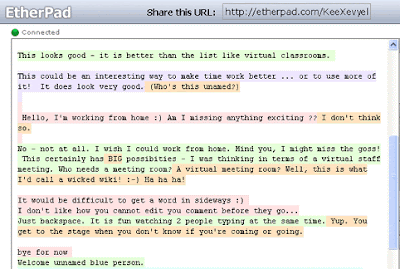
The JavaScript, web-based collaborative real-time editor, EtherPad, the latest version, became available to all on 3 February 2009. It permits up to eight people to work simultaneously on the same document.

Among its features are:


No account required
The only really real-time collaborative editor on the web
Edits highlighted in author's color
Infinite undo history
Syntax highlighting for editing code
Every keystroke backed up
A chat box

All you do is open a document and flick the code to those in your group who will participate collaboratively.

Check it out:

EtherPad Collaborative DocumentKa kite anō – Catch ya later

Home Study And Homework

Tēnā koutou katoa – Greetings to you allThe Gates of Wellington East Girls' Collegephoto by Hannah Dear
The gates of Wellington East Girls' College -
within which is fostered a culture of learning.

My good friend and fellow blogger, Shaun Wood, in his post,
I Hate Homework But . . . , brought our attention to the post,
Homework. Should it Stay or Should it Go?

In these posts and in their accompanying comments, there is useful and varied strategy given on how homework might be administered. Advice is also offered on how homework should be checked and assessed by the teacher. Some argument is put forward for and against why homework should be given at all.

While great store is placed in the virtue of lifelong learning, I found small mention of any need to introduce the culture and custom of it to the young learner.Could it be that the value of introducing the practice of lifelong learning has escaped the realm of the classroom?

In deference to all the useful and worthy advice contained in the posts, and there was much, I left my comment on Shaun’s, the gist of which is here:

In the secondary sector, home study is almost a necessity for many learners. As learners progress to certificate levels, it's crazy for them not to do home study.

BUT the distinction between home study and homework is important. Many learners will not do home study unless given homework. There is a solid layer of learners who will do their own home study even if they aren't set homework to do.

Home study is a learning accelerator pedal for many learners. By pushing it, some learners can take real control over what they can achieve. Not giving homework lets some learners slip through the net, and many of those simply do not know how to do their own home study.

I'm a pragmatist when it comes to learner achievement. I believe it's a two way process when time spent is concerned.

If the learner is prepared to put in the time with homework, I'm prepared to give them my time. If a learner is not prepared to put in the time, I'm not going to take time to follow it up, for the willing learners need my time.

A culture of learning exists in the classroom and within the school.
For lifelong learning to become a practice, the culture has to extend beyond the precinct of the school and into the home of the learner.


( 2 ) << - related posts

Ka kite anō – Catch ya later