

What sort of voice do you use when you write a blog post? Do you have an informal or personal tone to your writing? Or do you prefer the more formal structured approaches?
Perhaps you like to adjust your writing style to suit the topic. Many good writers do, but my observation has been that even some of the top bloggers use essentially a single voice in most of their writing.
Randy Olson’s book, Don’t Be Such A Scientist, slams the scientist for being too cerebral when it comes to writing for the lay reader. He explains that scientists are too literally minded, are poor story-tellers and in general tend to be unlikeable when they write about their passion, Science (check out Talk of the Nation interview).
Authorship
Bill Bryson is one of my favourite authors. He has written earnestly and engagingly on Science, and often. Just read a chapter or two from his book, A Short History of Nearly Everything, and you’ll know what I mean. But he’s not a scientist.Bryson is a journalist. Yet even for me, twice a Science graduate, his ‘voice’ immediately captures my interest in the Science he writes about. He speaks as if he is talking with me, not talking directly at me.
Can bloggers learn a thing or two from successful writers like Bryson?
I think we can. But I also feel there’s more to it than just being able to write well in a specific style.Genre
Knowing the appropriate genre to use, as well as how to apply it, is part-way to writers’ success. My literary friend and blogging colleague, Virginia Yonkers, agrees with this point of view.
Is there a single genre that is appropriate to writing blog posts?
Or should the genre be selected according to the topic of the post? Could genre be chosen to address a particular target group within the readership of the blog?
There are six genres that embrace most of the writing styles that bloggers may use:
descriptive
expository
narrative
persuasive
poetry
technical
Which would you select when you write your next post?


The voice I hear this passing night was heard
In ancient days by emperor and clown: – John Keats
Isn’t it . . .
interesting that bird-song has charmed the hearts of explorers the world over?
sensational how people are stirred to dance when they hear lively music?
touching how music can arouse memories of past events otherwise long forgotten?
profound that some melodies, still popular today, were played so long ago their origins have been forgotten?
curious how some forms of music can affect the function of the brain?
remarkable that nations burst into song as a symbol of solidarity in moments of triumph or disaster?
intriguing that all over the globe, mothers murmur, coo and sing to their newborn children who, at only a few days old, will invariably respond by listening or vocalising?
An ancient practice
Archaeological remains of flute-like instruments suggest that music must have been known and practiced as far back as 10,000 BC.
The fragmentary physical remains of musicianship represent a mere trace of the significance that music may have played in the lives of the people of those Palaeolithic times. One can only surmise that singing would also have been a component of that music. Perhaps it may well have been customary thousands of years before that era.
Music has an amazing power to bring people together. Legend tells us that Apollo initiated the earliest festivals of music and poetry around 6th century BC. Cultural elements of these arts became part of the festivity of the Pythian Games.
 Musicality
Dancing and music have been major components of cultures from time immemorial. Yet only in recent years has musicality been considered to be of key importance to communication and to human development.
We live in an environment that’s steeped in rhythm and movement. If all musical devices including radio, TV, CD and DVD drives, and the Internet were mysteriously to cease to function, the rhythmical component of our day-to-day lives would still make a significant contribution to the musicality of the environment we are in.
Just take a walk to the corner shop and listen to the rhythm and timbre of the sound of your footstep. Or lie still in a quiet room and sense the dull throb of your heartbeat. You become aware of the leisurely tempo of your own sibilant breathing.
It may be you overhear a conversation between neighbours in the street outside, voices too faint for you to make out the words. The patterns in their speech are familiar. You may even recognise a voice from its rhythm and pitch. A bird utters its warbling chronicle from a distant perch. You recognise the call of a songthrush.
New Zealand Emeritus Professor
In today's Radio NZ interview by Gordon Harcourt, New Zealander Colwyn Trevarthen, child psychologist and Emeritus Professor at Edinburgh University, explains the recent and not so recent researches on the mother and child relationship.
He tells of the major contribution brought to that relationship through the musicality of vocal interaction. The endearing conversation of parent and baby is a musical symphony. Babies are very attentive to the ritual of these interactions and take part by actively contributing through their own movement and vocalisation. He talks of recent studies that show an exact similarity of mother and baby communication to jazz music, in terms of the structural dynamics of rhythm and pitch.
Bridging the communication gap, well known in the study of autistic conditions, is made possible through music. Trevarthen introduces, through example, how communication with an autistic child can be initiated through the skilled use of rhythm.
Complexity in motion
Trevarthen describes the motion of the human body as polyrhythmic.
It is complex owing to the 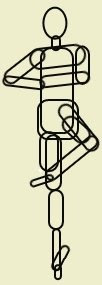 ability to stand on two feet with independent movement of legs, arms and hands.
He likens the complexity of the extravagant gestures of the human body to the structure of human thought.
People are as individual in the way they move as they are in the way they use speech patterns to communicate. Movement and dance, speech and speech patterns all contribute to a musicality that’s unique to the human form.
His idea on the origin of language, through the musicality of human interaction, is one that challenges traditional theories of the origin of speech.
The 34 minute interview was broadcast today, Saturday, 11 July 2009.
 A Green Pen Society contribution


A series of posts has recently nudged my interest in language and thinking. George Siemens, in his short post Tool making and language, drew our attention to Edmund Blair Bolles' post, The Idea of Language.
In it, Bolles posited that “the ingredients of speaking and toolmaking are similar. Both require a brain capable of complex imitation and a community that wants to share information. Toolmaking also requires hands capable of shaping tools, while speech requires a throat capable of vocalization.”
Different than chimps
Like the capability of making tools, the ability to use speech is an acquisition most humans own from birth. Peter Turney, in his post Meditation, Language, and Evolution, broaches the idea that meditation “seems to involve stopping or altering the internal monologue that usually fills our consciousness.” He posits that “this constant flow of language, is the main thing that distinguishes us from our nearest living relatives, the chimps.”
Peter thinks of the “human mind metaphorically as a chimp mind with language processing bolted on top.” But in the evolutionary history of humans, there must have been a time when language was a lesser part of our thinking and communicating. Even without language, our ancestors still had to think.
In order to think about complicated or complex ideas, humans today find a need to have the vocabulary of these in order to think about them and relate to one another. I believe that our ancestors must have been experts at thinking abstractly. They would not have had a ready vocabulary to help them with their thinking.
Think vocab
Higher order thinking skills need vocabulary. But our ancestors, at the evolutionary stage I refer to, would not have had that vocabulary, nor even perhaps the language ability, but they still had to think.
Trying to think without vocabulary is difficult to do. But in a creative artistic pursuit, such as in music, or fine art, or even in poetry when thinking on the lines of J K Baxter’s matrix of a poem – not the words and form – the mind thinks abstractly and is facile in that mode. Language gets in the way of this facile thinking.
Many who are adept at this mode of thinking simply curtail the use of vocabulary. What Peter refers to as ‘language processing’ is simply shut down. He sees advantages to "moderating the language layer" and suggests that "humans are in the middle of an ongoing evolutionary process; that language has not yet been fully integrated with our chimp cores."
Language may obstruct
I believe that language can get in the way of some modes of abstract thinking. Even the most highly skilled in the use of language have complained about the words getting in the way of what they wanted to express. William Wordsworth did and many poets have met this same impediment. Chicken-and-eggish though it may seem, it is understandable if you ascribe to the idea that words and language actually limit, rather than extend, some if not all forms of creative thinking.
Music extemporisation is a mode of thinking I’m familiar with. It is not unlike meditating. It has a similar calming and relaxing effect that is also prolonged, bringing about a feeling of at-one-ness most often met in playing jazz music, a genre based on extemporisation.
It’s curious that musicians who are site-readers and who are skilled in the notations and language of music, can often find it inordinately difficult to extemporise. I cite an example of this in Yehudi Menuhin, who had to admit that he could not improvise while he was dueting with Stephane Grappelli. That mode of thinking was beyond him, despite his undoubted superb skill with the violin.


 Posts


