Blogger in Middle-earth was nominated Blog-o-the-Month at ISTE Island's Blogger's Hutt last week (ISTE - International Society for Technology in Education).
Now it’s been awarded Blog Post of the Week! I will not be able to get my headphones on if my blog gets any more accolades!
E-learning Planet’s Pick of the Week has awarded my exploratory post, Visitor to Second Life, the honour of Blog Post of the Week!
 They are sure that any visitor, who has not explored Second Life yet, will become too curious not to visit it after reading my post.
I also got a commendation from Scott Merrick for that same post.
He reckons I haven’t really splashed around enough about my nomination for Blog-o-the-Month. There are notable elearning icons on the nomination list.
So here’s the splash. Kallan at Blogger's Hut
Fly across to Blogger’s Hut on ISTE Island now, and register your support for this blog. I need your vote!
If you need to register with Second Life first, the registration is easy.
I recommend it. Pick up your avatar and teleport to Blogger’s Hut. Blogger in Middle-earth has the blue square on the polling board.I share E-learning Planet's Pick of the Week with Michael Hanley's E-Learning Curve Blog. I congratulate Michael for being awarded
Blog of the Week for his five blog posts on podcasting for e-learning.
You should check out his blog.

 I left a comment on Clive Shepherd’s post Blogging is No Longer What It Was. But this post isn’t directly about what I wrote on Clive’s blog.
It’s just that I love blogging. I love the blogosphere and everything that’s in it. I’m not on a doctor’s prescription. But when I see a new post, I just feel like I’m witnessing something fresh and newly created – very very new - shiny, like a newborn star.
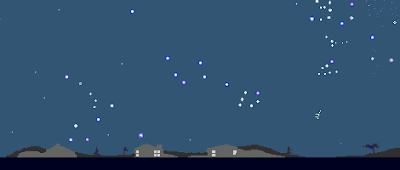
Primal observation in space:
I’m sure that the feelings I get when I discover things in the blogosphere are similar to the feelings my ancestors had when they looked up at the stars. Their eyes filled with wonder at what hung above them.
The sky must have been a great sight in those days. No city lights to haze the atmosphere. Come to that, no haze. Astronomers using optical equipment today, talk about the ‘seeing’, when they refer to how clear the atmosphere is above their telescopes. The ‘seeing’ way back in the days I’m talking about must have been something special!
Present day astronomers refer to the magnitude of a star - a number that they hang on how easy it is to see a star, or other visible light source in the sky. The fainter the star, the larger is its magnitude number.
Our ancestors would have been able to see faint stars of about magnitude 7. Today, we are lucky to see stars of magnitude 5 near a town - that’s about 7 times brighter. It's simply because the glare of streetlights prohibits us from seeing objects much fainter than that in the sky.
Observation in cyberspace:
Often, when I look into cyberspace, I feel like an early, prehistoric observer, sitting high on a hill, looking up to a vast night sky.
I make observations, and think that no one has ever spotted them before. Of course, like my ancestors, I am probably seeing some things that have been witnessed many many times - long before I saw them.
In cyberspace there are some beautiful stars, some brilliant stars - some with planets, interesting nebulae and scatterings of faint luminescent clouds. There are comets and shooting stars. Now and again, a supernova explodes and releases so much energy that the whole of cyberspace seems to resonate with it.
One of the observations I've made is to do with how commenters put their comments on a new post. Have you ever noticed, when a post first appears in the blogosphere, how most of the comments appear almost immediately afterwards? Logical don't you think?
Some posts differ from others though. Some attract no comments at all. Others are like supernovae, attracting so many comments immediately after posting, that it takes a while before it all stops. But it is very, very rare that a swarm of comments appears against a post well after the period when that first activity has ceased.
I often wonder about this. I take pity on these cold, abandoned, commentless posts.
I even think about racing around cyberspace with a bagful of comments, specifically looking for old posts, perhaps ones with no comments at all (and there are millions) and just dumping comments, willy-nilly, wherever I can – copy and paste fashion - just to give these lonely posts a bit of company. A bit like one of the tasks in the past Comment Challenge, when participants were asked to write 5 comments in 5 minutes on 5 different posts. That caused a bit of a stir among sedate bloggers!
Black holes:
But posts go off y’know, like stars that appear in the night sky and then just disappear! They shine bright over a brief period, perhaps get brighter, fade a bit, glow dimly for a while, and eventually collapse into a black hole – lost in cyberspace, never to be found by the average observer. Not even winked at.
Eons later, an intrepid wanderer might stumble across a darkly hidden post and check it out. Seeing this frozen, abandoned site of past activity, the observer realises that no one has been there for ages, and bounces off again into cyberspace, searching for newer, fresher territory.
As I post this, I realise that what I’ve written is like a newborn star. It may shine for a short while. It may even attract some attention - a comment or two. But eventually, it will join a growing mass of black holes, lost in the vastness of cyberspace.
They say that black holes are the re-cycling centres of the Universe.
I wonder how long it will take for this post to be recycled?

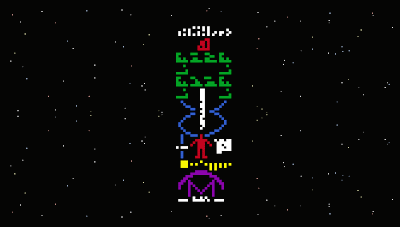 On November 16, 1974, the Arecibo radio-telescope in Puerto Rico, transmitted a radio signal to outer space. It was directed at a globular cluster, M13 - a massive cluster of hundreds of thousands of stars, some 25,100 light years away. This was an attempt to communicate with galactic civilizations outside our own galaxy.
Communicating in space:
The Arecibo message consisted of digital information. Laid out in an array of 73 rows by 23 columns, it may appear like the picture above.
The pattern in white, along the top row, defines the binary code used throughout the rest of the message. The second line shows information about the 5 essential elements of which we are made - hydrogen, carbon, nitrogen, oxygen, phosphorus. The blocks in green and blue and the vertical white block show the special parts that make up DNA, the building blocks of life itself.
Other parts to the left and right of the little red creature, show respectively the average height and population of the creatures here on earth. The yellow line depicts the sun and the relative sizes and positions of its eight planets and dwarf planet. Earth is identified by its displacement in the pattern. The violet radio telescope points to the code in white that shows the size of the telescope.
If the Arecibo message is detected and decoded by a galactic civilization, it will take over 50,000 years before we will receive a reply. If we ever receive one, let's hope it's not the equivalent of a voice-mail message.
More detailed information about our position in the universe was sent in another direction in 1977 on the Voyager mission. A capsule contained a gold recording of sounds here on earth, together with explicit engravings on its gold cover showing our precise location in the solar system.
 Courtesy NASA
.
Communicating in cyberspace:
Much of the advice given to young learners networking in cyberspace is to do with the protection of personal identity. Young networkers, who understand the risks, use a nickname in their communications. They take care not to share personal data such as full name, age, phone number, email address or street address.
Both the Arecibo message and the Voyager information contravene the precautions now recognised to protect personal information when communicating. If these missions were launched today, would we be so willing to share precise details about ourselves as well as our precise location? We'll have to wait a bit to find out what the consequences might bring us.


 Posts


