Monday, August 4, 2008

Referrals make significant contributions

Tēnā koutou katoa - Greetings to you all
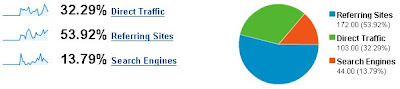
I’m still watching my Google Analytics - looking for patterns that might tell me something useful. It looks like I've a long haul ahead of me. One chart that caught my interest, however, was Traffic Sources showing referring sites contributing to about 54% of visits.

I followed up a few leads, hoping to see a reason for the referrals and of course there was some. Two clear-cut peaks indicated referrals from one particular site, zenhabits.net.

It was easy to see how these had come about when I checked the dates. I’d made a comment on one post on the 21st and on another later post on the 26th. The first I attribute to 8 visits the following day (22nd) with a tail of 1 visit the day after. The second attracted a cluster of 5 during the 3 days following my comment with a solitary visit occurring 6 days later.

What I find interesting is the almost immediate response from visitors prompted by the comments, followed by virtually no visits at all.

This pattern is not unlike the pattern I’ve found with comments to a post – a blip (size depending on the post of course) followed by virtually no more comments once the blip is over.


I’m still analysing.

( 9 ) ( 8 ) ( 7 ) ( 6 ) ( 5 ) ( 4 ) << - related posts - >> ( 2 ) ( 1 )

Ka kite anō - Catch ya later

Saturday, August 2, 2008

Is it possible our brains can sing the same tune?

Tēnā koutou katoa - Greetings to you allBelly Of A Fiddle - artist Ken Allan
What do we mean by 'wiring of the brain'? Are all our brains 'wired' the same at birth?
Is it possible for individual brains to become 're-wired' in similar ways by ensuring they all learn the same things in the same way and by the same means?

In a recent post by Tony Karrer, Brain 2.0, a fascinating series of discussions arose around learning, and whether the methods used in learning actually affect the development (wiring) of the brain. A current belief is that if someone acquires learning through a particular process or method, then the way the learning happens in the brain (the way the brain becomes 'wired') is necessarily set according to the means used to learn.

Similarly 'wired'

The assumption is that if everyone learnt the same things by the same means their brains would become similarly ‘wired’. By the same token, if everyone learnt the same things but by different ways and means, then everyone’s brain would be uniquely ‘wired’. No two people would have their brains ‘wired’ the same way.

This could well be what happens in life. Even people from similar families with similar cultural backgrounds must necessarily have different learning experiences. The sequence in which even like experiences may have occurred for each individual, is going to be different from person to person.

Similar perceptions

Are these differences likely to affect each individual's perception (the way they see things) even if the differences are small? If so, it would be reasonable to think that everyone's perception of things would not be exactly the same. Could it be that this is because their brains are now 'wired' differently? And can this difference in perception affect the way each individual continues to learn?

Darwin put to the test

In a comment I put to Tony, I used an example to illustrate how perception could possibly affect learning:

Suppose a fundamentalist and an agnostic follow an elearning course in Darwin's theory of evolution. Neither participant knew anything about Darwin’s ideas beforehand. Is it conceivable that, even if these learners learn the theory using precisely the same method, the way they learn will be different because of different ways that their brains were 'wired' beforehand?

Let’s assume that both learners attain a similar level of understanding of the theory of evolution as assessed by an exacting test. The fundamentalist who may not agree with the theory - it being at odds with the religion - will nevertheless understand the principles to the same degree as the agnostic.

Bearing in mind that the fundamentalist will disagree with what was learnt and the agnostic may not, are the learners' brains still 'wired' differently according to their beliefs? Or has some degree of alignment occurred through following precisely the same course along the same ideas?

As a teacher, it has never ceased to fascinate me how people see things so differently. Even the most straightforward topic broached in a discussion forum of like people can often bring forth a huge diversity of opinion. Might it be difficult to align or re-align individual brains through learning methods, simply because of their different degrees of perception to begin with?

What do you think?

( 5 ) ( 4 ) ( 3 ) ( 2 ) << - related posts

Ka kite anō - Catch ya later

Friday, August 1, 2008

What on earth has happened to Google Reader?

Tēnā koutou katoa
Greetings to you all

I'm normally quite careful to keep up to date with things that appear in my Google Reader.

But lately I've found it to be a blogger's nightmare!


Only yesterday I noticed that some sites I checked regularly simply didn't appear in the list (I have about 90 listed blogs).

Then I spotted a bubble that obscured part of the screen telling me something about Reader and my blog roll - something to do with items on my blog roll being not listed in my subscriptions, or whatever.

I didn't bother about this, probably because I was viewing Reader on another computer and got distracted, so I decided to ignore it.

But no, I found that this was indeed what was happening. And by a process that seemed to take place over 24 hours, most of my blog roll items were removed from the listed sites in Reader. During this time I made several attempts at opening manage subscriptions but to no avail. Some perfunctory checks on different browsers confirmed that it wasn't anything to do with Firefox or IE.

This morning I found that manage subscriptions was working again and to my relief, all my subscriptions were listed there. So I dashed back to Reader home page and refreshed it, only to discover that, yes, it listed most sites that were NOT on my blog roll. Even my own blog site, that I had subscribed to when first built, was not on the list!

I thought I had been shown something fantastic when Michele Martin first explained how Reader worked - I had. I could check to see what new posts had arrived from all my favourite blog sites and tell at a glance how many of each there were. But now when I read the new posts in a site it disappears from the list.

What use is that?

Well, it appears that Reader will list those sites that have posts not yet read. Any sites not appearing in Reader's list are those that have been read up to date with no unread new posts.

Phew!

I thought I was going mad!


(Update 3/08/08) As you can read from the discussion below, Angela prompted me to do a bit of playing about. The solution is simple. Under Add subscription in the left panel in Reader is a toggle option that I had obviously clicked by mistake. It threw Reader into the mode described above - I've toggled it back now:


Ka kite anō
Catch ya later

Tuesday, July 29, 2008

NetSafe Conference 2008 - July 28 - 30


The NetSafe Conference 2008 got off to a fine start (Rydges Lakeland Resort) with a wide range of keynote speakers and presenters from all over the Globe. Now at the close of Day Two I have a clearer view of the issues.

All speakers certainly know their stuff and I am impressed with their commitment to the issues. Among the most energetic of them all was Jeffrey Cole with his keynote on general aspects of the development of the Internet, ' What Are We Really Talking About?'. Points from his presentation are:

Dial-up as a barrier to logging on to the Internet so the advent of Broadband was a major accelerator in the promotion of the use of the Internet.

Web 3.0 on the horizon and will be with us in 5 to 8 years - his vision of Web 3.0 is where there will be a truly free platform for the flow of information.

Newspapers (apart from their odious reputation for a large carbon footprint) will disappear in 20 - 25 years.

Teenage use of the web and related technologies were key players in changing the emphasis of the use of social networking service tools simply because of the age groups already using some of them.

Cole sees the film industry being diminished by TV (and is already suffering because of it) but that TV will be diminished through the preferential use of the Internet.

Other general themes I picked up from the Conference:
  • specific issues to do with cyber-safety are not widely reflected in the content of the education curriculums in western countries and in some are not even mentioned as such.

  • in one prominent university in New Zealand the topic of ICT (including issues to do with cyber- safety) was only an option in teacher education courses - a point that made me think of the implications of this for future teachers who will be educating our lifelong learners.

I haven't stopped thinking about both these last points for they seem to be cornerstones to an important means to assisting to address the issues from the teacher/school point of view. It was significant that when I raised the matter of the weight of these issues on two separate occasions, there was strong general agreement about the importance of them.

When I put a motion (and I put it on two separate occasions at different forums) that a recommendation should come from the Conference, there appeared to be a reluctance from the NetSafe facilitators to follow this through (nevertheless, I confirmed this morning 30/07/08 that NetSafe had approached representative from the Ministry of Education of New Zealand about the matter of curriculum content - good on them!)

I'm off to dinner. More to come tomorrow.

( 5 ) ( 4 ) ( 3 ) ( 2 ) << - related posts

Ka kite anō – Catch ya later

Friday, July 25, 2008

Antics with Google Analytics on my 50th

My %0th Post

Tēnā koutou katoa - Greetings to you all

I’ve been having fun with Google Analytics recently.
I have to say that at first sight the software all looks very impressive. Not being a statistician, however, I take everything with a chunk of salt. My head spins, not with the data so much as with the implications of the results. I suspect that much of what I’ve gathered isn’t too useful, considering GA has been running on my site for only 10 days, I’m new to blogging anyway and this is only my 50th post – but who knows?

Some numbers that may show a few home truths are visits according to locality. Of all the 140 visits since recording started on 16 July, 67 of them were from my home town of Middle-earth. Next is the whole of USA with 32 visitors.

I suspect that data to do with Middle-earth could we
ll be skewed for a raft of different reasons. I’m strongly tempted to discount those as useful indicators, at least for the time being. Ten days isn’t a long enough time to collect data that’s likely to be useful.

Firefox clearly ahead

What is probably more valid, but less useful to me as a blogger, is the Technical Profile on browsers, which shows clearly that Firefox is head and shoulders above its rivals. I suspect that this statistical ratio is similar to results gathered at other locations and is more or less universal rather than blog site specific.

Chart of Technical Profile
I’m off to Queenstown for three days (dig the scenery on the link!), to the NetSafe Conference with a view to genning up on all that’s new in the field of cyber-citizenship. I’ll try and keep you posted.

( 9 ) ( 8 ) ( 7 ) ( 6 ) ( 5 ) ( 4 ) ( 3 ) << - related posts - >> ( 1 )

Ka kite anō - Catch ya later